
Catalogue Search | MBRL


Are you sure you want to remove the book from the shelf?

{{itemTitle}}
6,582
result(s) for
"Young, Susan"
Sort by:


Stability vs. flexibility
How entrepreneurial opportunities are formed and exploited depends upon the institutional environment in which they are embedded. The varying amounts of risk and uncertainty across and within heterogeneous institutional environments have important implications for the types of opportunity developed. While the international business and entrepreneurship literatures consider the effect of environmental risk and uncertainty on firms, risk and uncertainty are often treated as interchangeable or synonymous, and rarely are both considered to be present together. To address this, we develop a new theoretical model based on institutional economics, describing how institutional arrangements promoting stability–thus supporting an entrepreneur’s ability to assess risk – will lead to more imitative opportunities, while institutions promoting flexibility – thus supporting an entrepreneur’s ability to respond to uncertainty by iterating – will foster more innovative opportunities. We test this framework using crossnational data across 40 countries from the GEM survey, finding that institutional arrangements that promote stability do lead to more imitation, while institutions that promote flexibility foster more innovation. By treating risk and uncertainty as distinct constructs, our study makes theoretical contributions to research on institutional environments and opportunity types, with implications for future research on subsidiary initiatives, the evolution of MNEs, and born-global firms.
Journal Article

Firms' corporate social responsibility behavior: An integration of institutional and profit maximization approaches
Understanding firms' behavior across countries — a key concern in the international business literature — requires the joint consideration of both institutional influences and firms' profit maximization goals. In the corporate social responsibility (CSR) area, however, researchers have utilized theories that take into account only one or the other — institutional theory, which explains CSR as legitimacyseeking activities in line with national-level institutions, or economic-based approaches that consider CSR effects only in terms of firm profitability. While an institutional argument implies convergence in CSR behavior among firms in similar institutional contexts, profit maximization logic treats CSR as a firm-specific behavior. We integrate these perspectives by demonstrating the moderating effects of firms' economic motivations for seeking legitimacy on the relationship between institutional environment and CSR responsiveness. We argue that variations in firms' economic visibility and economic vulnerability can bring about differences in their need for societal goodwill, and in turn, their legitimacy seeking. Findings on a database of apparel firms' employee-related CSR across 23 countries support this overall argument. The integration of such fundamentally different theoretical perspectives allows us to contribute new theoretical insights to international business on the influence of national institutions on firms' behavior.
Journal Article


A systematic review and analysis of long-term outcomes in attention deficit hyperactivity disorder: effects of treatment and non-treatment
Background
In childhood, attention deficit/hyperactivity disorder (ADHD) is characterized by age-inappropriate levels of inattentiveness/disorganization, hyperactivity/impulsiveness, or a combination thereof. Although the criteria for ADHD are well defined, the long-term consequences in adults and children need to be more comprehensively understood and quantified. We conducted a systematic review evaluating the long-term outcomes (defined as 2 years or more) of ADHD with the goal of identifying long-term outcomes and the impact that any treatment (pharmacological, non-pharmacological, or multimodal) has on ADHD long-term outcomes.
Methods
Studies were identified using predefined search criteria and 12 databases. Studies included were peer-reviewed, primary studies of ADHD long-term outcomes published between January 1980 to December 2010. Inclusion was agreed on by two independent researchers on review of abstracts or full text. Published statistical comparison of outcome results were summarized as poorer than, similar to, or improved versus comparators, and quantified as percentage comparisons of these categories.
Results
Outcomes from 351 studies were grouped into 9 major categories: academic, antisocial behavior, driving, non-medicinal drug use/addictive behavior, obesity, occupation, services use, self-esteem, and social function outcomes. The following broad trends emerged: (1) without treatment, people with ADHD had poorer long-term outcomes in all categories compared with people without ADHD, and (2) treatment for ADHD improved long-term outcomes compared with untreated ADHD, although not usually to normal levels. Only English-language papers were searched and databases may have omitted relevant studies.
Conclusions
This systematic review provides a synthesis of studies of ADHD long-term outcomes. Current treatments may reduce the negative impact that untreated ADHD has on life functioning, but does not usually 'normalize' the recipients.
Journal Article

Mobilizing global knowledge : refugee research in an age of displacement
\"In 2018, the United Nations High Commission for Refugees documented a record high 71.4 million displaced people around the world. As states struggle with the costs of providing protection to so many people and popular conceptions of refugees have become increasingly politicized and sensationalized, researchers have come together to form regional and global networks dedicated to working with displaced people to learn how to respond to their needs ethically, compassionately, and for the best interests of the global community. \"Mobilizing Global Knowledge\" brings together academics and practitioners to reflect on a global collaborative refugee research network. Together, the members of this network have had a wide-ranging impact on research and policy, working to bridge silos, sectors, and regions. They have addressed power and politics in refugee research, engaged across tensions between the Global North and Global South, and worked deeply with questions of practice, methodology, and ethics in refugee research. Bridging scholarship on network building for knowledge production and scholarship on research with and about refugees, \"Mobilizing Global Knowledge\" brings together a vibrant collection of topics and perspectives. It addresses ethical methods in research practice, the possibilities of social media for data collection and information dissemination, environmental displacement, transitional justice, and more. This is essential reading for anyone interested in how to create and share knowledge to the benefit of the millions of people around the world who have been forced to flee their homes.\"-- Provided by publisher.
Book

Cognitive-behavioural therapy for ADHD in adolescents and adults
\"The first edition of this book introduced the Young-Bramham Programme, a pioneering approach to cognitive behavioural treatment for ADHD in adults, which was well-received by clinical and academic communities alike. Based on the latest findings in the field, the authors have expanded the second edition to incorporate treatment strategies not only for adults, but also for adolescents with ADHD. Updates the proven Young-Bramham Programme to be used not only with adults but also with adolescents, who are making the difficult transition from child to adult services New edition of an influential guide to treating ADHD beyond childhood which encompasses the recent growth in scientific knowledge of ADHD along with published treatment guidelines Chapter format provides a general introduction, a description of functional deficits, assessment methods, CBT solutions to the problem, and a template for group delivery Provides a wealth of downloadable assessment checklists and tools\"--
eBook
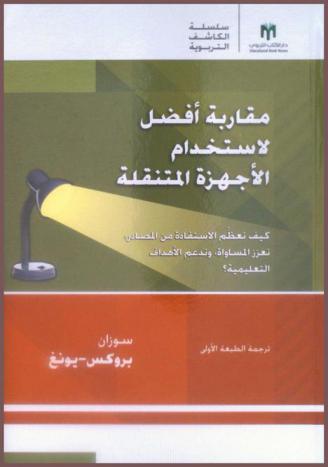
مقاربة أفضل لاستخدام الأجهزة المتنقلة : كيف نعظم الاستفادة من المصادر، نعزز المساواة، وندعم الأهداف التعليمية ؟
يقدم كتاب مقاربة أفضل لاستخدام الأجهزة المتنقلة لقادة المدارس والمناطق التعليمية نصائح عملية ومختصرة حول كيفية إعداد برنامج هجين للأجهزة التكنولوجية المتنقلة أو كيفية تحويل البرنامج القائم على خطط واحد لواحد أو مبادرات أحضر جهازك الخاص إلى برنامج هجين أكثر مرونة ميسور التكلفة منصف ويركز على التعلم وباعتمادها على الأبحاث الحالية وعلى خبراتها الواسعة في هذا المجال تجادل Brooks-Young مدافعة عن المبادرات الهجينة ثم تجري تقصيا للمفاتيح الخمسة لعملية التطبيق الناجح وهي الارتباط بالمناهج البنية التحتية والدعم التدريب والتطوير المهني الميزانية والسياسات والإجراءات ويختم الكتاب بقائمة تفقد لخطوات العمل المرتبطة بكل مفتاح من هذه المفاتيح مقدما للمديرين ولفرقهم التخطيطية مسارا واضحا يساعدهم على التقدم.
BOOK

Females with ADHD: An expert consensus statement taking a lifespan approach providing guidance for the identification and treatment of attention-deficit/ hyperactivity disorder in girls and women
Background
There is evidence to suggest that the broad discrepancy in the ratio of males to females with diagnosed ADHD is due, at least in part, to lack of recognition and/or referral bias in females. Studies suggest that females with ADHD present with differences in their profile of symptoms, comorbidity and associated functioning compared with males. This consensus aims to provide a better understanding of females with ADHD in order to improve recognition and referral. Comprehensive assessment and appropriate treatment is hoped to enhance longer-term clinical outcomes and patient wellbeing for females with ADHD.
Methods
The United Kingdom ADHD Partnership hosted a meeting of experts to discuss symptom presentation, triggers for referral, assessment, treatment and multi-agency liaison for females with ADHD across the lifespan.
Results
A consensus was reached offering practical guidance to support medical and mental health practitioners working with females with ADHD. The potential challenges of working with this patient group were identified, as well as specific barriers that may hinder recognition. These included symptomatic differences, gender biases, comorbidities and the compensatory strategies that may mask or overshadow underlying symptoms of ADHD. Furthermore, we determined the broader needs of these patients and considered how multi-agency liaison may provide the support to meet them.
Conclusions
This practical approach based upon expert consensus will inform effective identification, treatment and support of girls and women with ADHD. It is important to move away from the prevalent perspective that ADHD is a behavioural disorder and attend to the more subtle and/or internalised presentation that is common in females. It is essential to adopt a lifespan model of care to support the complex transitions experienced by females that occur in parallel to change in clinical presentation and social circumstances. Treatment with pharmacological and psychological interventions is expected to have a positive impact leading to increased productivity, decreased resource utilization and most importantly, improved long-term outcomes for girls and women.
Journal Article