
Catalogue Search | MBRL


Are you sure you want to remove the book from the shelf?

{{itemTitle}}
178
result(s) for
"Yukio Noguchi"
Sort by:
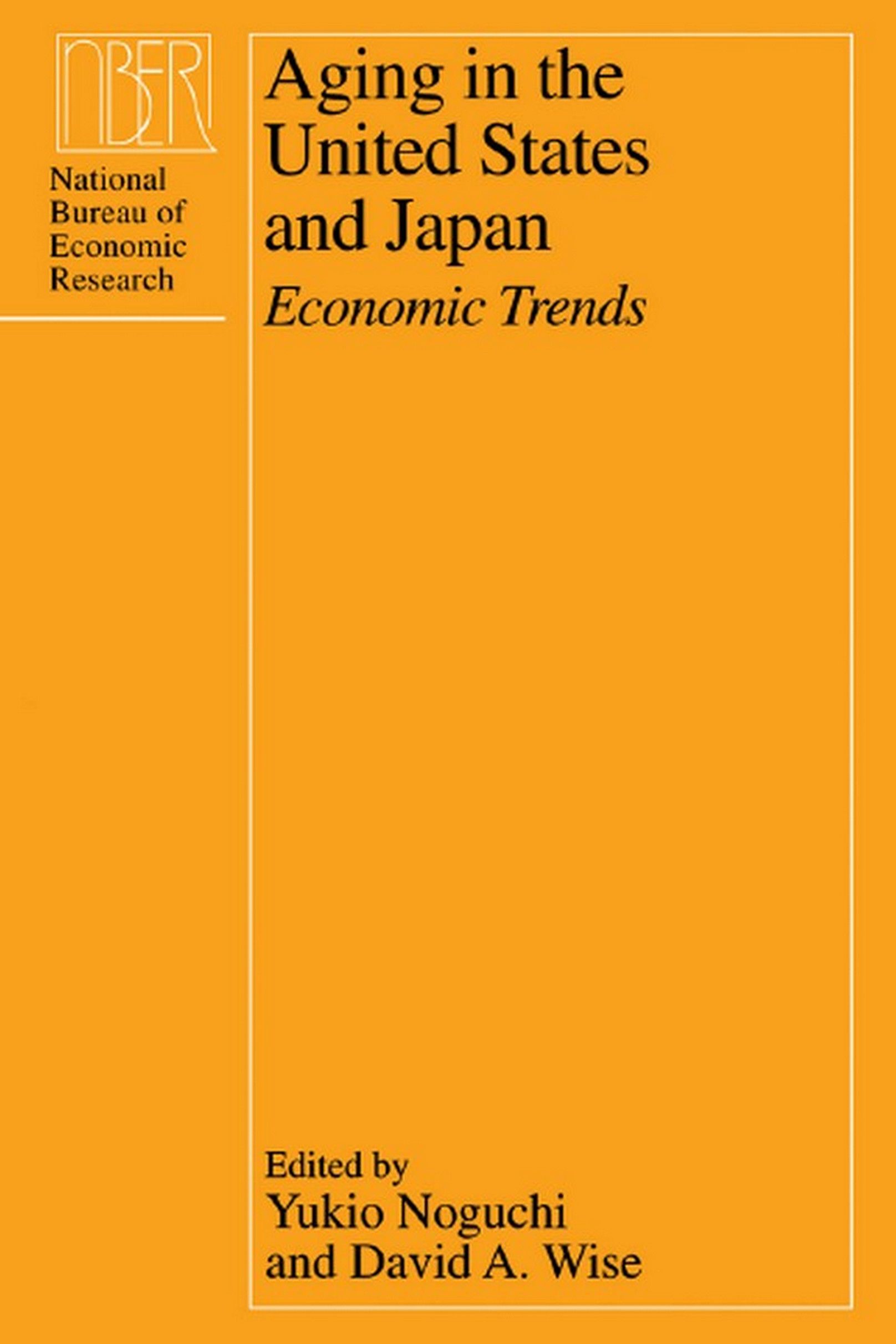
Aging in the United States and Japan
Japanese and American economists assess the present economic status of the elderly in the United States and Japan, and consider the impact of an aging population on the economies of the two countries. With essays on labor force participation and retirement, housing equity and the economic status of the elderly, budget implications of an aging population, and financing social security and health care in the 1990s, this volume covers a broad spectrum of issues related to the economics of aging. Among the book's findings are that workers are retiring at an increasingly earlier age in both countries and that, as the populations age, baby boomers in the United States will face diminishing financial resources as the ratio of retirees to workers sharply increases. The result of a joint venture between the National Bureau of Economic Research and the Japan Center for Economic Research, this book complements Housing Markets in the United States and Japan (1994) by integrating research on housing markets with economic issues of the aged in the United States and Japan.
eBook

Housing Markets in the United States and Japan
Although Japan and the United States are the world's leading economies, there are significant differences in the ways their wealth is translated into living standards. A careful comparison of housing markets illustrates not only how living standards in the two countries differ, but also reveals much about saving patterns and how they affect wealth accumulation. In this volume, ten essays discuss the evolution of housing prices, housing markets and personal savings, housing finance, commuting, and the impact of public policy on housing markets. The studies reveal surprising differences in housing investment in the two countries. For example, because down payments in Japan are much higher than in the United States, Japanese tend to delay home purchases relative to their American counterparts. In the United States, the advent of home equity credit may have reduced private saving overall. This book is the first comparison of housing markets in Japan and the United States, and its findings illuminate the effects of housing markets on productivity growth, business investment, and trade.
eBook
Aging in the United States and Japan
Japanese and American economists assess the present economic status of the elderly in the United States and Japan, and consider the impact of an aging population on the economies of the two countries. With essays on labor force participation and retirement, housing equity and the economic status of the elderly, budget implications of an aging population, and financing social security and health care in the 1990s, this volume covers a broad spectrum of issues related to the economics of aging. Among the book's findings are that workers are retiring at an increasingly earlier age in both countries and that, as the populations age, baby boomers in the United States will face diminishing financial resources as the ratio of retirees to workers sharply increases. The result of a joint venture between the National Bureau of Economic Research and the Japan Center for Economic Research, this book complements Housing Markets in the United States and Japan (1994) by integrating research on housing markets with economic issues of the aged in the United States and Japan.
eBook

The relationship between drug treatment and the clinical characteristics of febrile seizures
Background
Drugs such as theophylline, antihistamines, and antiallergics with anti-histaminic actions have been shown to induce febrile seizures. The relationship between febrile seizures and medications has not been actively investigated. The present study aimed to investigate the relationship between the clinical characteristics of febrile seizures and the use of medications.
Methods
Two hundred and sixty-five children treated at our emergency room due to febrile seizures were studied to investigate the relationship between the clinical characteristics of febrile seizures, such as the type and duration of convulsions, and the drug treatment.
Results
The duration of convulsions was longer among children who took theophylline and antihistamines than among children who did not take these medications. Of the antihistamines, mequitazine did not prolong the duration of convulsion.
Conclusions
Theophylline should not be used in febrile children, particularly infants. Cautions should be taken in using histamine H1 antagonists in young infants because such drugs could potentially disturb the anticonvulsive central histaminergic system. However, mequitazine appears to be a suitable antihistamine for use in children with febrile seizures, since it does not prolong convulsions.
Journal Article
Housing markets in the United States and Japan
Although Japan and the United States are the world's leading economies, there are significant differences in the ways their wealth is translated into living standards. A careful comparison of housing markets illustrates not only how living standards in the two countries differ, but also reveals much about saving patterns and how they affect wealth accumulation. In this volume, ten essays discuss the evolution of housing prices, housing markets and personal savings, housing finance, commuting, and the impact of public policy on housing markets. The studies reveal surprising differences in housing investment in the two countries. For example, because down payments in Japan are much higher than in the United States, Japanese tend to delay home purchases relative to their American counterparts. In the United States, the advent of home equity credit may have reduced private saving overall. This book is the first comparison of housing markets in Japan and the United States, and its findings illuminate the effects of housing markets on productivity growth, business investment, and trade.
eBook

Housing Markets in the United States and Japan
Although Japan and the United States are the world's leading economies, there are significant differences in the ways their wealth is translated into living standards. A careful comparison of housing markets illustrates not only how living standards in the two countries differ, but also reveals much about saving patterns and how they affect wealth accumulation. In this volume, ten essays discuss the evolution of housing prices, housing markets and personal savings, housing finance, commuting, and the impact of public policy on housing markets. The studies reveal surprising differences in housing investment in the two countries. For example, because down payments in Japan are much higher than in the United States, Japanese tend to delay home purchases relative to their American counterparts. In the United States, the advent of home equity credit may have reduced private saving overall. This book is the first comparison of housing markets in Japan and the United States, and its findings illuminate the effects of housing markets on productivity growth, business investment, and trade
Book

The 1940 System: Japan under the Wartime Economy
Many observers point out that the economic system in Japan is fairly different from those of other capitalistic countries. The basic elements which constitute the so-called Japanese economic system can be identified as follows: 1. employment practices such as the lifetime-employment, the seniority wage, and in-house labor unions, 2. weak influence of shareholders on corporate decisions, 3. an indirect financial system, 4. intensive government interventions on private economic activities, and 5. a tax structure which relies heavily on income tax. Many argue that these features are reflections of the unique aspects of Japan's cultural and social norms whose origins can be traced back to the history of Japan. A paper argues that these are not necessarily intrinsic Japanese traits and that most of them were introduced as the wartime system during the years around 1940, and hence can be called the \"1940 system.\"
Journal Article