
Catalogue Search | MBRL


Are you sure you want to remove the book from the shelf?

{{itemTitle}}
5
result(s) for
"Ziegeler, Debra, author"
Sort by:

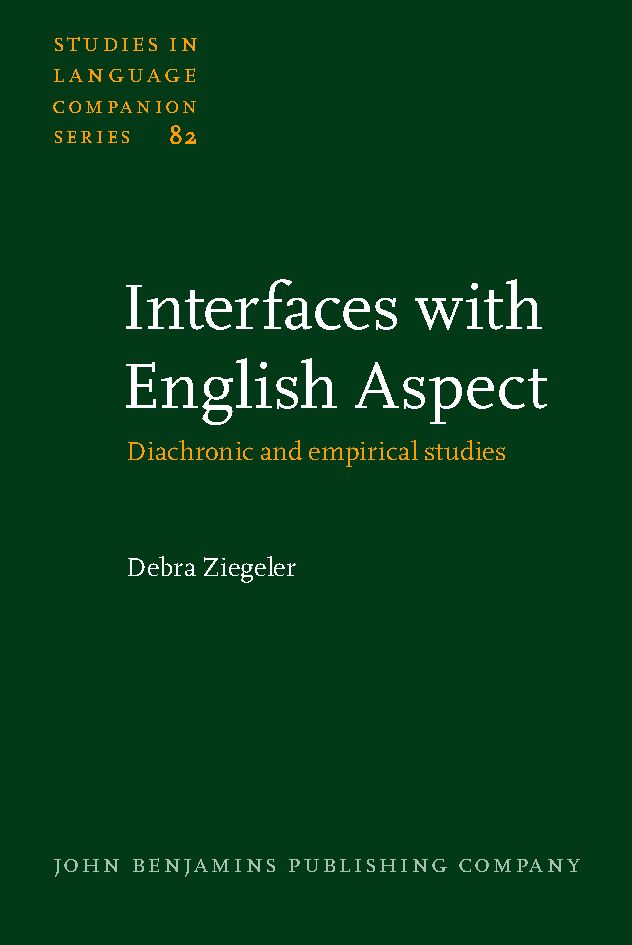
Interfaces with English aspect : diachronic and empirical studies
The field of verbal aspect has been a focus for the derivation of a multiplicity of theoretical approaches ranging over decades of linguistic research. From the point of view of recent studies, though, there has been relatively little emphasis on the nature of the interaction of aspect with other categories, and the ways in which our knowledge of aspect acts as a primary semantic contributor to the creation of other basic verbal parameters such as tense and modality. This book aims to cross some of the categorial borders, using a collection of studies on the interfaces of English aspect with other grammatical domains. The studies in the book have been assembled in order to answer two central issues surrounding the nature of English aspect: the possibility of the historical co-existence of a perfective and imperfective grammatical distinction in English, and the derivation of modality as an inference arising out of specific conflicts and combinations of lexical and grammatical aspect. In answering these questions, a data-driven, rather than a theory-driven approach is favoured, and the general principles of Gricean pragmatics and grammaticalisation are applied to a wide range of empirical sources to propose alternative explanations to some long-established problems of English historical linguistics and semantics.
eBook

Converging Grammars
This volume provides a much-needed, critical overview of the field of constructions and construction grammar in the context of Singapore English, and poses the question of identifying a construction in contact when the lexicon is derived from one language and the syntax from another. Case studies are illustrated in which the possibility of a 'merger'-construction is offered to resolve such problems. The book is intended for students of construction theories, variation studies, or any researcher of contact grammars
eBook
Hypothetical modality : grammaticalisation in an L2 dialect
This book marks a new development in the field of grammaticalisation studies, in that it extends the field of grammaticalisation studies from relatively homogeneous languages to those possessing well-established and institutionalised second language varieties. In Hypothetical Modality, special reference is made to Singaporean English, a native-speaker L2 dialect of considerable importance in the South-East Asian region, and to the expression in the dialect of hypothetical modality, which appears to be indistinguishable from non-hypothetical modality in terms of the use of preterite or past forms of modal verbs. Within a grammaticalisation framework, a number of factors can be seen to be relevant to an explanation, including substratum and contact features such as tense/aspect marking, levels of lexical retention as an individual (psychological) phenomenon, and the fact that such dialects have a discontinuity in their development. In addition, the book defines pragmatic approaches to the understanding of hypothetical modality, in both diachronic and synchronic terms.
eBook

Up and down the Cline
The basic idea behind this volume is to probe the nature of grammaticalization. Its contributions focus on the following questions: (i) In how far can grammaticalization be considered a universal diachronic process or mechanism of change and in how far is it conditioned by synchronic factors? (ii) What is the role of the speaker in grammaticalization? (iii) Does grammaticalization itself provide a cause for change or is it an epiphenomenon, i.e. a conglomeration of causal factors/mechanisms which elsewhere occur independently? (iv) If it is epiphenominal, how do we explain that similar pathways so often occur in known cases of grammaticalization? (v) Is grammaticalization unidirectional? (vi) What is the nature of the parameters guiding grammaticalization? The overall aim of the book is to enrich our understanding of what grammaticalization does or does not entail via detailed case studies in combination with theoretical and methodological discussions.
eBook