
Catalogue Search | MBRL


Are you sure you want to remove the book from the shelf?

{{itemTitle}}
76
result(s) for
"stephen citron"
Sort by:
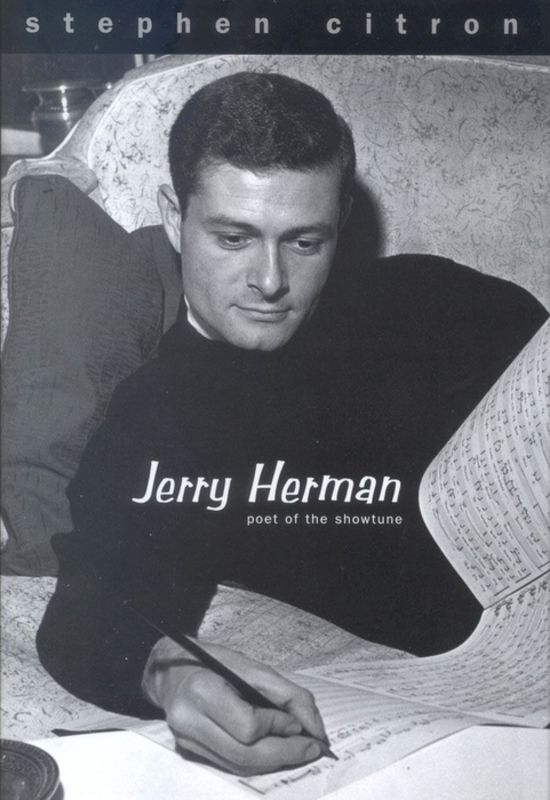
Jerry Herman
This revealing and comprehensive book tells the full story of Jerry Herman's life and career, from his early work in cabaret to his recent compositions for stage, screen, and television.Stephen Citron draws on extensive open-ended interviews with Jerry Herman as well as with scores of his theatrical colleagues, collaborators, and close friends. The resulting book-which sheds new light on each of Herman's musicals and their scores-abounds in fascinating anecdotes and behind-the-scenes details about the world of musical theater. Readers will find a sharply drawn portrait of Herman's private life and his creative talents. Citron's insights into Herman's music and lyrics, including voluminous examples from each of his musicals, are as instructive as they are edifying and entertaining.
eBook
mame
When Patrick Dennis, né Edward Everett Tanner III, wroteAuntie Mame: An Irreverent Escapade, he had no idea that this character would take her place in the forefront of theatrical heroines, much less become a generic household word for a sophisticated relative in charge of a youth. The author’s choice of the name Mame Dennis for his heroine was purposeful. Tanner was looking for a name that would suggest “mamma” in a super-cosmopolitan way; to balance the Christian name he had settled on he chose Dennis from the Manhattan telephone directory because of its elegant ring. He liked it so
Book Chapter
the grand tour
By the beginning of 1975, afterMack and Mabel’sabrupt close, Jerry Herman felt like a fish whose tank has run dry. Accustomed throughout the sixties to having two, sometimes three shows running on Broadway, he now had none. Worse, with the critiques for his last two flops resounding in his ears, he realized that the kinds of musicals he felt comfortable attending—or writing—were quickly disappearing. The concept musical that had begun as far back asLove Life (1948),and was nurtured with shows likeCabaret (1966),had come to full flowering inCompany(1970). Shows like these made
Book Chapter
early days
Whenever Jerry Herman’s songwriting was accepted enthusiastically, his thoughts harked back to his mother, for it was she who had fostered his music, who had insisted that he study piano,who was never too busy to listen to his early work. Not that his father and the rest of the Hermans were philistines. Quite the contrary, but he had a tendency to think of them as visually rather than aurally gifted.
David Herman, Jerry’s grandfather, born in 1880 in Poland near the Russian border in a small town on the outskirts of Minsk, was not unmusical, for he sang in the
Book Chapter
college and beyond
Even though its marquee made it look deceptively like a nightclub from the outside, in 1949, when Jerry Herman matriculated there, the University of Miami in Coral Gables had a serious curriculum. The school put its ten thousand students through a rigorous schedule of classes in all forms of theater arts leading to a bachelor of arts degree.
“It had a progressive drama department that made youdotheater instead of just talking about it,” Herman says. “You didn’t just sit in the classroom or work only in your own field. You also learned how to act, direct and design
Book Chapter
after la cage
WithLa Cagelaunched at the Palace and doing capacity business, Herman had more time to attend to his personal life. He had always been caring and responsive to his large circle of theatrical friends and had kept contact with acquaintances from his childhood and camp days. He paid special attention to the many older women from his mother’s circle, now in their seventies. These he looked after with particular attention, as he no doubt would have cared for Ruth, had she remained alive. He remembered who was sick, who had lost a close family member, and he made sure
Book Chapter
mame—and its movie
By the time of its opening in Philadelphia, 27 March 1966,Mamewas in excellent shape. So good, in fact, that during its previews, Jerry Herman remembered sitting in a movie theater with Angela Lansbury on one side and Bea Arthur on the other. “I suddenly thought of my tribulations withHello, Dolly!in Detroit,” he recalled, “and whispered to Angela and Bea: ‘You know, we’re supposed to be going through on-the-road hell. If anybody saw us now, they wouldn’t believe it.’”¹
But although the first-night audience roared its approval and Herman, an incurable optimist, felt hardly anything more needed
Book Chapter
hello, dolly
David Merrick arrived in Detroit in the autumn of 1963 after the dispirited opening—and abrupt closing after seven performances—of his Broadway production ofThe Resistible Rise of Arturo Ui. He was generally hypercritical of his shows out of town, but this year withThe Rehearsal, Luther,andArturo Ui,each asuccès d’estimebut failing at the box office, he was more testy than usual.
The audience at the first preview ofDolly:ADamned Exasperating Womanwas not enthusiastic, and after Merrick read the local reviews, one of which was headlined “GOODBYE, DOLLY,” Merrick began to scream
Book Chapter