
Catalogue Search | MBRL


Are you sure you want to remove the book from the shelf?

{{itemTitle}}
21,703
result(s) for
"Spatial aspects"
Sort by:


How socio-spatial aspects of urban space influence social sustainability: a case study
Today’s society is increasingly concerned with the social impacts of sustainability. Social and economic difficulties necessitated a reconsideration of urban space, with socio-spatial issues at the center of discussions. Urban space is a facilitator for accomplishing social and environmental equity and fostering the sustainability of community. This study aims to discover the relationship between the socio-spatial characteristics of urban space and social sustainability. It highlights socio-spatial dimensions such as social equity (accessibility, social facilities, daily operations), environmental equity (open spaces), and sustainability of community (attachment, sense of community, sense of safety, participation). Applied to two study areas in Izmir, Turkey, the research method consists of detailed spatial analyses, a questionnaire survey, and statistical analyses. The findings show that the study areas had considerably differing social sustainability scores in the indicators of accessibility, daily operations, open spaces, attachment, social relations, sense of safety, and participation whereas they showed similar results in social facilities and sense of neighborliness. Furthermore, there are many promising relationships between social sustainability measures with varying strengths. Most particularly, residents who stated that their neighborhood was more accessible and that daily operations were more pleasant showed higher results in attachment and participation. Residents who evaluated their open spaces higher showed greater social relationships and a higher sense of safety. So, the study shows that the sustainability of community is highly influenced by social and environmental equity, which should be thoroughly considered in planning and developing the urban space. The study summarizes the relationship between socio-spatial aspects, followed by a discussion.
Journal Article

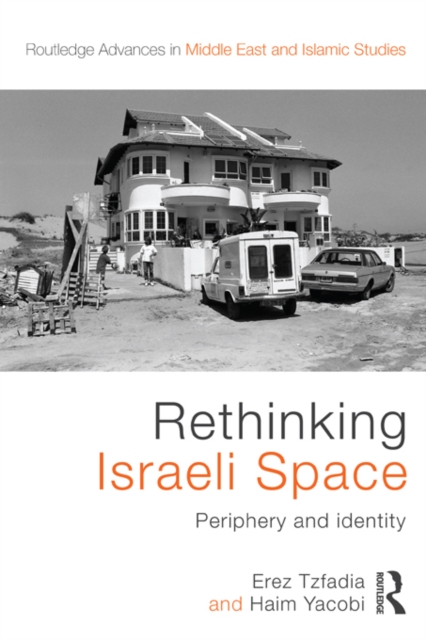
Rethinking Israeli Space
This book sheds light on the production of Israeli space and the politics of Jewish and Arab cities. The authors' postcolonial approach deals with the notion of periphery and peripherality, covering issues of spatial protest, urban policy and urban planning.
Discussing periphery as a political, social and spatial phenomenon and both a product and a process manufactured by power mechanisms, the authors show how the state, the regime of citizenship, the capitalist logic, and the logic of ethnonationalism have all resulted in ethno-class division and stratification, which have been shaped by spatial policy. Rather than using the term periphery to describe an economic, geographical and social situation in which disadvantaged communities are located, this critical examination addresses the traditionally passive dimension of this term suggest that the reality of peripheral communities and spaces is rather more conflicted and controversial.
The multidisciplinary approach taken by this book means it will be a valuable contribution to the fields of planning theory, political science and public policy, urban sociology, critical geography and Middle East studies.
eBook


Making Place
Space and place have become central to analysis of culture and history in the humanities and social sciences. Making Place examines how people engage the material and social worlds of the urban environment via the rhythms of everyday life and how bodily responses are implicated in the making and experiencing of place. The contributors introduce the concept of spatial ethnography, a new methodological approach that incorporates both material and abstract perspectives in the study of people and place, and encourages consideration of the various levels-from the personal to the planetary-at which spatial change occurs. The book's case studies come from Costa Rica, Colombia, India, Austria, Italy, the United Kingdom, and the United States.
eBook


Time and the Migrant Other: European Border Controls and the Temporal Economics of Illegality
The Western world's borders increasingly seem like a battleground where a new kind of \"threat\" is repelled—the so-called \"illegal migrant.\" At Europe's southern frontiers, sea patrols, advanced surveillance machinery, and fencing keep migrants out, much like at the U.S., Israeli, and Australian borders. Such investments have created a dense web of controls that displaces the border both inward and outward into the borderlands beyond it. Building upon recent border studies and ethnographies of illegality, I explore in this article Europe's migration controls by focusing on their temporal rather than their spatial aspects. I show that, in the borderlands, irregular migrants are not only subjected to extended periods of waiting, as migrants often are, but they also face an active usurpation of time by state authorities through serial expulsions and retentions. The ways in which migrants' time is appropriated reveal a complex economics of illegality, complementing existing \"biopolitical\" perspectives on Europe's borders. Las fronteras del mundo Occidental parecen crecientemente como un campo de batalla donde una nueva clase de \"amenaza\" es repelida—el así Ilamado \"migrante ilegal.\" En las fronteras del sur de Europa, patrullas marítimas, sistemas de vigilancia avanzadas y vallas impiden la entrada de migrantes de una manera similar a los controles fronterizos de Estados Unidos, Israel y Australia. Tales inversiones han creado una densa red de controles que desplaza la frontera tanto hacia el interior como hacia al exterior y más allá de las zonas fronterizas. Basándome en estudios de fronteras y etnograféas de ilegalidad recientes, exploro en este artículo los controles migratorios de europa, concentrándome en sus aspectos temporales más que en los espaciales. Muestro que, en las zonas fronterizas, los migrantes irregulares no sólo son sujetos a períodos extendidos de espera, como suele ser el caso para muchos migrantes, sino que también enfrentan una activa usurpación de tiempo por parte de las autoridades estatales a través de expulsiones y retenciones en serie. Las diversas formas en que se apropia el tiempo de los migrantes revelan una compleja economía de ilegalidad, la cual complementa perspectivas \"biopolíticas\" sobre las fronteras de Europa.
Journal Article


Spatial Concepts of Lithuania in the Long Nineteenth Century
This book deals with the spatial concepts of Lithuania and other geo-images that either \"competed\" in the nineteenth century with the term Lithuania or were of a different taxonomic level (Samogitia, Prussia's Lithuania, Lithuania Minor, Poland, the Western Region, the Northwest Region, Lita/Lite, Belarus, East Prussia etc.).
eBook