
Catalogue Search | MBRL


Are you sure you want to remove the book from the shelf?

{{itemTitle}}
21
result(s) for
"États-Unis Politique et gouvernement 1961-1963."
Sort by:

An unfinished love story : a personal history of the 1960s
The Pulitzer Prize-winning historian reflects on her 42-year marriage with Dick Goodwin, one of the shining stars of John F. Kennedy's New Frontier and the journey of going through the letters, diaries, documents and memorabilia he saved over the years.
Book
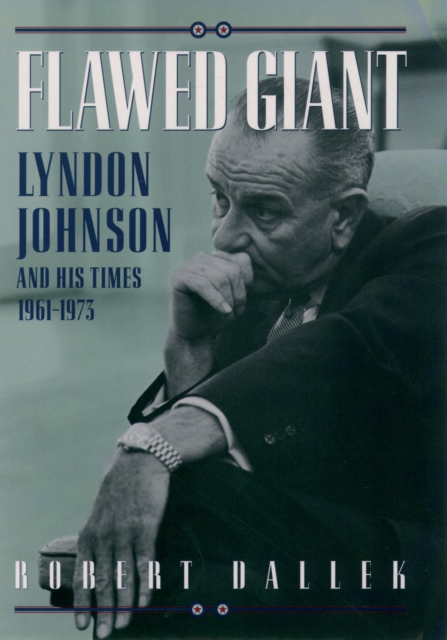
Flawed giant : Lyndon Johnson and his times, 1961-1973
Flawed Giant--the monumental concluding volume to Robert Dallek's biography of Lyndon Baines Johnson--provides the most through, engrossing account ever published of Johnson's years in the national spotlight.
eBook

JFK, LBJ, and the Democratic Party
JFK, LBJ, and the Democratic Party is a richly detailed, comprehensive, and provocative account of presidential party leadership in the turbulent 1960s. Using many primary sources, including resources from presidential libraries, state and national archival material, public opinion polls, and numerous interviews, Sean J. Savage reveals for the first time the influence of Presidents John F. Kennedy and Lyndon B. Johnson on the chairmanship, operations, structure, and finances of the Democratic National Committee. Savage further enriches his account with telephone conversations recently released from the Kennedy and Johnson presidential libraries, along with rare photos of JFK and LBJ.
eBook

Blind over Cuba : the photo gap and the missile crisis
In the aftermath of the Cuban Missile Crisis, questions persisted about how the potential cataclysm had been allowed to develop. A subsequent congressional investigation focused on what came to be known as the “photo gap”: five weeks during which intelligence-gathering flights over Cuba had been attenuated.
?In Blind over Cuba, David M. Barrett and Max Holland challenge the popular perception of the Kennedy administration’s handling of the Soviet Union’s surreptitious deployment of missiles in the Western Hemisphere. Rather than epitomizing it as a masterpiece of crisis management by policy makers and the administration, Barrett and Holland make the case that the affair was, in fact, a close call stemming directly from decisions made in a climate of deep distrust between key administration officials and the intelligence community.
?Because of White House and State Department fears of “another U-2 incident” (the infamous 1960 Soviet downing of an American U-2 spy plane), the CIA was not permitted to send surveillance aircraft on prolonged flights over Cuban airspace for many weeks, from late August through early October. Events proved that this was precisely the time when the Soviets were secretly deploying missiles in Cuba. When Director of Central Intelligence John McCone forcefully pointed out that this decision had led to a dangerous void in intelligence collection, the president authorized one U-2 flight directly over western Cuba—thereby averting disaster, as the surveillance detected the Soviet missiles shortly before they became operational.?
The Kennedy administration recognized that their failure to gather intelligence was politically explosive, and their subsequent efforts to influence the perception of events form the focus for this study. Using recently declassified documents, secondary materials, and interviews with several key participants, Barrett and Holland weave a story of intra-agency conflict, suspicion, and discord that undermined intelligence-gathering, adversely affected internal postmortems conducted after the crisis peaked, and resulted in keeping Congress and the public in the dark about what really happened.?
Fifty years after the crisis that brought the superpowers to the brink, Blind over Cuba: The Photo Gap and the Missile Crisis offers a new chapter in our understanding of that pivotal event, the tensions inside the US government during the cold war, and the obstacles Congress faces when conducting an investigation of the executive branch.
eBook

Younger Than That Now
Retrospectives of the 1960s routinely include the face of youth rebellion: long-haired students occupying campus buildings, young men burning draft cards, hippies dancing at Woodstock. In Younger Than That Now, Holly V. Scott explores how the idea of \"youth\" served as a tactic in the political and social activism of these years. In the early part of that decade, young white activists began to learn from the civil rights movement's defiance of racism. They examined their own lives and concluded that campus rules and the draft were repression as well. As a group, they were ripe for revolution, and their age gave them a unique perspective for understanding and protesting against injustice. In short, young people began to use their youth as a political strategy.
Some in the New Left were dubious of this strategy and asked how it might damage long-term progress. Young feminists and people of color were particularly quick to question the idea that age alone was enough to sustain a movement. And the media often presented young people as impulsive and naive, undermining their political legitimacy. In tracing how \"youth\" took on multiple meanings as the 1960s progressed, Scott demonstrates the power of this idea to both promote and hinder social change.
eBook
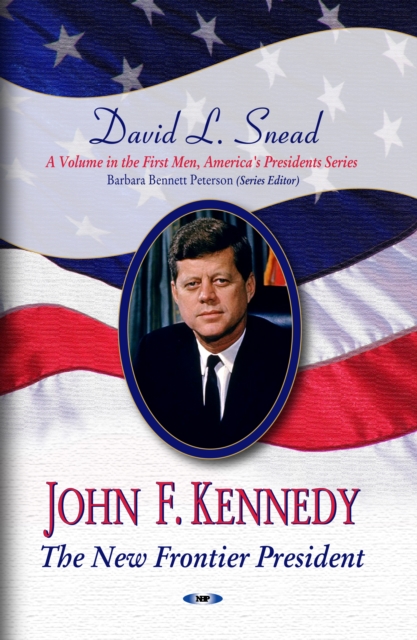
John F. Kennedy
President of the United States of America is an official title sought by many and won by only a few individuals. The series entitled First Men, America's Presidents, contains a book length biography of each President of the United States of America. Every book contains information on the President's early education, professional career, military or political service prior to the presidency, interpretative discussion of both domestic and foreign policies during each presidency, and the conclusion of their political lives in public service. The two major themes of this series are the character traits marking success in the presidency, and the changes in the office of presidents throughout America's history. This new book is in celebration of John F Kennedy, our 35th president, and his major contribution to our country before his untimely, tragic death.
eBook
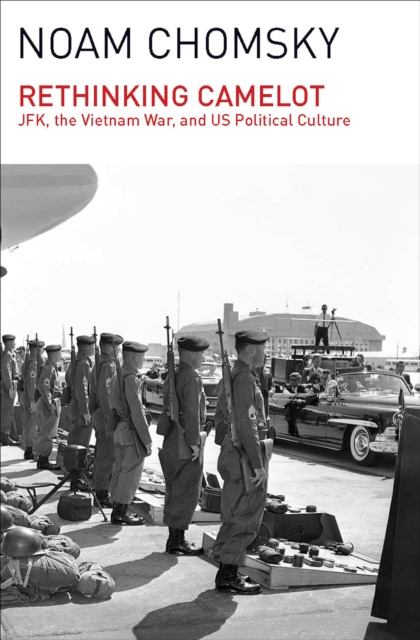
Rethinking Camelot
The famed political critic \"analyzes the issue most prominently posed in Oliver Stone's film JFK . . . strong arguments against Kennedy mythologists\" (Publishers Weekly). Rethinking Camelot is a thorough analysis of John F. Kennedy's role in the US invasion of Vietnam and a probing reflection on the elite political culture that allowed and encouraged the Cold War. In it, Chomsky dismisses efforts to resurrect Camelot-an attractive American myth portraying JFK as a shining knight promising peace, foiled only by assassins bent on stopping this lone hero who would have unilaterally withdrawn from Vietnam had he lived. Chomsky argues that US institutions and political culture, not individual presidents, are the key to understanding US behavior during Vietnam. Rethinking Camelot is \"an interesting work not only for the history it explores, but also as a study of how various individuals and groups write and interpret history\" (Choice). Praise for Noam Chomsky \"Chomsky is a global phenomenon . . . perhaps the most widely read voice on foreign policy on the planet.\" -The New York Times Book Review \"The conscience of the American people.\" -New Statesman \"Reading Chomsky is like standing in a wind tunnel. With relentless logic, Chomsky bids us to listen closely to what our leaders tell us-and to discern what they are leaving out . . . The questions Chomsky raises will eventually have to be answered. Agree with him or not, we lose out by not listening.\" -Business Week \"One of the radical heroes of our age . . . a towering intellect . . . powerful, always provocative.\" -The Guardian
eBook
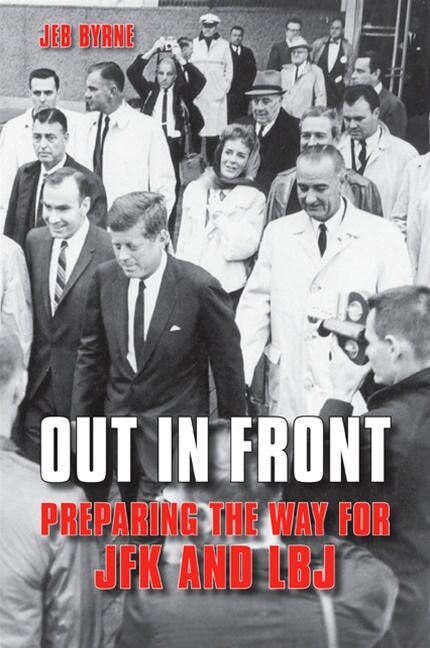
Out in Front
Imagine one's first job assignment to be arranging John F. Kennedy's visit to Fort Worth on the morning of November 22, 1963. Lively and fascinating, Out in Front: Preparing the Way for JFK and LBJ reveals Jeb Byrne's experiences as an advance man for JFK and as the deputy director of the LBJ advance unit during the 1964 campaign. Byrne's life experiences illuminate the work done behind the scenes of campaign stops and political appearances. His personal memoir exposes the duties, contemplations, and struggles of the advance man hidden from the public eye.
eBook

Piercing the bamboo curtain
This is the first comprehensive study of U.S. policy toward China during the presidency of Lyndon Johnson, a critical phase of the Cold War immediately preceding the dramatic Sino-American rapprochement of the early 1970s. Based on a wide array of recently declassified government documents, this study challenges the popular view that Johnson’s approach to China was marked by stagnation and sterility, exploring the administration's relationship to both the Vietnam War and the Cultural Revolution. By documenting Johnson’s contributions to the decision-making process Lumbers offers a new perspective on both his capacity as a foreign policy leader and his role in the further development of the Cold War. A major contribution to our understanding of both Sino-American relations and the Vietnam War, this book will be of great interest to students of the Cold War, U.S. foreign relations, Asian Politics and the Johnson Presidency.
eBook
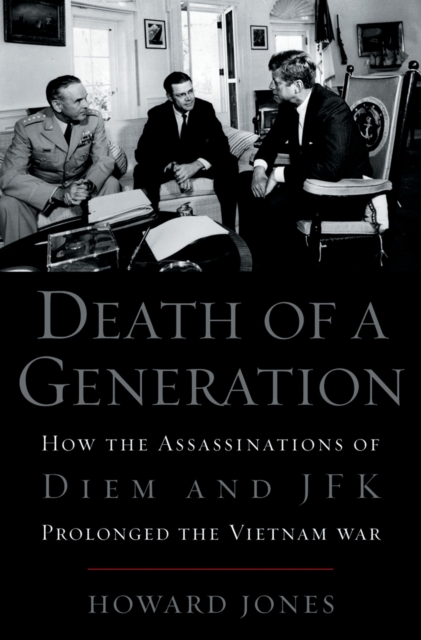
Death of a Generation
When John F. Kennedy was shot, millions were left to wonder how America, and the world, would have been different had he lived to fulfill the enormous promise of his presidency. For many historians and political observers, what Kennedy would and would not have done in Vietnam has been a sourceof enduring controversy.Now, based on convincing new evidence--including a startling revelation about the Kennedy administration's involvement in the assassination of Premier Diem--Howard Jones argues that Kennedy intended to withdraw the great bulk of American soldiers and pursue a diplomatic solution to the crisisin Vietnam.Drawing upon recently declassified hearings by the Church Committee on the U.S. role in assassinations, newly released tapes of Kennedy White House discussions, and interviews with John Kenneth Galbraith, Robert McNamara, Dean Rusk, and others from the president's inner circle, Jones showsthat Kennedy firmly believed that the outcome of the war depended on the South Vietnamese. In the spring of 1962, he instructed Secretary of Defense McNamara to draft a withdrawal plan aimed at having all special military forces home by the end of 1965. The Comprehensive Plan for South Vietnam wasready for approval in early May 1963, but then the Buddhist revolt erupted and postponed the program. Convinced that the war was not winnable under Diem's leadership, President Kennedy made his most critical mistake--promoting a coup as a means for facilitating a U.S. withdrawal. In the cruelest ofironies, the coup resulted in Diem's death followed by a state of turmoil in Vietnam that further obstructed disengagement. Still, these events only confirmed Kennedy's view about South Vietnam's inability to win the war and therefore did not lessen his resolve to reduce the U.S. commitment. By theend of November, however, the president was dead and Lyndon Johnson
began his campaign of escalation. Jones argues forcefully that if Kennedy had not been assassinated, his withdrawal plan would have spared the lives of 58,000 Americans and countless Vietnamese.Written with vivid immediacy, supported with authoritative research, Death of a Generation answers one of the most profoundly important questions left hanging in the aftermath of John F. Kennedy's death.
eBook