
Catalogue Search | MBRL


Are you sure you want to remove the book from the shelf?

{{itemTitle}}
104
result(s) for
"écocritique"
Sort by:


The Cambridge Introduction to Literature and the Environment
The degrading environment of the planet is something that touches everyone. This 2011 book offers an introductory overview of literary and cultural criticism that concerns environmental crisis in some form. Both as a way of reading texts and as a theoretical approach to culture more generally, 'ecocriticism' is a varied and fast-changing set of practices which challenges inherited thinking and practice in the reading of literature and culture. This introduction defines what ecocriticism is, its methods, arguments and concepts, and will enable students to look at texts in a wholly new way. Boxed sections explain key critical terms and contemporary debates in the field with 'hands-on' examples and comparisons. Timothy Clark's thoughtful approach makes this an ideal first encounter with environmental readings of literature.
eBook
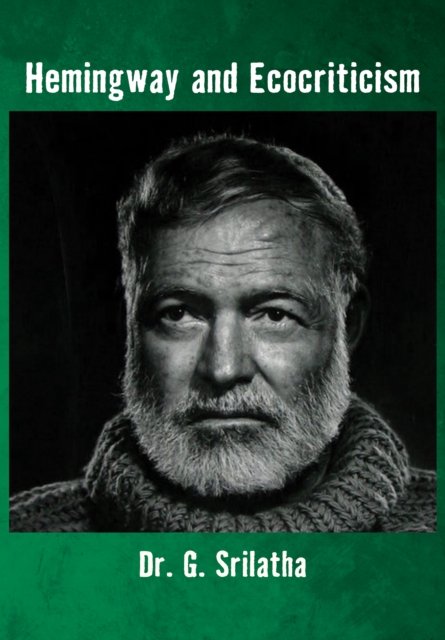
Hemingway and Ecocriticism
Hemingway and Ecocriticism focuses on the famous author's short stories from ecocritical perspectives, which are concerned with the relationship between humans and the landscape and plead for a better understanding of nature. Of Hemingway's first 49 short stories, 22 exhibit ecological concerns in some form or other. They reveal great damage caused to nature and human beings alike. G. Srilatha holds that while Hemingway was an unabashed hunter, fisher, and sportsman, he was also a conservationist and conveyed this attitude in most of his stories. Many show that human and biological environments are mutually interdependent. Despite ecological devastation, Hemingway's protagonists turn to nature to escape from the trauma of war and to seek solace.
eBook

ecological other
With roots in eugenics and other social-control programs, modern
American environmentalism is not always as progressive as we would
like to think. In The Ecological Other , Sarah Jaquette Ray
examines the ways in which environmentalism can create social
injustice through discourses of the body. Ray investigates three
categories of ecological otherness: people with disabilities,
immigrants, and Native Americans. Extending recent work in
environmental justice ecocriticism, Ray argues that the expression
of environmental disgust toward certain kinds of bodies draws
problematic lines between ecological \"subjects\"-those who are good
for and belong in nature-and ecological \"others\"-those who are
threats to or out of place in nature. Ultimately, The
Ecological Other urges us to be more critical of how we use
nature as a tool of social control and to be careful about the ways
in which we construct our arguments to ensure its protection. The
book challenges long-standing assumptions in environmentalism and
will be of interest to those in environmental literature and
history, American studies, disability studies, and Native American
studies, as well as anyone concerned with issues of environmental
justice.
eBook

Une approche écopoétique et écocritique de la nouvelle futuriste, fantastique et scientifique Le Tout-au-ciel, de Rachilde
In this article, we aim to bring back into focus a novella by Rachilde (1860-1953). Le Tout-au-ciel was published in Mercure de France in 1902 and deviates significantly from every-thing else Rachilde produced during her literary career. It portrays a dystopian world that is fantastical, scientific, and futuristic. In addition to analysing its reception, we will delve into its ecocritical discourse, exploring the author’s positions, doubts, and aversions toward the ef-fects of progress on the environment. We will also examine how Rachilde identifies the dangers of a global society while highlighting social inequalities and the behaviour of those driving progress. Finally, we will analyse the ecopoetic mechanisms employed by the author to magnify the mysteries of a writing style that already hints at the seeds of a literary genre that would only emerge a decade later with Marinetti's first manifesto.
Journal Article
En attendant la montée des eaux de Maryse Condé : pour une solidarité transnationale face aux désastres
This article explores Maryse Condé’s novel En attendant la montée des eaux (2010) through an ecocritical and transnational lens. Drawing on the theories of Rob Nixon, Ursula Heise, and Achille Mbembe, the analysis highlights the interconnections between local and global crises. In the novel, Haiti, an emblematic site of ecological and humanitarian struggles, is depicted as a space where historical, economic, and environmental injustices converge, while also offering a reflection on transnational solidarity. The study adopts a reading of the charac- ters’ trajectories and recurring themes in Condé’s work, revealing the limitations of Caribbean utopias and the impacts of inequalities on the Global South.
Journal Article
Une cartographie des espaces dans le roman Viendra le temps du feu de Wendy Delorme
This article analyses, in Wendy Delorme’s novel Viendra le temps du feu (2021), by means of cultural theories of space – geocriticism, ecocriticism, ecopoetics, ecofeminism, posthumanism – the literary mappings of repression and dissidence across the city, the body, and nature, in order to reveal how Delorme’s rebellious voices sketch, within the fractures of the present, the contours of another way of inhabiting the world.
Journal Article

The Eco-Self in Early Modern English Literature
The Eco-Self in Early Modern English Literature tracks an important shift in early modern conceptions of selfhood, arguing that the period hosted the birth of a new subset of the human, the eco-self, which melds a deeply introspective turn with an abiding sense of humans' embedment in the world. A confluence of cultural factors produced the relevant changes. Of paramount significance was the rapid spread of literacy in England and across Europe: reading transformed the relationship between self and world, retooled moral reasoning, and even altered human anatomy. This book pursues the salutary possibilities, including the ecological benefits, of this redesigned self by advancing fresh readings of texts by William Shakespeare, Christopher Marlowe, John Webster, and Margaret Cavendish. The eco-self offers certain refinements to ecological theory by renewing appreciation for the rational, deliberative functions that distinguish humans from other species.
eBook

Dark Scenes from Damaged Earth
An urgent volume of essays engages the Gothic to advance
important perspectives on our geological era
What can the Gothic teach us about our current geological era?
More than just spooky, moonlit castles and morbid graveyards, the
Gothic represents a vibrant, emergent perspective on the
Anthropocene. In this volume, more than a dozen scholars move
beyond longstanding perspectives on the Anthropocene-such as
science fiction and apocalyptic narratives-to show that the Gothic
offers a unique (and dark) interpretation of events like climate
change, diminished ecosystems, and mass extinction.
Embracing pop cultural phenomena like True Detective ,
Jaws , and Twin Peaks , as well as topics from the
New Weird and prehistoric shark fiction to ruin porn and the
\"monstroscene,\" Dark Scenes from Damaged Earth
demonstrates the continuing vitality of the Gothic while opening
important new paths of inquiry. These essays map a genealogy of the
Gothic while providing fresh perspectives on the ongoing climate
chaos, the North/South divide, issues of racialization, dark
ecology, questions surrounding environmental justice, and much
more.
Contributors: Fred Botting, Kingston U; Timothy Clark, U of
Durham; Rebecca Duncan, Linnaeus U; Michael Fuchs, U of Oldenburg,
Germany; Esthie Hugo, U of Warwick; Dawn Keetley, Lehigh U; Laura
R. Kremmel, South Dakota School of Mines and Technology; Timothy
Morton, Rice U; Barry Murnane, U of Oxford; Jennifer Schell, U of
Alaska Fairbanks; Lisa M. Vetere, Monmouth U; Sara Wasson,
Lancaster U; Jeffrey Andrew Weinstock, Central Michigan U.
eBook
Ecopoetics and the Global Landscape
Ecopoetics and the Global Landscape: Critical Essays surveys ecopoetry from a global perspective across different historical epochs.Its comparative approach foregrounds the importance of ecopoetics within the context of distinct national literatures and cultures to reveal the ubiquitous intersection of poetry with ecocriticism.
eBook