Catalogue Search | MBRL


Are you sure you want to remove the book from the shelf?

{{itemTitle}}
6
result(s) for
"إيطاليا دستور"
Sort by:
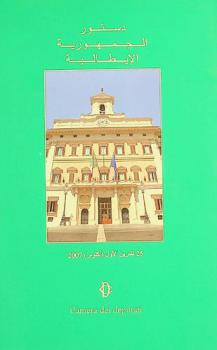
دستور الجمهورية الإيطالية
يتناول كتاب (دستور الجمهورية الإيطالية) والذي قام بتأليفه (Camera dei deputati) ويقع في حوالي (52) صفحة من القطع المتوسط موضوع (القانون الدستوري الإيطالي) مستعرضا المحتويات التالية : الجزء الأول : في حقوق المواطنين وواجباتهم : العلاقات المدنية : العلاقات الأخلاقية الاجتماعية : العلاقات الاقتصادية : العلاقات السياسية، الثاني : في تنظيم الجمهورية.
Book

Legality vs Constitutional Principles
This paper explores the dialectical relationship between legality and constitutional principles in Italy after World War II, within the context of rebuilding the state and establishing a new democratic order. The author explains that postwar Italy needed to redefine the relationship between authority and citizens, which was embodied in the 1948 Constitution. However, the implementation of this Constitution faced practical difficulties, as the previous legal system inherited from Fascism and earlier regimes remained in force alongside the new constitutional framework, resulting in a duality between formal legality and constitutional legality. The study focuses on the clash between the Court of Cassation, which defended the principle of legality, and the newly established Constitutional Court, tasked with ensuring the supremacy of the Constitution. This conflict highlighted the limits of the principle of state continuity, which preserved older laws even when they conflicted with constitutional principles. The lack of implementing legislation further delayed the effective application of constitutional rights, rendering provisions on social justice and equality largely aspirational in the early years. The paper also examines the role of the Constituent Assembly, which drafted the Constitution with the aim of balancing state powers and guaranteeing fundamental rights to liberty, equality, labor, and social justice. Yet the persistence of older legislation hindered the transition toward a democratic social state. The study underlines how this transitional phase produced two levels of legality: one rooted in the certainty of established law, and another based on new constitutional principles awaiting enforcement. It further discusses the notion of \"suspended\" constitutional legality, where no immediate mechanisms were created to invalidate unconstitutional laws, but rather a gradual process of legal adaptation was pursued. The author concludes that the Italian experience illustrates the challenge of reconciling traditional legality with constitutional legality, and demonstrates that building a true democratic state requires moving beyond constitutional texts to implementing reforms that guarantee the effective realization of constitutional rights. Abstract Written by Dar AlMandumh, 2025, Using AI
Journal Article