
Catalogue Search | MBRL


Are you sure you want to remove the book from the shelf?

{{itemTitle}}
98,446
result(s) for
"الاقتصاد"
Sort by:
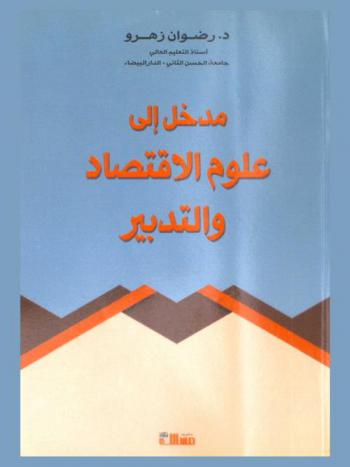
مدخل إلى علوم الاقتصاد والتدبير
يتناول هذ العمل المتواضع المبادئ الأساسية لعلم الاقتصاد ولمحة سريعة عن تاريخ الفكر الاقتصادي كذلك أبرز وظائف العملية التدبيرية من حيث التنظيم والتخطيط والقيادة والرقابة والتوجيه والتقييم لافتا في الوقت ذاتاه إلي المواصفات الواجب توفرها في المسؤولين عن تدبير الأعمال والمنظمات ومستعرضا مجموعة من القضايا الهامة في مجال التدبير وبصورة خاصة تدبير المارد البشرية آملين أن يجد الطالب في هذا الكتاب الغاية التي ينشدها.
Book

Al-Ma'āLāT Approach in Islamic Finance
The jurisprudence of al-Ma'ālāt is an ancient jurisprudence rooted in Islamic law, and it is concerned with analyzing and taking into consideration the consequences and results people's actions can generate. The Fiqh was used by the Prophet and Sahaba, and it, thereafter, became so famous during the period of Imam Abu Hanifah, the founder of the Hanafi School of Jurisprudence. Fiqh of al-Ma'alat is a great distinctive feature and one of the important jurisprudential aspects of the Hanafi School. The school makes copious use and reference to the theory and practices of al-Ma'ālāt. Where the Hanafi school uses the term \"Ariat i.e., have you pondered if that happened\" and then builds the fatwa ruling based on this future event and also on the expected results of this event. History also mentions Al-Shaṭibī's attempts to draw the attention of the imams of his time to the importance of this jurisprudence through his book Al Muwafaqāt. But despite all the attempts, the writings on it are still few compared to Maqasid Al shariah, and the writings in it in Islamic economics and finance in the English language are almost non-existent, as there is only one source in English according to the researcher's knowledge. Unusually however, this important discipline was not given adequate attention especially by later scholars. Despite its significance. The reasons behind that, as the researcher think due to it is not easy to discover and need deep knowledge and interdisciplinary approach which not easy for each imam to discover or can do it. This article is an attempt to restore interest in it by looking at it through several Islamic, economic and administrative aspects, but to start with this jurisprudence to \"gain an understanding of the existing research and debates relevant to a particular topic or area of study, and to present that knowledge in the form of a written report. You will also gain insight into how researchers apply the concepts you are learning in your unit to real world problems.
Journal Article

The Impact of Logistic Processes on the Internationalization of SMEs
Logistics encompasses a comprehensive range of processes and services designed to deliver products to consumers. When consumers are situated beyond the geographical confines of a country, it involves international logistic services, signifying the company's engagement in economic activities at the global level. This study endeavors to assess the influence of logistic operations on the internationalization of small and medium-sized enterprises (SMEs) in Algeria. The methodology involved a survey conducted among 108 Algerian SMEs actively engaged in international activities. Data analysis was carried out utilizing the SPSS 26 program. The findings affirm that logistic services wield a positive and noteworthy impact on the internationalization endeavors of Algerian SMEs.
Journal Article

Measuring the Impact of Government Support Policies on the Phenomenon of Poverty in the Iraqi Economy for the Period 2004-2024
Poverty is one of the negative phenomena that poses a real challenge to government performance, especially with the start of political change in Iraq and its transition to a free economy, which is an economic system that relies primarily on the effectiveness of the private sector in achieving economic development as a basic factor in the national economy. According to economic theory, poverty is a phenomenon with negative dimensions that greatly affect the creation of some problems that accompany the increase in its rates. Every increase in poverty rates indicates a combination of problems, the most important of which is the emergence and spread of crimes, in addition to the increase in the rate of students leaving school. The importance of this research is that it addresses the issue of poverty quantitatively by taking into account the actual dimensions of government support policies for individuals. This reality constitutes an addition to these policies and directs support towards social activities that may be effective and influential in achieving growth rates and addressing the phenomenon of poverty. The research concluded that there is a close relationship with a positive impact in the relationship between the decline in poverty rates and government support policies represented by (social security). The research recommends searching for modern mechanisms to employ government policy and in a practical way to support individuals who deserve these benefits. The importance of the research: The research derives its importance from the fact that it addresses one of the most important problems that accompany developing countries, and was spreading at increasing rates in the Iraqi economy throughout the study period. This phenomenon was addressed by measuring the actual impact of government support policies and the most important of these policies that actually had an impact on poverty. Research objective: The research aims to demonstrate the actual impact of government support policies in achieving low rates of poverty by quantitatively tracking the poverty line in Iraq during the study period, and identifying the best policies that had a positive impact. Research problem: The phenomenon of poverty is one of the phenomena that characterize developing countries, but the increase of this phenomenon and great injustice in Iraq was a dangerous indicator. After the economic transformation in Iraq, it was necessary to move towards redistributing income in a way that is compatible with achieving low rates of poverty. Research hypothesis: The research hypothesis is that the Iraqi economy is a rich economy, and possesses many components that qualify it to get rid of the phenomenon of poverty once and for all, but the reality does not reflect the government's actual interest in influencing the high rates of poverty that were recorded throughout the study period.
Journal Article

The Reform Agenda of Mainstream Economics: Importance, Relevance, and Obstacles for Islamic Economics
Mainstream economics textbooks focus too much on neoclassical mod-els (with perfect competition as reference model) while the mainstream research practice is much more diverse and closer to the real world and political issues. Progress was made in microeconomics by new insights particularly from behavioral and experimental economics and new tools such as simulations and network analysis. In macroeconomics, however, the dominant Dynamic Stochastic General Equilibrium (DSGE) models have structurally failed to predict the global crisis. Their enhancement by the inclusion of an explicit financial sector is on top of the main-stream reform agenda. Islamic economics may benefit from the innovations in microeconomics, while the macroeconomic reform agenda is of limited relevance as long as the market share of Islamic finance remains quite low in most Muslim countries. A dialogue on reform between mainstream and Islamic economics should take into account that Islamic economists underline the importance of the Qur'ān and Sunnah as the primary sources of positive and normative knowledge, while secular mainstream rejects proofs of positive statements by reference to di-vine sources. This may become a severe methodological obstacle for more plural-ism in economics.
Journal Article

Macroeconomic Determinants of Economic Growth Using Panel Data Analysis
This study aims to identify the most important determinants of economic growth in a sample of six countries from the Middle East and North Africa region. Two of which are from high income countries, Bahrain and Saudi Arabia, and two of the highest middle-income countries, Jordan and Lebanon, and two from lower Middle income, namely Egypt and Morocco. They were chosen in addition to the classification of income groups, based on data available to sample countries during the period 2001-2017. Augmented-Dickey-Fuller, a test of stationary of endogenous and exogenous variables, and Granger Causality Analysis were used to infer the causal relationship between these variables and economic growth. By applying Panel Data Analysis, according to Hausman Test, and by comparison between the fixed and random effect models, the results showed a preference for the random effect model. The results showed that the employment rate, foreign direct investment, gross national income, government expenditure, and inflation were among the most important in determining economic growth in the region during that period. All of them had a significant and positive impact on economic growth, except for the rate of growth in gross national income, which negatively affected the rate of economic growth. The pairwise Granger Causality showed that unidirectional causality is running from foreign direct investment Gross Domestic Product growth rates, from both Gross Capital Formation growth rates and Imports growth rates to Employment Ratio. Unidirectional causality also runs from both of Exports growth rates, Gross Capital Formation growth rates, Imports growth rates to Foreign Direct Investment as a percent of Gross Domestic Product. There is also unidirectional causality from foreign direct investment and imports to unemployment.
Journal Article