
Catalogue Search | MBRL


Are you sure you want to remove the book from the shelf?

{{itemTitle}}
1,007
result(s) for
"الاقتصاد الحديث"
Sort by:

The Nature of Money in Modern Economy: Implications and Consequences
This paper discusses the great importance of the monetary question, and briefly examines some of the dominant erroneous concepts of money and their effects upon societies. It also points and links to the great progress currently being made by researchers in this field, so readers can examine them more fully. It presents very brief summaries of what some of the important new papers do. It also aims at helping instructors in outlining a reading curriculum to assist in a long overdue understanding of money power. Finally, the paper presents a money and banking system proposal which has evolved since the Great Depression of the 1930s, and is now ready for implementation and has even been introduced as potential legislation into the United States Congress.
Journal Article

The Key Factors of Business Internationalization
The opening of markets and the internationalization of exchanges and the development of information technology and telecommunication have profoundly modified the company's economic, commercial and technological environment. This process is a challenge for companies that want to internationalize. In this paper, we present the main theories of internationalization and focus on the success factors that allow the company to survive and develop.
Journal Article
Islamic Alternatives to the Secular Morality Embedded in Modern Economics
Economics, as a distinct discipline started out as a branch of moral philosophy. Early in the 20th century, logical positivists argued that science is the only source of knowledge, and values are not part of science. The desire to make humanities 'scientific' led to the creation of the 'social sciences', which claimed to be objective and value-free. In fact, values are inevitably involved in the study of human societies. Hence, when the social scientists could not remove them, they buried them into the foundations. In economics, 'rational' behavior was defined to be the pursuit of pleasure, without any explicit recognition or acknowledgement of the value judgment involved. Similarly, the scarcity foundations of modern economics also conceal many value judgements. In particular, secular morality at the heart of economics makes pursuit of pleasure and profits the goal of life for all rational human beings. Once we recognize the secular moral principles on which modern economics is built, the path to creating an Islamic alternative becomes clear. An Islamic society is built on the foundations of cooperation, generosity, and social responsibility, in stark contrast to the competition, greed, and individualism which are the basis of capitalist societies. Islam has a well-developed moral philosophy to deal with economic affairs, embodied in the science of fiqh (jurisprudence) as it has developed over the centuries. By rejecting the secular morality built into the foundations of modern economics, we can create a radical alternative based on the moral foundations of Islam. The modern world offers many new challenges; environments radically different from those faced by our elders. Thus, building a revolutionary Islamic economics requires ijtihad (diligent and creative research) to use the well-developed methodology of fiqh creatively to find new solutions to the deep and complex problems currently facing humanity and the planet.
Journal Article

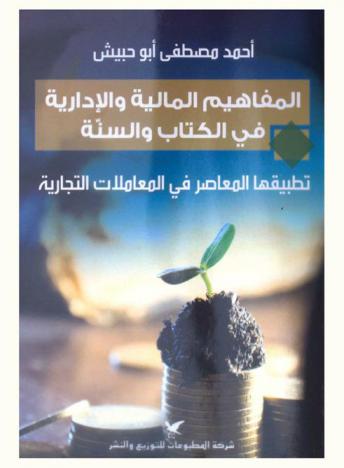
المفاهيم المالية والإدارية في الكتاب والسنة : تطبيقها المعاصر في المعاملات التجارية
تناول \"المفاهيم المالية\" موضوع تطبيق الشريعة الإسلامية في الشؤون المالية والإدارية وخلافا لسائر الكتب في هذا المجال لا يقتصر مضمونه على علاقة الفرد بالفرد بل يتعداها إلى علاقة مؤسسة بمؤسسة أو مؤسسة بفرد يتطرق الكاتب إلى موضوعات شتى بدءا بمفاهيم التداين وغرامات التأخير والتفرقة بين إخراج الزكاة وإخراج الضرائب ومفهوم العمل والإفلاس والرقابة الداخلية وسواها كل ذلك من منظور الدين الإسلامي والشريعة الإسلامية كتاب مبني على البحث والتحليل وإمعان العقل بهدف مساعدة الشركات ورجال الأعمال الذين يودون تطبيق الشريعة الإسلامية في حياتهم التجارية وتعريفهم بشكل أوضح بالمبادئ والمفاهيم المنصوص عليها في الكتاب والسنة.
BOOK
Islamic Alternatives to the Secular Morality Embedded in Modern Economics: Discussion of the Paper by Asad Zaman
The objective of this discussion on the paper of Asad Zaman (2021) is to cast an overview as to what ought to be the learned outlook regarding Islamic economics within its scientific containment. In this way, it is surmised that the potentiality of Islamic economics, its scientific approach, and the broader socioscientific field can be searched and advanced in comparative Western perspective. By gradually establishing this enriched domain of advanced and conforming methodological approach, the future of Islamic economics in its ontological and scientific context can be discovered. This is indeed a momentous task of many together in the perspective of the collective world of learning.
Journal Article