
Catalogue Search | MBRL


Are you sure you want to remove the book from the shelf?

{{itemTitle}}
97
result(s) for
"علم الوراثة النباتية"
Sort by:
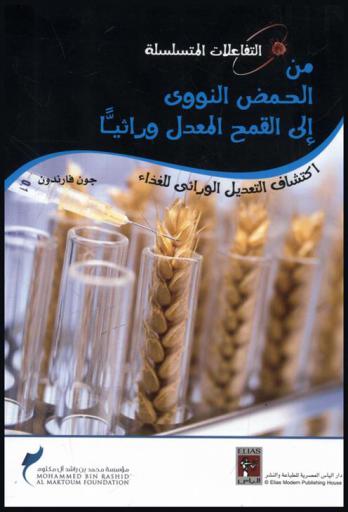
من الحمض النووي إلى القمح المعدل وراثيا : اكتشاف التعديل الوراثي الغذائي
كيف يمكن تحوير (DNA) النبات؟ ما هو أول كائن معدل وراثيا؟ هل تساهم المحاصيل المعدلة وراثيا فى القضاء على الجوع فى البلدان النامية؟ يعرض \"التفاعلات المتسلسلة\" تاريخ وتطور بعض أحداث التقدم العلمى الرئيسية فى القرن الحادى والعشرين. ويوضح الكتاب كيف يمكن لاكتشاف علمي ما أن يؤدى إلى سلسلة من الاختراعات التى قد تغير من مجرى حياتنا تغييرا جذريا.
Book

Utilizing biotechnology tools for silecting salt tolerant rootstock of peach Hassawi
This study was carried out with an aim of evaluation of performance of Hassawi peach rootstocks and
testing their variance towards salinity stress thus to find out a quick effective modern technique for
their reculture and re-propagation again in the region. Eight different concentrations of sodium
chloride (NaCl) that represent progressive gradual levels of salinity were used to investigate
tolerability of the explants towards variant levels of salinity stress. Thus to evaluate the performance
of these Hassawi peach rootstocks (peach, plum ]ghwj[, and almond). Date and results declared the
general superiority of bitter almond to the other rootstocks, as it vitally survived and tolerated salinity
to 3500 ppm NaCl, followed by peach that tolerated salinity to 2500 ppm, and eventually ghwj that just
survived with maximum tolerance of 2000 ppm of NaCl. The study recommends to count on bitter
almond as a salinity tolerant rootstock followed by peach for grafting Hassawi peach rootstocks for its
regeneration again in Al-Ahsa oasis, and to exclude plum rootstock because of its low salinity tolerance
besides its very low harmonization with peach that negatively affect grafting process.
Journal Article
Morphological and anatomical variations of fruits in some taxa of Valerianaceae Batsch family
This study was conducted at the different geographical regions at the north of Iraq; during
the field trips, many samples of individuals of two genera Valeriana L. and Valerianella Miller
were collected. The fruits of specimens morphologically have been inspected, and some parts
of fruits were anatomically examined by paraffin method, from both studies the diagnostic
characteristics of fruits were determined. This study was proved the morphological
characteristics of significance within genera and species levels, while anatomical features had
a large role in separation between the two studied genera, it was proved that the crosssectional
outlines of fruits played a significant role in delimiting among species of the genus
Valerianella.
Journal Article
DNA methylation and feSOD gene expression affected by plant density in Zea mays L.
Methylation Sensitive Amplification Polymorphism (MSAP) was used to characterize the alterations in DNA methylation in maize (Zea mays L.) inbred lines and their half-daillels affected by plant densities (213333 plant h-1 and 13333 plant h-1). The two restriction was enzymes ( HpaII and MspI) succeeded in diagnosing a total of 23 specific loci, most of (22 loci) were Methylation Sensitive Loci (MSL), while the only one NML (No Methylated Loci) was monomorphic. Thirteen out of 22 MSL loci polymorphic, recording a were polymorphism percentage of 59%. Results of FeSOD gene expression cleared the different response of maize inbreds and hybrids to high plant density stress. Generally, the expression of the targeted gene was increased in plants submitted to high plant density stress compared with low density. The inbred 3 and its single hybrid 1×3 achieved the highest level of gene expression under high planting density (5505.7 and 21098.6 copy, respectively), meanwhile, inbred 5 and it's single hybrid 4×5 gained the maximum level of FeSOD expression at the low plant density (8317.6 and 6862.1 copy, respectively). The response reached to its maximum limit in many of those genotypes, some other genotypes showed relatively steady performance along with higher stress, such as parent 1, that gave the lowest number of gene copies in both, high and low plant density (1375.8 and 1569.5 copy, respectively).
Journal Article
Determination genetic diversity of inbred lines and hybrids of maize using ISSR technic
This study was carried out in the biotechnology laboratories of the Seed Inspection and Certification Department - Ministry of Agriculture during 2019, to study the relation among molecular five inbred lines with hybrid crosses of maize. to estimate the genetic diversity and determine the degree of genetic similarity among them using the ISSR based on PCR technic with 6 primers. All primers produced 79 bands at a rate of 13.2 bands per primer. The number of amplified bands ranged from 10 to the primer UBC 835 and 16 in the UBC 897, with a molecular length ranged between 100 - 1700 bp. The total number and percentage of polymorphic bands was 71 and 90% respectively. The primers UBC 856 and UBC 866 the highest percentage of had polymorphic bands of 100%. While the UBC 835 showed the lowest (70%). The highest efficiency and specificity were 12.7% and 9.9% respectively in UBC835. Based on molecular marker data and genetic similarity using the UPGMA method in establishing the dendrogram, the study showed that genetic similarity between the inbred lines ranged from 0.105 to 0.40, the highest (0.40) between the two strains BK121 and Zm6 , While the lowest degree of similarity (0.105) was between the two strains BK121 and ART-817 .
Journal Article
Impact of moisture depletion percentages on somegrowth characters and yield for selected genotypes of bread wheat
field experiments were carried out at the Abu- Graib Research Station - Office of Agricultural Research
Ministry of Agriculture, to investigate moisture depletion effect for some traits of selected genotypes during
2014-2015, which depended to the long term of breeding program (2008-2014). The 9th selected genotypes and the
control variety IPA 99 were evaluated during season 2015-2016 using split plot arrangement within RCBD and
three replications. The main plots included four levels of water stress (20%, 40%, 60% and 80%), depletion of
available water while, genotypes occupied sub plots.The results revealed significant differences among depletion
%, genotypes and their interaction in all studied characters. Moisture depletion 20% of available water
indicated the superiority of number days to 50% flowering (110.3 days), plant height (98..29 cm), flag leaf area
(34.8 cm2), flag leaf angle (67.700), number days to 100% physiological maturity (146.53 days), spike length
(11.53 cm), number of spikelets spike-1 (18.07), grain yield (5.06 t ha-1) and highest water use efficiency (1.63 kg
m-3). The lowest value of the characters were found by depletion 80% of available water. The genotype 179 to
took highest number of days to 50% flowering (114 days), IPA99 had highest flag leaf area (33.21 cm2) and
highest period of 100% physiological maturity (145.75 days), genotype 27 had highest plant height (102.11 cm)
and 186 produced highest spike length (11.75 cm), highest number of spikelests spike-1 (19.58), highest yield
(5.64 t ha-1). Significant differences were found in interactions between genotypes and water stress in most
characters studied, this shows of genotypes tolerance differences to water stress. So we can select one or more
genotype , which tolerance to 20% moisture depletion
Journal Article
Embryo culture and in vitro clonal propagation of oak (Quercus aegilops L.)
An attempt was done to develop a micropropagation protocol for oak using embryo culture. Oak is considered a hard-to-root woody plant by conventional propagation methods, that’s why using tissue culture techniques is a very suitable alternative method. For oak embryo culture, WPM was used and found to be better than MS medium for embryo germination which gave 66.13%. As well as adding of GA3 to the medium improved the germination rate of embryos (43.25% and 82.25 %). At initiation stage, WPM was used and found to be the best medium by giving the highest number of shoots/ explant which was 1.80, the highest number of leaves (15.17 leaves/ explant) and the longest shoots (1.42 cm) followed by MS medium then GD which gave the lowest parameters which gave 0.98 shoots/ explant, 7.20 leaves/ explant and 1.06 cm shoot length. At shoot multiplication stage, BA was better than Kinetin for multiplication of oak explants. The addition of BA at 3 mg.l-l gave the highest number of shoot and leaves which were 3.33 and 26.11 respectively. The longest shoots were achieved when 4.5 mg.l-l of BA was used. Furthermore, kinetin at 3 and 4.5 mg-l gave the lowest parameters which were 1 cm in length and 1.54 leaves/ explant. For rooting stage, NAA was better than IAA in giving better parameters and rooting percentage. The highest number of roots and rooting percentage were achieved when 1 mg.l-l was added by giving 6 roots/ explant and 100% rooting percentage. While the longest roots were achieved when 0.5 mg.l-l of NAA was used (3.67 cm) followed by 1.5 mg.l-l IAA which gave 3.55 roots/ explant with rooting percentage 90%. The produced plantlets were successfully acclimatized and transferred to the open-air conditions with a rate reached 85%.
Journal Article
Estimation of hybrid vigour, combining ability and gene action using (line x tester) analysis in maize
Field experiment was conducted at field of Fallujah- Anbar Governorate/ Iraq, during the two seasons of 2017.
Seeds of eight maize inbred lines were cultivated, and line × tester method was used to produce 16 crosses. The
seeds of parents were cultivated and crosses in the fall season of 2017 in a randomized complete block design
with three replicates. The objectives of the study were to estimate gene action, hybrid vigour, and the effects of
general and specific combination abilities of the inbred lines and to evaluate test cross performance of the
hybrids for grain yields and yield related traits. There were significant differences between parents and their
crosses for all studied traits. The results showed that crosses (ZM12 x ZM51W) and (ZM12 x ZM43W) gave the
highest hybrid vigour in grain yield (39.32% and 31.62% respectively) to the best parents. The two crosses also
were superior in the plant grain yield (222.29 and 217.15 gm. plant -1
).The specific combination ability
components were larger than the general combination ability components. The dominance genetic variation was
more important than the genetic variation additive. The heritability in its narrow sense was low ranging between
2.17% for grain yield.plant-1
and 25% for Leaf area, and this led to a high degree of dominance on the one for all
the studied traits except leaf area. It can be concluded that it is possible to use some parents which outperformed
others of crosses, because most of traits were under the influence of dominant and over dominant gene effects.
Journal Article
قابلية الائتلاف و قوة الهجين و الفعل الجيني باستعمال تحليل السلالة × الكشاف في الذرة الصفراء
A field experiment was conducted at the Field Crops Research Station of State Board of
Agricultural Research at Abu Ghraib in spring 2015. Seven inbred lines of maize (IK8, ZP,
W13R, H.S, IK58, ABS 5, ZP607) were used in this study, using Line x Tester analysis, to
produced twenty F1 crosses. The parents and crosses were grown in fall season of 2015 using RCBD with three replicates to determine heterosis and general, specific combining ability effects and gene action. Significant differences were found among parental lines and their crosses for all the traits. The result were showed that the cross (IK8 × IK58) gave the highest hybrid vigor in grain yield (42.46%) and produced highest grain yield 214.7 gm.plant-1. The values of specific combining ability variance for all the traits revealed superior to the variance of general combining ability. The dominance genetic variance more important than additive variance, the narrow sense heritability for ear length very low (2.5%), white was highest (36.42%). The result indicate that some inbred lines could be used in a breeding program to develop new versions of high yield hybrids and most studied traits were under dominance and over dominance gene action.
Journal Article