
Catalogue Search | MBRL


Are you sure you want to remove the book from the shelf?

{{itemTitle}}
18
result(s) for
"第二次世界大战"
Sort by:
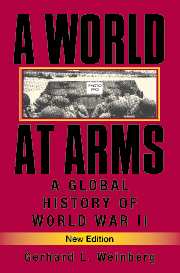
A World at Arms
Widely hailed as a masterpiece, this is the first history of World War II to provide a truly global account of the war that encompassed six continents. Starting with the changes that restructured Europe and her colonies following the First World War, Gerhard Weinberg sheds new light on every aspect of World War II. Actions of the Axis, the Allies, and the Neutrals are covered in every theater of the war. More importantly, the global nature of the war is examined, with new insights into how events in one corner of the world helped affect events in other distant parts. In a new edition, with a new preface, A World at Arms remains a classic of global history.
eBook
A terrestrial observatory approach to the integrated investigation of the effects of deforestation on water, energy, and matter fluxes
Integrated observation platforms have been set up to investigate consequences of global change within a terrestrial network of observatories (TERENO) in Germany. The aim of TERENO is to foster the understanding of water, energy, and matter fluxes in terrestrial systems, as well as their biological and physical drivers. Part of the Lower Rhine Valley-Eifel observatory of TERENO is located within the Eifel National Park. Recently, the National Park forest management started to promote the nat- ural regeneration of near-natural beech forest by removing a significant proportion of the spruce forest that was established for timber production after World War II. Within this context, the effects of such a disturbance on forest ecosystem functioning are currently investigated in a deforestation experiment in the Wtistebach catchment, which is one of the key experimental re- search sites within the Lower Rhine Valley-Eifel observatory. Here, we present the integrated observation system of the Wiistebach test site to exemplarily demonstrate the terrestrial observatory concept of TERENO that allows for a detailed mon- itoring of changes in hydrological and biogeochemical states and fluxes triggered by environmental disturbances. We present the observation platforms and the soil sampling campaign, as well as preliminary results including an analysis of data con- sistency. We specifically highlight the capability of integrated datasets to enable improved process understanding of the post-deforestation changes in ecosystem functioning.
Journal Article

American Geographers and World War II: Spies, Teachers, and Occupiers
This article reviews the military duties of a number of U.S. geographers during World War II. It divides those duties into three kinds: spies, teachers, and occupiers. In each case, a specific form of geographical expertise was deployed-instrumental to achieving a particular military end. In particular, the article examines the roles of geographers: first, in the analysis of military intelligence at the Office of Strategic Services; second, in the provision of geographical courses for the university-based Civil Affairs Training School and the Army Specialized Training Program; and, finally, as agents of occupation in Japan once World War II ended.
Journal Article

Posttraumatic stress symptoms among Polish World War II survivors: the role of social acknowledgement
Background: There is growing evidence of the important role played by socio-interpersonal variables on the maintenance of PTSD. Many World War II survivors in Poland could, as a result of political circumstances during the aftermath of the war, have experienced a lack of social recognition of their war-related trauma.
Objective: The main aim of the study was to examine the association between perceived social reactions and the level of posttraumatic stress symptoms (PTSD) and depression.
Method: Participants (N = 120) were aged 71-97 years (M = 82.44; SD = 6.14). They completed a WWII trauma-related questionnaire, the Posttraumatic Diagnostic Scale (PDS), the Impact of Events Scale (IES) and Beck's Depression Inventory (BDI). The Social Acknowledgement Questionnaire (SAQ) was used to measure participants' perception of others' acknowledgement and disapproval of their war trauma.
Results: The rate of probable PTSD, diagnosed according to DSM-IV, was 38.3%. PTSD symptoms and General Disapproval were significantly correlated for all three PTSD symptom groups (Pearson's r ranged from .25 to .41). The structural equation modelling results also demonstrated the importance of General Disapproval with regard to the level of PTSD symptoms. It explained both the intensity of PTSD symptoms (13.4% of variance) and the level of depression (12.0% of variance).
Conclusion: In addition to confirming the high rate of PTSD among WWII survivors in Poland, the results indicate the importance of social reactions to survivors' traumatic experiences.
Journal Article

From Decoy to Cultural Mediator
This paper explores the role of tourism in soldier indoctrination by applying the concept of the “militourist gaze”—ways of representing, perceiving, and interacting with others that combine militarism and tourism—to analyze Allied military media, soldier memoirs, and photographs from World War II and the Occupation of Japan. The first part of the paper shows how in guides to Japan for U.S. military personnel published in the closing stages of the war, the tourist gaze is blamed for blinding the U.S. to Japan’s war plans. The second and third sections explore how the privileges of the Occupation enjoyed by the Allied military were reinforced through participation in bombsite and sex tourism in the immediate postwar. The final two sections focus on the late 1940s, and argue that, with Japan being recast as a vital Cold War ally, Occupation soldiers were gradually encouraged to forget World War II and embrace prewar touristic notions of their former enemy. The paper concludes that both during war and the Occupation, the militourist gaze became a tool in Allied army soldier indoctrination. Over the short span of four years (1945–1949), soldier education regarding Japan shifted from utilizing this gaze to intensify hatred and suspicion to encourage friendship and trust. The militourist gaze, the author argues, is vital not only in building amity and overlooking past hatreds to form new war alliances, but also in mobilizing soldiers for war.
Journal Article
Cultures of (Dis)remembrance and the Effects of Discourse at the Hiyoshidai Tunnels
This paper examines the early postwar history of the physical remains of World War II through the example of Keio University’s Hiyoshi Campus. During the war, the Japanese Imperial Navy’s Combined Fleet used this site as their headquarters, and they built a massive underground tunnel system there. Furthermore, after the war, the campus was confiscated and used by the U.S. Occupation Eighth Army until 1949. Yet this history of the Hiyoshi Campus was almost completely forgotten until the late 1980s. This paper argues that the reasons for this lie in the postwar history of the site and the university. Namely, Keio intellectuals in the early postwar sought to portray the school as an historical pioneer of liberal democracy in Japan. Yet in this historical rewriting, instances of liberal cooperation with militarism such as Keio’s wartime past became inconvenient truths, and the physical wartime remains on campus, as visible reminders of this past, became unwanted and undesirable anachronisms. In this way, the paper argues that the forgetting of war sites such as the Hiyoshidai tunnels was, in some ways, a byproduct of the creation of a liberal-democratic postwar Japan.
Journal Article

Mobilizing Rivers: Hydro-Electricity, the State, and World War II in Canada
World War II drove an unprecedented search for resources at a global scale to supply military activity in Europe, Asia, and beyond. This article contributes to recent debates about the environmental consequences of global warfare by examining how total war imposed political pressures on states, industries, and citizens that conditioned the resource development process and overrode preexisting constraints. Examining Canada's role as a supply warehouse for the Allies, the analysis focuses on a keystone resource, hydro-electricity, which powered a wide range of resource processing and manufacturing activity. To mobilize the economy, the Canadian state ordered the damming of rivers, interconnection of systems, and rationalization of industrial and consumer demands. Drawing on a wide range of archives, I examine the wartime politics of resource development, the centralizing strategy of the federal government, and the role of international governments in shaping the development agenda. Global war redrew the rules of river development and hydro power, created the opportunity for new state powers, and weakened the position of river development critics. The case allows us to consider the direct and indirect effects of global military activity in shaping resource development at a number of geographical and temporal scales.
Journal Article
BETWEEN WAR AND PEACE
Sixty-nine years ago, on August 15, 1945, Japan unconditionally surrendered to the Allies, marking the end of China's War Against Japanese Aggression and World War II (WWII).
Magazine Article
WORLD
POLAND
Polish President Bronislaw Komorowski (right) and his German counterpart Joachim Gauck take part in a wreath-laying ceremony at the Westerplatte Monument during a ceremony marking the 75th anniversary of the start of World War II on September 1
Magazine Article
Better Late Than Never
World War II (WWII) finally ended when Japan announced its unconditional surrender on August 15, 1945. But the battle waged by Chinese victims for compensation and apologies from the Japanese Government and Japanese companies involved in the war has never ceased.
Magazine Article