
Catalogue Search | MBRL


Are you sure you want to remove the book from the shelf?

{{itemTitle}}
56
result(s) for
"1268-1559"
Sort by:


The Democratization of Knowledge in Renaissance Italy
The book identifies to what extent it is possible to speak of a democratization of knowledge in Renaissance Italy. It establishes the boundaries of the present investigation within the Aristotelian tradition, and outlines democratization as a process capable of assigning power to people. It deals with how the democratization of knowledge historically is invested equally in ideas from religion and philosophy, involving the same democratizers, moved by similar intentions, employing identical techniques of vulgarization and targeting equivalent communities of recipients.
eBook

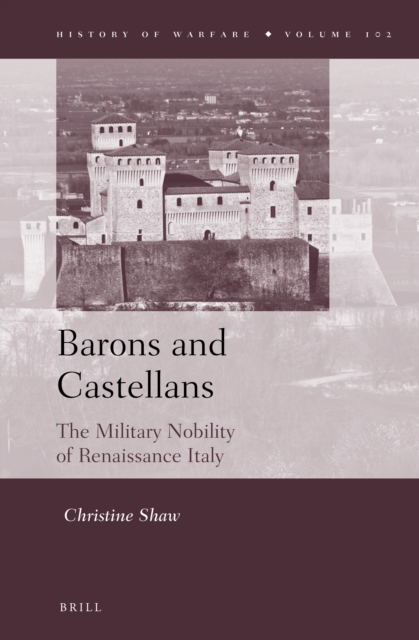
Barons and Castellans
In Barons and Castellans: The Military Nobility of Renaissance Italy, Christine Shaw provides the first comparative study of \"lords of castles\", great and small, throughout Italy, examining their military and political significance, and how their roles changed during the Italian Wars.
eBook

The Cambridge companion to the Italian Renaissance
\"The Renaissance in Italy continues to exercise a powerful hold on the popular imagination and on scholarly enquiry. This Companion presents a lively, interdisciplinary and current approach to the period that extends in Italy from the turn of the fourteenth century through the latter decades of the sixteenth. Addressed to students, scholars and non-specialists, it introduces the richly varied materials and phenomena as well as the different methodologies through which the Renaissance is studied today in both the English-speaking world and in Italy. The chapters are organised around axes of humanism, historiography and cultural production, and cover many areas including literature, science, music, religion, education, technology, artistic production and economics. The diffusion of the Renaissance throughout Italian territories is emphasised. Overall, the Companion provides an essential overview of a period that witnessed both a significant revalidation of the classical past and the development of new, vernacular and increasingly secular values\"-- Provided by publisher.
BOOK

The Humanist Interpretation of Hieroglyphs in the Allegorical Studies of the Renaissance
The Hieroglyphenkunde by Karl Giehlow published in 1915, described variously by critics as \"a masterpiece\", \"magnificent\", \"monumental\" and \"incomparable\", is here translated into English for the first time. Giehlow's work with an initial focus on the Hieroglyphica of Horapollo, the manuscript of which was discovered by Giehlow, was a pioneering attempt to introduce the thesis that Egyptian hieroglyphics had a fundamental influence on the Italian literature of allegory and symbolism and beyond that on the evolution of all Renaissance art. The present edition includes the illustrations of Albrecht Dürer from the Pirckheimer translation of the Horapollo from the early fifteenth century.
eBook

The World of the Italian Renaissance
Originally published in 1982, this book tackles the underlying problem of what is meant by 'the Renaissance' and outlines those social, economic and topographical factors which triggered it off. It covers a number of subjects: the family, war, trade, religion and art.
eBook

Chaucer and Italian Culture
Chaucerian scholarship has long been intrigued by the nature and consequences of Chaucer's exposure to Italian culture during his professional visits to Italy in the 1370s. In this volume, leading scholars take a new and more holistic view of Chaucer's engagement with Italian cultural practice, moving beyond the traditional 'sources and analogues' approach to reveal the varied strands of Italian literature, art, politics and intellectual life that permeate Chaucer's work. Each chapter examines from different angles links between Chaucerian texts and Italian intellectual models, including poetics, chorography, visual art, classicism, diplomacy and prophecy. Echoes of Petrarch, Dante and Boccaccio reverberate throughout the book, across a rich and diverse landscape of Italian cultural legacies. Together, the chapters cover a wide range of theory and reference, while sharing a united understanding of the rich impact of Italian culture on Chaucer's narrative art.
eBook