
Catalogue Search | MBRL


Are you sure you want to remove the book from the shelf?

{{itemTitle}}
7,860
result(s) for
"13th century"
Sort by:


Along the Silk Roads in Mongol Eurasia : generals, merchants, and intellectuals
During the thirteenth and fourteenth centuries, Chinggis Khan and his heirs established the largest contiguous empire in the history of the world, extending from Korea to Hungary and from Iraq, Tibet, and Burma to Siberia. Ruling over roughly two thirds of the Old World, the Mongol Empire enabled people, ideas, and objects to traverse immense geographical and cultural boundaries. Along the Silk Roads in Mongol Eurasia reveals the individual stories of three key groups of people-military commanders, merchants, and intellectuals-from across Eurasia. These annotated biographies bring to the fore a compelling picture of the Mongol Empire from a wide range of historical sources in multiple languages, providing important insights into a period unique for its rapid and far-reaching transformations.
Read together or separately, they offer the perfect starting point for any discussion of the Mongol Empire's impact on China, the Muslim world, and the West and illustrate the scale, diversity, and creativity of the cross-cultural exchange along the continental and maritime Silk Roads.
Features and Benefits:
* Synthesizes historical information from Chinese, Arabic, Persian, and Latin sources that are otherwise inaccessible to English-speaking audiences.
* Presents in an accessible manner individual life stories that serve as a springboard for discussing themes such as military expansion, cross-cultural contacts, migration, conversion, gender, diplomacy, transregional commercial networks, and more.
* Each chapter includes a bibliography to assist students and instructors seeking to further explore the individuals and topics discussed.
* Informative maps, images, and tables throughout the volume supplement each biography.
eBook


Kabbalistic Revolution
The set of Jewish mystical teachings known as Kabbalah are often imagined as timeless texts, teachings that have been passed down through the millennia. Yet, as this groundbreaking new study shows, Kabbalah flourished in a specific time and place, emerging in response to the social prejudices that Jews faced.
Hartley Lachter, a scholar of religion studies, transports us to medieval Spain, a place where anti-Semitic propaganda was on the rise and Jewish political power was on the wane.Kabbalistic Revolutionproposes that, given this context, Kabbalah must be understood as a radically empowering political discourse. While the era's Christian preachers claimed that Jews were blind to the true meaning of scripture and had been abandoned by God, the Kabbalists countered with a doctrine that granted Jews a uniquely privileged relationship with God. Lachter demonstrates how Kabbalah envisioned this increasingly marginalized group at the center of the universe, their mystical practices serving to maintain the harmony of the divine world.
For students of Jewish mysticism,Kabbalistic Revolutionprovides a new approach to the development of medieval Kabbalah. Yet the book's central questions should appeal to anyone with an interest in the relationships between religious discourses, political struggles, and ethnic pride.
eBook

The apple of his eye : converts from islam in the reign of Louis IX
The thirteenth century brought new urgency to Catholic efforts to convert non-Christians, and no Catholic ruler was more dedicated to this undertaking than King Louis IX of France. His military expeditions against Islam are well documented, but there was also a peaceful side to his encounter with the Muslim world, one that has received little attention until now. This splendid book shines new light on the king's program to induce Muslims - the \"apple of his eye\" - to voluntarily convert to Christianity and resettle in France. It recovers a forgotten but important episode in the history of the Crusades while providing a rare window into the fraught experiences of the converts themselves. William Chester Jordan transforms our understanding of medieval Christian-Muslim relations by telling the stories of the Muslims who came to France to live as Christians. Under what circumstances did they willingly convert? How successfully did they assimilate into French society? What forms of resistance did they employ? In examining questions like these, Jordan weaves a richly detailed portrait of a dazzling yet violent age whose lessons still resonate today. Until now, scholars have dismissed historical accounts of the king's peaceful conversion of Muslims as hagiographical and therefore untrustworthy. Jordan takes these narratives seriously--and uncovers archival evidence to back them up. He brings his findings marvelously to life in this succinct and compelling book, setting them in the context of the Seventh Crusade and the universalizing Catholic impulse to convert the world.
Book

Procurators, Priests and Clerics: Male Leadership of the Beguinage of St. Elizabeth of Valenciennes in the Thirteenth and Fourteenth Centuries
This study examines the distinctive male leadership—comprising procurators, parish priests, and chaplains—of the beguinage of St. Elizabeth in Valenciennes during the thirteenth and fourteenth centuries. Contrary to the majority of beguine communities in the southern Low Countries, where leadership appointments were dictated by religious or secular authorities, this community was entitled to elect its male administrators autonomously. The elected were generally influential figures in local religious and secular affairs and maintained a close relationship with the comital family of Hainaut. The analysis will demonstrate how this politically embedded ecclesiastical framework not only ensured doctrinal legitimacy but also mediated conflicts between secular lords and church authorities, thus enabling the community’s survival amid accusations of heresy and institutional repression. By examining the electoral criteria and functional specialization of male leaders, and their interactions with self-governed beguines, this research tries to offer a new perspective on the complex governance strategies of the medieval beguine movement.
Journal Article
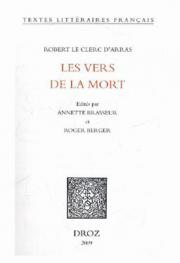
Les vers de la mort
\"Les Vers de la Mort de Robert le Clerc d'Arras ont été trop longtemps occultés par le succès de ceux d'Hélinand de Froidmont. Cette œuvre volumineuse (3744 vers) abordait cependant des sujets très variés, renfermait un vaste répertoire d'images et de comparaisons, souvent originales, et faisait usage d'un vocabulaire exceptionnellement riche. Elle méritait donc d'être enfin mise en valeur. Annette Brasseur et Roger Berger auraient pu se contenter d'éditer ce texte, mais ils ont tenu à en fournir plusieurs clefs d'interprétation par une mise en français moderne, une annotation abondante et un glossaire étendu. Ils ont réussi également à dater ces Vers de manière précise et à retracer, en l'insérant bien dans la société arrageoise du XIIIe siècle, une partie de l'existence du poète. Ils ont aussi démontré qu'il était l'auteur de Li loenge Nostre Dame, un poème jusqu'ici resté anonyme et, comme le précédent, inachevé, Mort n'ayant pas accordé à son chantre, le noble héritier d'Hélinand, le délai qu'il avait si douloureusement sollicité.\"
Book
Bestiary Imagery in Hebrew Manuscripts of the Thirteenth Century
In medieval bestiaries, knowledge about animals and their behavior is regularly given a Christian moral interpretation. This article explores the use of imagery related to the bestiary tradition in three Hebrew books made around the year 1300, focusing especially on the richly decorated Rothschild Pentateuch (Los Angeles, Getty Museum MS 116). These Hebrew books signal how bestiary knowledge and its visual expression could be adapted to enrich the experience of medieval Jewish reader-viewers, adding to our understanding of Jewish-Christian interactions in medieval Europe.
Journal Article


An elemental exploration of the metal contents of an early 13thcentury craft box from Lõhavere, using pXRF
The craft box recovered from a 13thcentury hillfort at Lõhavere, Estonia, contained a wellpreservedselection of copperalloy objects. The limited corrosion on these objects allowed amore accurate estimation of their compositions through nondestructive surface measurements.Using the resulting pXRF database, this study explored a possible correlation between the typesof objects and their material composition. By comparing the most common contaminants withthe alloying metals, a qualitative estimation of the material quality was conducted. The resultsshowed that despite a considerable overlap between object types, the material composition dif feredbased on the items’ appearance and function. A shift from brass to bronze and tinnedobjects coincided with a greater availability of tin at the hillfort, as well as a rise in silver smith ing.Moreover, objects with a silver appearance seemed to be more desirable in this period, apartfrom some highstatus personal ornaments and traditional spiral tube decorations. The resultspossibly reflect different metalworking practices compared to earlier periods and contempo rarysites. Some evidence of recycling is present among the spiral tubes, suggesting that theyoriginated from different raw material sources, possibly removed from obsolete clothing.Alternatively, this could indicate a varying quality of imported copperalloy, including wire,along the Hansa trade routes.
Journal Article