
Catalogue Search | MBRL


Are you sure you want to remove the book from the shelf?

{{itemTitle}}
7,788
result(s) for
"14th century"
Sort by:


The Insight of Unbelievers
In the year 1309, Nicholas of Lyra, an important Franciscan Bible commentator, put forth a question at the University of Paris, asking whether it was possible to prove the advent of Christ from scriptures received by the Jews. This question reflects the challenges he faced as a Christian exegete determined to value Jewish literature during an era of increasing hostility toward Jews in western Europe. Nicholas's literal commentary on the Bible became one of the most widely copied and disseminated of all medieval Bible commentaries. Jewish commentary was, as a result, more widely read in Latin Christendom than ever before, while at the same moment Jews were being pushed farther and farther to the margins of European society. His writings depict Jews as stubborn unbelievers who also held indispensable keys to understanding Christian Scripture. In The Insight of Unbelievers, Deeana Copeland Klepper examines late medieval Christian use of the Hebrew Bible and Jewish interpretation of Scripture, focusing on Nicholas of Lyra as the most important mediator of Hebrew traditions.Klepper highlights the important impact of both Jewish literature and Jewish unbelief on Nicholas of Lyra and on Christian culture more generally. By carefully examining the place of Hebrew and rabbinic traditions in the Christian study of the Bible, The Insight of Unbelievers elaborates in new ways on the relationship between Christian and Jewish scholarship and polemic in late medieval Europe.
eBook

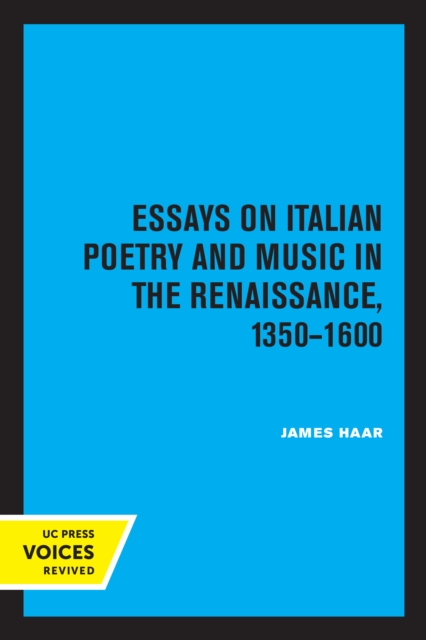
Essays on Italian Poetry and Music in the Renaissance, 1350-1600
These essays illuminate the changing nature of text-music relationships from the time of Petrarch to Guarini and, in music, from the madrigals of Giovanni da Cascia to those of Gesualdo da Venosa. Haar traces a line of development from the stylized rhetoric of Trecento song through the popularizing trends of Quattrocento music and on to the union of verbal and musical cadence that marked the high Renaissance in sixteenth-century Italian music. This title is part of UC Press's Voices Revived program, which commemorates University of California Press's mission to seek out and cultivate the brightest minds and give them voice, reach, and impact. Drawing on a backlist dating to 1893, Voices Revived makes high-quality, peer-reviewed scholarship accessible once again using print-on-demand technology. This title was originally published in 1986.
eBook


Along the Silk Roads in Mongol Eurasia : generals, merchants, and intellectuals
During the thirteenth and fourteenth centuries, Chinggis Khan and his heirs established the largest contiguous empire in the history of the world, extending from Korea to Hungary and from Iraq, Tibet, and Burma to Siberia. Ruling over roughly two thirds of the Old World, the Mongol Empire enabled people, ideas, and objects to traverse immense geographical and cultural boundaries. Along the Silk Roads in Mongol Eurasia reveals the individual stories of three key groups of people-military commanders, merchants, and intellectuals-from across Eurasia. These annotated biographies bring to the fore a compelling picture of the Mongol Empire from a wide range of historical sources in multiple languages, providing important insights into a period unique for its rapid and far-reaching transformations. Read together or separately, they offer the perfect starting point for any discussion of the Mongol Empire's impact on China, the Muslim world, and the West and illustrate the scale, diversity, and creativity of the cross-cultural exchange along the continental and maritime Silk Roads. Features and Benefits: * Synthesizes historical information from Chinese, Arabic, Persian, and Latin sources that are otherwise inaccessible to English-speaking audiences. * Presents in an accessible manner individual life stories that serve as a springboard for discussing themes such as military expansion, cross-cultural contacts, migration, conversion, gender, diplomacy, transregional commercial networks, and more. * Each chapter includes a bibliography to assist students and instructors seeking to further explore the individuals and topics discussed. * Informative maps, images, and tables throughout the volume supplement each biography.
eBook

Sceptred isle : a new history of the fourteenth century
Beginning with the death of Edward I in 1307 and ending with the deposition of Richard II in 1399, 'Sceptred Isle' is the story of a century told through the lives of the last Plantagenets, uncovering lesser-known voices and untold stories along the way. Through the epic drama of regicide, war, the prolonged spectre of the Black Death, religious antagonism, revolt and the end of a royal dynasty, we encounter the human stories behind a fractured monarchy, the birth of the struggle between Europeanism and nationalism, social rebellion and a global pandemic. 'Sceptred Isle' is a thrilling narrative account of a century of revolution, shifting power and great change - social, political and cultural - shedding new light on a pivotal period of English history and the people who lived it.
BOOK

Geç Orta Çağ Avrupa'sında İktidar Mücadelesinde Köylü-Burjuva İşbirliği: Flander Örneği (1297-1328)
Bu çalışmamızda Geç Orta Çaǧ'da Flander'de ortaya çıkan isyanlar zincirini mütalaa etmeyi hedeflemekteyiz. Bunun için Flander bölgesinin erken dönemi, şehirler ve loncalar hakkında kısa bir malumat verdikten sonra isyanların oluşumuna zemin hazırlayan siyasi ve ekonomik etkenler üzerinde duracaǧız. Olayları kronolojik bir şekilde dönem kaynakları ışıǧında ele alırken, bir yandan da muhtelif problemler üzerinde deǧerlendirmelerde bulunacaǧız. Bu problemlerin başında isyanın niteliǧi, Ingiltere-Fransa miinasebetlerinin etkisi ve feodal sistem ile şehirleşme baǧlantısı gelmektedir. Çalışma konumuz aslında XII. - XV. yüzyıllar arasına yayılmakla beraber, daha iyi tahlil yapabilmek için olayların en yoǧun yaşandıǧı ve belirleyici olduǧu XIV. yüzyılın ilk yarısı ile sınırlı tuttuk. Flander'in, İngiltere ve Fransa ile ilişkilerine gerektiǧi kadar girerek konuyu daǧıtmamayı hedefledik. Çalışmamızda varacaǧımız en önemli çıkarım, sözünü ettiǧimiz isyanın bir devrim olmadıǧı yönündedir. Ayrıca olayları, günümüzdeki anlamıyla bir sınıf çatışmasından öte burjuva ve köylülerin kendi iktidar ve ekonomik çıkarlarını muhafaza etmek için birlikte hareket edip, feodal sisteme direnmesi olarak deǧerlendirmekteyiz. Hatta isyanın bir sonucunun da feodal sistemin Fransa'dan kuzeye doǧru ilerlemesinde Flander'in engel olduǧunu ifade edebiliriz. Netice itibariyle bölgedeki ayaklanmaları ne Fransa'daki ne de İngiltere'deki köylü isyanlarıyla mukayese etmememiz gerektiǧi kanaatini taşımaktayız. Olayların gelişimi hakkında malumat verirken mümkün mertebe dönem kaynaklarından istifade etmeye çalıştık. Lakin konuyla ilgili tartışmalarda alanında uzman isimlerden de istifade ettik ki bunların başında, Ortaçaǧ Flander'inden söz edeceǧimiz zaman ilk müracaat edilecek isim Henri Pirenne gelmektedir. Onun yanı sıra David Nicholas, W. Blockmans, William H. TeBrake gibi çok sayıda araştırmacıdan faydalandık.
Journal Article


Reexamining the Murals in the Second-Story Circumambulation Corridor of Shalu Monastery: Political-Religious Imagery and Butön’s Buddhist Vision in 14th-Century Tibetan Art
This study re-examines a previously undocumented mural panel in the second-story circumambulation corridor of Shalu Monastery, Tibet. Challenging conventional dating, it attributes the murals to the expansion under Grags pa rgyal mtshan (1306–1333) rather than a later period. Furthermore, their precise date likely falls after Butön Rinpoche assumed the role of abbort in 1320. The iconographic program, centered on Śākyamuni and Maitreya and flanked by the Thousand Buddhas of the Bhadrakalpa, integrates narratives of the Buddha’s life and Maitreya’s descent. The inclusion of Cakravartin ideology reflects the politico-religious ideology of the Yuan era. The analysis argues that the mural design embodies the Buddhist vision of Butön Rinpoche, synthesizing doctrines of prophecy, the integration of the Thousand Buddhas into the Vajraśekhara Maṇḍala system, kingship, etc., and establishes these murals as an influential early paradigm in Tibetan medieval art.
Journal Article