
Catalogue Search | MBRL


Are you sure you want to remove the book from the shelf?

{{itemTitle}}
1,891
result(s) for
"1707-1754"
Sort by:

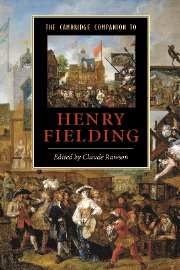
The Cambridge Companion to Henry Fielding
Now best known for three great novels - Tom Jones, Joseph Andrews and Amelia - Henry Fielding (1707–1754) was one of the most controversial figures of his time. Prominent first as a playwright, then as a novelist and political journalist, and finally as a justice of peace, Fielding made a substantial contribution to eighteenth-century culture, and was hugely influential in the development of the novel as a form, both in Britain and more widely in Europe. This collection of specially-commissioned essays by leading scholars describes and analyses the many facets of Fielding's work in theatre, fiction, journalism and politics. In addition it assesses his unique contribution to the rise of the novel as the dominant literary form, the development of the law, and the political and literary culture of eighteenth-century Britain. Including a Chronology and Guide to Further Reading, this volume offers a comprehensive account of Fielding's life and work.
eBook


'Let me look again': The Moral Philosophy and Literature Debate at 40
This article explores the relationship between ethics and literature, particularly as it has been conceived in academic debates since the early 1980s. It offers a reconciliation of the dichotomy between literature and moral philosophy through the concept of bifocality : writing that responds to the moral demands of a lived reality in both a philosophical and literary way. I suggest that bifocal writing is often found in works of testimony. Primo Levi's 1986 work The Drowned and the Saved , a collection of essays on the significance of the Holocaust, is then presented as an arch example.
Journal Article


Talking My Riddels: A Conversation with Dominic Power
Since it's very clear that you have to use the language, I remember the delight when I could actually speak it, and I was able to riff on the language, and that was just wonderful. Because if you trust the book, it just takes you there. [...]my biggest challenge was getting it in on time, and getting it inside two hours, which I failed. [...]I felt that the book was taking me along with it, and that gives you a strange sense of enormous confidence. Because they read fine if you do it right, and the language is so good in creating this fragmented world.
Journal Article

John Forbes : Scotland, Flanders and the Seven Years' War, 1707-1759
\"In November 1758 Brigadier General John Forbes's army expelled the French army from Fort Duquesne at the forks of the Ohio River. Over seven months Forbes had co-ordinated three obstructive and competitive colonies, managed Indian diplomacy, and cut a road through over a hundred miles of mountain and forest. This is the first full biography of Forbes, which traces his rise from surgeon in the Scots Greys to distinguished service in War of the Austrian Succession before his 1757 posting to North America. John Oliphant puts Forbes' life and career in the wider context of the social and military world of the 18th century and offers important insights into the Seven Years' War in North America\"--From publisher's website.
Book

Escaping Type: Nonreferential Character and the Narrative Work of Henry Fielding's Tom Jones
In Escaping Type: Nonreferential Character and the Narrative Work of Henry Fielding's Tom Jones, Urda sees Fielding pushing against the limits of type in his representation of Tom Jones, a moment in the development of fictionality from Catherine Gallagher's influential perspective. She reminds us that Fielding is an important exception to progressive histories of the novel, here working against traditional type to create a more \"individuated\" Tom, but without rendering the interiority Gallagher associates with fictiveness and individuation. Fielding does not present especially particularized individuals, but he does test the limits of type.
Journal Article
“That Little Insignificant Fellow, Tom Thumb”: Henry Fielding’s Early Burlesque and the Origins of Jane Austen’s Style
Margaret Anne Doody argues that both Tom Jonesand an earlier Fielding novel, Joseph Andrews, “are in an immediate relation to ‘Henry and Eliza,’ which picks up a number of plot points and thematic developments from them (not excluding Fielding’s own brand of irony)” (xxix). Whether the diminutive hero was undertaken by Jane, her younger brother Charles, one of George Austen’s younger pupils, or someone else, Jane Austen was evidently impressed enough by Fielding’s script and immersed enough in its language to fill the pages of Volume the First with exuberant and outrageous works that not only show how congenial she must have found Fielding’s burlesque style but also recall Fielding’s Tom Thumb in several particulars, including place names, plot elements, characters, and rhetorical strategies. In the eighteenth century, as Dr. Johnson tells us, burlesque referred to a type of satire that ridicules its targets in a “Jocular” manner, “tending to raise laughter” by means of “unnatural or unsuitable language or images.” A more recent definition of literary burlesque specifies that it achieves comic incongruity either by treating a serious subject in a nonserious manner or by treating a trivial subject in a serious manner, either way mixing high with low (Abrams and Harpham 37). Yet in Austen’s early novels we are just as likely to find her treating serious matters with unserious language, as in this comic epitaph in “Frederic and Eliza” for Charlotte Drummond, who commits suicide when she realizes that she has agreed to marry two different men:
Journal Article

Past as Prologue: 'Dickens v. Dickens' in Chancery
In 1934, the widow of Sir Henry Fielding Dickens filed a complaint with the Court of Chancery to defend her right to keep some 40,000 pounds (roughly 2,400.000 today) from the sale of The Life of Our Lord , an unpublished Dickens manuscript inherited by her late husband. Her niece, Ethel Dickens, disputed Lady Dickens's claim. Ethel contended that because Dickens's Will consigned copyright benefits to the Charles Dickens Family Trust, the proceeds from the sale belonged not only to Lady Dickens but to all the author's heirs. The case, which took up a full year of the court calendar, was marked by acrimony on both sides of the dispute, only to conclude, as a close examination of the primary documents supports (and the author of Bleak House seems to have foreseen), with neither side having won.
Journal Article