
Catalogue Search | MBRL


Are you sure you want to remove the book from the shelf?

{{itemTitle}}
5,471
result(s) for
"1723-1790"
Sort by:

Adam Smith, Radical and Egalitarian
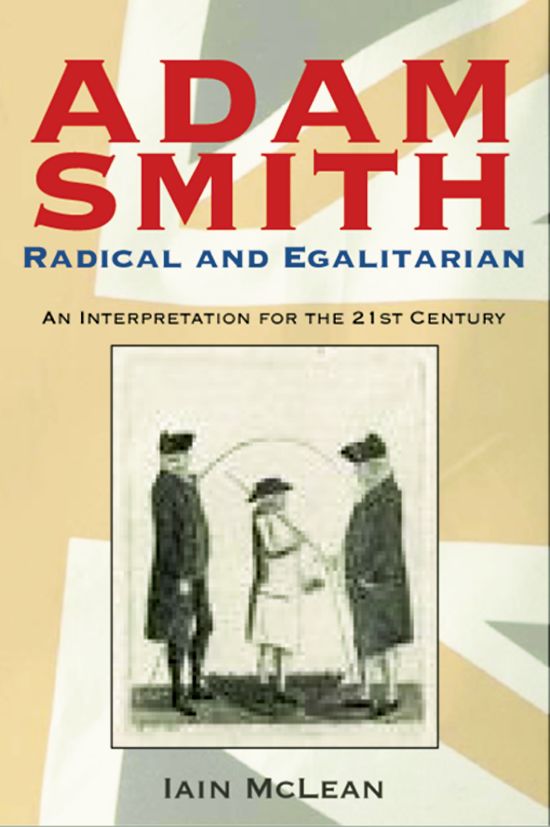
Foreword by the Rt. Hon. Gordon Brown, Chancellor of the ExchequerThis book aims to show that Adam Smith (1723-90), the author of The Wealth of Nations, was not the promoter of ruthless laissez-faire capitalism that is still frequently depicted. Smith’s “right-wing” reputation was sealed after his death when it was not safe to claim that an author may have influenced the French revolutionaries. But as the author, also, of The Theory of Moral Sentiments, which he probably regarded as his more important book, Smith sought a non-religious grounding for morals, and found it in the principle of sympathy, which should lead an impartial spectator to understand others’ problems. This book locates Smith in the Scottish Enlightenment; shows how the two books are perfectly consistent with one another; traces Smith’s influence in France and the United States; and draws out the lessons that Adam Smith can teach policy makers in the 21st Century. Although Smith was not a religious man, he was a very acute sociologist of religion. The book accordingly explains the Scottish religious context of Smith’s time, which was, as it remains, very different to the English religious context.The whole book is shot through with Iain McLean’s love for the Edinburgh of his birth, and for the Scottish Enlightenment. It begins and ends with poems by Smith’s great admirer Robert Burns.
eBook


Adam Smith : systematic philosopher and public thinker
This book treats Adam Smith as a systematic philosopher. Smith was a giant of the Scottish Enlightenment with polymath interests. The book explores Smith’s economics and ethics in light of his other commitments on the nature of knowledge, the theory of emotions, the theory of mind, his account of language, the nature of causation, and his views on methodology. It places Smith’s ideas in the context of a host of other philosophers, especially David Hume, Rousseau, and Isaac Newton; it draws on the reception of Smith’s ideas by Sophie de Grouchy, Mary Wollstonecraft, and other philosophers and economists to sketch the elements of and the detailed connections within Smith’s system. The book traces out Smith’s system and puts it in the context of his highly developed views on the norms that govern responsible speech. In particular, the book articulates Smith’s concerns with the impact of his public policy recommendations, especially on the least powerful in society. In so doing, the book offers new interpretations of Smith’s views on the invisible hand, Wealth of Nations, his treatment of virtue, the nature of freedom, the individual’s relationship to society, his account of the passions, the moral roles of religion, and his treatment of the role of mathematics in economics. While the book offers a single argument, it is organized in modular fashion and includes a helpful index; readers with a more focused interest in Smith’s achievements can skip ahead to the section of interest.
eBook


On Adam Smith's Wealth of Nations
Adam Smith was a philosopher before he ever wrote about economics, yet until now there has never been a philosophical commentary on the Wealth of Nations. Samuel Fleischacker suggests that Smith's vastly influential treatise on economics can be better understood if placed in the light of his epistemology, philosophy of science, and moral theory. He lays out the relevance of these aspects of Smith's thought to specific themes in the Wealth of Nations, arguing, among other things, that Smith regards social science as an extension of common sense rather than as a discipline to be approached mathematically, that he has moral as well as pragmatic reasons for approving of capitalism, and that he has an unusually strong belief in human equality that leads him to anticipate, if not quite endorse, the modern doctrine of distributive justice.
eBook

Adam Smith : a very short introduction
\"In 1776 Adam Smith (1723-90) wrote 'The Wealth of Nations', a book so foundational it has led to him being called the 'father of economics'. Today he is associated with the promotion of self-interest, a defence of greed and a criticism of any governmental 'interference' in market transactions which, if left to the 'invisible hand', will produce prosperity and liberty. Yet if Smith is actually read these associations are more a caricature than a faithful portrait. In this 'Very Short Introduction', Christopher Berry offers a balanced and nuanced view of this seminal thinker, embedding his fierce defence of free trade, competition, and assault on special interests in contemporary European history, politics, and philosophy. As Berry explores, Smith was far more than an economist. His book 'The Theory of Moral Sentiment', offered a complex account of ethics in the context of human social behavior. His scope as a professor at the University of Glasgow, a major center of the Scottish Enlightenment, was extensive. Beyond courses in philosophy and jurisprudence he also gave classes covering history, literature, and language. In addition to his two major works he also wrote a pioneering study of the history of astronomy as an illustration of the motivations that drive humans to seek answers to questions\"-- Provided by publisher.
Book

Erasing the Invisible Hand
This book examines the use, principally in economics, of the concept of the invisible hand, centering on Adam Smith. It interprets the concept as ideology, knowledge, and a linguistic phenomenon. It shows how the principal Chicago School interpretation misperceives and distorts what Smith believed on the economic role of government. The essays further show how Smith was silent as to his intended meaning, using the term to set minds at rest; how the claim that the invisible hand is the foundational concept of economics is repudiated by numerous leading economic theorists; that several dozen identities given the invisible hand renders the term ambiguous and inconclusive; that no such thing as an invisible hand exists; and that calling something an invisible hand adds nothing to knowledge. Finally, the essays show that the leading doctrines purporting to claim an invisible hand for the case for capitalism cannot invoke the term but that other nonnormative invisible hand processes are still useful tools.
eBook


The Roman Predicament
Modern America owes the Roman Empire for more than gladiator movies and the architecture of the nation's Capitol. It can also thank the ancient republic for some helpful lessons in globalization. So argues economic historian Harold James in this masterful work of intellectual history.
The book addresses what James terms \"the Roman dilemma\"--the paradoxical notion that while global society depends on a system of rules for building peace and prosperity, this system inevitably leads to domestic clashes, international rivalry, and even wars. As it did in ancient Rome, James argues, a rule-based world order eventually subverts and destroys itself, creating the need for imperial action. The result is a continuous fluctuation between pacification and the breakdown of domestic order.
James summons this argument, first put forth more than two centuries ago in Adam Smith'sWealth of Nationsand Edward Gibbon'sDecline and Fall of the Roman Empire, to put current events into perspective. The world now finds itself staggering between a set of internationally negotiated trading rules and exchange--rate regimes, and the enforcement practiced by a sometimes-imperial America. These two forces--liberal international order and empire--will one day feed on each other to create a shakeup in global relations, James predicts. To reinforce his point, he invokes the familiarbon motonce applied to the British Empire:\"When Britain could not rule the waves, it waived the rules.\"
Despite the pessimistic prognostications of Smith and Gibbon, who saw no way out of this dilemma, James ends his book on a less depressing note. He includes a chapter on one possible way in which the world could resolve the Roman Predicament--by opting for a global system based on values as opposed to rules.
eBook