
Catalogue Search | MBRL


Are you sure you want to remove the book from the shelf?

{{itemTitle}}
3,484
result(s) for
"1743-1826"
Sort by:


Jefferson on Display
By attending closely to Jefferson's controversial clothing choices and physical appearance, as well as to his use of portraiture, architecture, and the polite refinements of dining, grooming, and conversation, Wilson shows in fascinating detail how Jefferson's self-presentation served his political agenda.
When we think of Thomas Jefferson, a certain picture comes to mind for some of us, combining his physical appearance with our perception of his character. During Jefferson's lifetime this image was already taking shape, helped along by his own assiduous cultivation. InJefferson on Display,G. S. Wilson draws on a broad array of sources to show how Jefferson fashioned his public persona to promote his political agenda. During his long career, his image shifted from cosmopolitan intellectual to man of the people. As president he kept friends and foes guessing: he might appear unpredictably in old, worn, and out-of-date clothing with hair unkempt, yet he could as easily play the polished gentleman in a black suit, as he hosted small dinners in the President's House that were noted for their French-inspired food and fine European wines. Even in retirement his image continued to evolve, as guests at Monticello reported being met by the Sage clothed in rough fabrics that he proudly claimed were created from his own merino sheep, leading Americans by example to manufacture their own clothing, free of Europe.
By paying close attention to Jefferson's controversial clothing choices and physical appearance--as well as his use of portraiture, architecture, and the polite refinements of dining, grooming, and conversation--Wilson provides invaluable new insight into this perplexing founder.
eBook

\Most blessed of the patriarchs\ : Thomas Jefferson and the empire of the imagination
Presents a history that explicates Thomas Jefferson's vision of himself, the American Revolution, Christianity, slavery, and race.
BOOK

Jefferson's call for nationhood : the first inaugural address
Widely celebrated in its own time, Thomas Jefferson's first inaugural address has been hailed as the Sermon on the Mount of good government. Curiously, this masterpiece-the full text of which is reproduced in this volume-has never received sustained analysis. Here, Browne describes its origins, composition, meaning, and delivery, offering a model of analysis for rhetorical scholars.
eBook

The cavernous mind of Thomas Jefferson, an American savant
While every biographer has something to say concerning Thomas Jefferson's cavernous mind - his varied interests and the depth of his understanding of them - there has never been, strange as it might seem, a non-anthology dedicated to fleshing out key features of his mind, exploring Jefferson's varied interests through his varied personae. This book does just that, studying Jefferson as lawyer, moralist, politician, scientist, epistolist, aesthetician, farmer, educationalist, and philologist.
BOOK
Thomas Jefferson and the Development of American Public Education
This title is part of UC Press's Voices Revived program, which commemorates University of California Press's mission to seek out and cultivate the brightest minds and give them voice, reach, and impact. Drawing on a backlist dating to 1893, Voices Revived makes high-quality, peer-reviewed scholarship accessible once again using print-on-demand technology. This title was originally published in 1962.
eBook

Thomas Jefferson grows a nation
Examines the life and career of Thomas Jefferson, who in addition to his acccomplishments as a politician and president was also talented in the field of agriculture.
BOOK
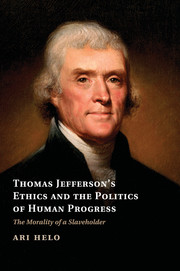
Thomas Jefferson's Ethics and the Politics of Human Progress
Could Jefferson claim any consistency in his advocacy of democracy and the rights of man while remaining one of the largest slaveholders in Virginia? This extensive study of Jefferson's intellectual outlook suggests that, once we fully acknowledge the premises of his ethical thought and his now outdated scientific views, he could. Jefferson famously thought the human mind to be 'susceptible of much improvement … most of all, in matters of government and religion'. Ari Helo's thorough analysis of Jefferson's understanding of Christian morality, atheism, contemporary theories of moral sentiments, ancient virtue ethics, natural rights, and the principles of justice and benevolence suggests that Jefferson refused to be a philosopher, and did so for moral reasons. This book finds Jefferson profoundly political in his understanding of individual moral responsibility and human progress.
eBook

How Should America Remember Thomas Jefferson?, in Economist Video
Thomas Jefferson was a political figure that personifies contradictions. He proclaimed equality, but owned slaves, voiced racist beliefs, and supported policies that preserved systemic slavery. As we celebrate America’s 250th birthday, how we choose to remember Thomas Jefferson speaks to our nation’s comfort level in confronting the history of our founding fathers.
Streaming Video