
Catalogue Search | MBRL


Are you sure you want to remove the book from the shelf?

{{itemTitle}}
97,978
result(s) for
"1800"
Sort by:

Subtle insights concerning knowledge and practice = Kalimهat wajهiza mushtamila 'alهa nukat laٍtهifa fهi al-'ilm wa-l-'amal
Surprisingly modern essays on the unity of all monotheistic regimens by a medieval philosopher. Written in the mid-thirteenth century for the newly appointed governor of Isfahan, this compact treatise and philosophical guidebook includes a wide-ranging and accessible set of essays on ethics, psychology, political philosophy, and the unity of God. Ibn Kammuna,a Jewish scholar writing in Baghdad during a time of Mongol occupation, was a controversial figure whose writings sometimes incited riots. He argued, among other things, the commonality of all monotheisms, both prophetic and philosophical. Here, for the first time in English, is a surprisingly modern work on the unity of all monotheistic regimes from a key medieval philosopher.
Book

Reorienting the East
Reorienting the Eastexplores the Islamic world as it was encountered, envisioned, and elaborated by Jewish travelers from the Middle Ages to the early modern period. The first comprehensive investigation of Jewish travel writing from this era, this study engages with questions raised by postcolonial studies and contributes to the debate over the nature and history of Orientalism as defined by Edward Said.
Examining two dozen Hebrew and Judeo-Arabic travel accounts from the mid-twelfth to the early sixteenth centuries, Martin Jacobs asks whether Jewish travelers shared Western perceptions of the Islamic world with their Christian counterparts. Most Jews who detailed their journeys during this period hailed from Christian lands and many sailed to the Eastern Mediterranean aboard Christian-owned vessels. Yet Jacobs finds that their descriptions of the Near East subvert or reorient a decidedly Christian vision of the region. The accounts from the crusader era, in particular, are often critical of the Christian church and present glowing portraits of Muslim-Jewish relations. By contrast, some of the later travelers discussed in the book express condescending attitudes toward Islam, Muslims, and Near Eastern Jews. Placing shifting perspectives on the Muslim world in their historical, social, and literary contexts, Jacobs interprets these texts as mirrors of changing Jewish self-perceptions. As he argues, the travel accounts echo the various ways in which premodern Jews negotiated their mingled identities, which were neither exclusively Western nor entirely Eastern.
eBook
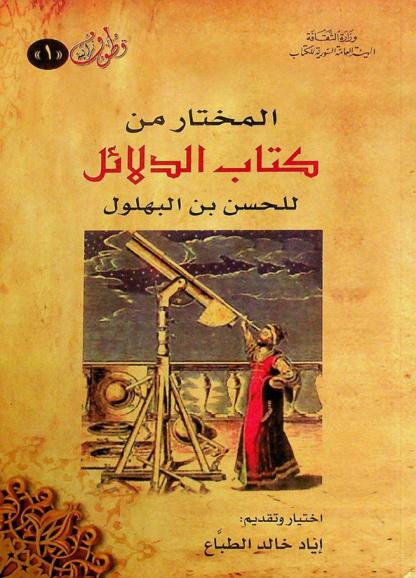
المختار من كتاب الدلائل
يعنى الكتاب بعلم الآثار العلوية، والوقاية من السموم، والفراسة، والاكتناه، والأشهر ودلائلها، ويضم دلائل العلوم الطبيعية والحيوية والطبية والفلكية والعلوم الإنسانية، وما يتبع ذلك من توثيق مقارن لحضارات الشعوب، وعاداتها الاجتماعية، كالأعياد ومواسمها. فهو بحق موسوعة حضارية علمية. والغاية من نشر هذا الاختيار هو تعريف القارئ والمثقف العربي بجانب مغمور من تراثنا العلمي، يفيد بالاطلاع على جانب مهم من جوانب الثقافة العربية، وتاريخ العلوم عند العرب.
Book

Picturing experience in the early printed book : Breydenbach's Peregrinatio from Venice to Jerusalem
Bernhard von Breydenbach's Peregrinatio in terram sanctam (Journey to the Holy Land), first published in 1486, is one of the seminal books of early printing and is especially renowned for the originality of its woodcuts. In Picturing Experience in the Early Printed Book, Elizabeth Ross considers the Peregrinatio from a variety of perspectives to explain its value for the cultural history of the period. Breydenbach, a high-ranking cleric in Mainz, recruited the painter Erhard Reuwich of Utrecht for a religious and artistic adventure in a political hot spot—a pilgrimage to research the peoples, places, plants, and animals of the Levant. The book they published after their return ambitiously engaged with the potential of the new print medium to give an account of their experience.
The Peregrinatio also aspired to rouse readers to a new crusade against Islam by depicting a contest in the Mediterranean between the Christian bastion of the city of Venice and the region's Muslim empires. This crusading rhetoric fit neatly with the state of the printing industry in Mainz, which largely subsisted as a tool for bishops' consolidation of authority, including selling the pope's plans to combat the Ottoman Empire.
Taking an artist on such an enterprise was unprecedented. Reuwich set a new benchmark for technical achievement with his woodcuts, notably a panorama of Venice that folds out to 1.62 meters in length and a foldout map that stretches from Damascus to Sudan around the first topographically accurate view of Jerusalem. The conception and execution of the Peregrinatio show how and why early printed books constructed new means of visual representation from existing ones—and how the form of a printed book emerged out of the interaction of eyewitness experience and medieval scholarship, real travel and spiritual pilgrimage, curiosity and fixed belief, texts and images.
eBook

Praxagoras of Cos on arteries, pulse and pneuma : fragments and interpretation
This study offers an edition and fresh analysis of the fragmentary evidence for the views of Praxagoras of Cos (4th-3rd c. BC) on arteries, pulsation and pneuma. It presents the relevant fragments and draws new conclusions on Praxagoras' views and sources.
eBook


An Ottoman cosmography : translation of Cihānnümā
Cihannüma is the summa of Ottoman geography and one of the axial texts of Islamic intellectual history. Katib Çelebi (d. 1657) sought to combine the Islamic geographical tradition with the new European discoveries, atlases and surveys. His cosmography included a comprehensive description of the regions of the world, extending westward from Japan and as far as the eastern Ottoman provinces. Ebu Bekr b. Behram ed-Dimaski (d. 1691) continued with a survey of the Arab countries and the remaining Ottoman provinces of Anatolia. Ibrahim Müteferrika combined the two, with additional notes and maps of his own, in one of the earliest Ottoman printed books, Kitab-i Cihannüma (1732). Our translation includes the entire text of MuÞteferrik?a's edition, distinguishing clearly between the contributions of the three authors. Based on Katib Çelebi's original manuscript we have made hundreds of corrections to Müteferrika's text. Additional corrections are based on comparison with Katib Çelebi's Arabic, Persian, Turkish, Latin and Italian sources.
eBook
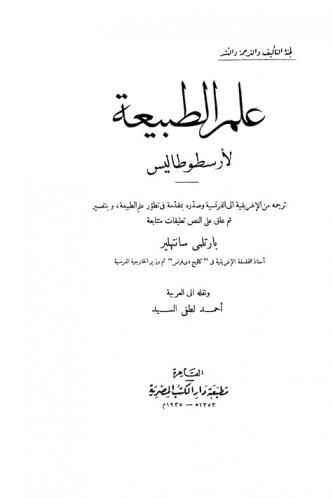
علم الطبيعة
يتناول كتاب (علم الطبيعة) والذي قام بتأليفه (أرسطوطاليس) في حوالي (441) صفحة من القطع المتوسط موضوع (علم الطبيعة) مستعرضا المحتويات التالية : مقدمة بارتلمي سانتهلير لكتاب الطبيعة لأرسطو، تفسير بارتلمي سانتهلير لكتاب الطبيعة لأرسطو وفيه مبادئ الوجود في عشرة أبواب، في الطبيعة في تسعة أبواب، حد الحركة اللا متناهي في اثنا عشر بابا، في المكان وفي الخلو وفي الزمان في عشرون بابا، في الحركة في تسعة أبواب، قابلية الحركة للتجزئة في ستة عشر بابا، نظرية الحركة في ستة أبواب، أبجدية الحركة في خمسة عشرة بابا.
RAREBOOK

Hugo Grotius on the law of war and peace
Despite its significant influence on international law, international relations, natural law and political thought in general, Grotius's Law of War and Peace has been virtually unavailable for many decades. Stephen Neff's edited and annotated version of the text rectifies this situation. Containing the substantive portion of the classic text, but shorn of extraneous material, this edited and annotated edition of one of the classic works of Western legal and political thought is intended for students and teachers in four primary areas: history of international law, history of political thought, history of international relations and history of philosophy.
eBook