
Catalogue Search | MBRL


Are you sure you want to remove the book from the shelf?

{{itemTitle}}
4,845
result(s) for
"1816-1855"
Sort by:


Charlotte Brontë : the imagination in history
This study of Charlotte Brontë's novels draws on original research in a range of early Victorian writings, on subjects ranging from women's day-dreaming to sanitary reform, from the Great Exhibition to early Victorian religious thought. It is not, however, merely a study of context. Through a close consideration of the ways in which Brontë's novels engage with the thinking of their time, it offers a powerful argument for the ‘literary’ as a distinctive mode of intelligence, and reveals a Charlotte Brontë more alert to her historical moment and far more aesthetically sophisticated than she has usually been taken to be.
eBook

The invention of Charlotte Brontë : a new life
\"A ground-breaking biography that uncovers the truth behind the myths to reveal the Brontës as they've never been seen before. As the beloved author of Jane Eyre, Charlotte Brontë is one of the most radical talents of the 19th century. And one of the most mysterious. Her early death left her friends and the public demanding answers. Tasked with telling the story of her tragic life, fellow writer Elizabeth Gaskell investigated, uncovering secrets of family discord, illicit love, and professional rivalries more incredible than any fiction. Determined to deliver not only justice, but revenge on Brontë's behalf, Gaskell slandered those who'd mistreated her in a book so controversial it was banned within weeks - but not before it had given birth to the romantic myth of the Brontës. Ever since, historians have argued about how much of it is true. Here, for the first time ever, is the full story. Based entirely on first-hand accounts and rarely seen private letters, this riveting biography debunks the myths to shed new light on dramatic events of Brontë's last years of grief, fulfilment, and tragedy - uncovering the shocking media scandal that followed her death, as her friends and family battled to control how history would remember her\" -- Publisher's description from dust jacket.
BOOK

Bluebeard Gothic
Using psychoanalysis as the primary model of textual analysis,Bluebeard Gothicfocuses on the conjunction of religion, sacrifice, and scapegoating to provide an original interpretation of a canonical and frequently-studied text.
eBook


Family Likeness
In nineteenth-century England, marriage between first cousins was both legally permitted and perfectly acceptable. After mid-century, laws did not explicitly penalize sexual relationships between parents and children, between siblings, or between grandparents and grandchildren. But for a widower to marry his deceased wife's sister was illegal on the grounds that it constituted incest. That these laws and the mores they reflect strike us today as wrongheaded indicates how much ideas about kinship, marriage, and incest have changed.
InFamily Likeness, Mary Jean Corbett shows how the domestic fiction of novelists including Jane Austen, Charlotte Brontë, George Eliot, Elizabeth Gaskell, and Virginia Woolf reflected the shifting boundaries of \"family\" and even helped refine those borders. Corbett takes up historically contingent and culturally variable notions of who is and is not a relative and whom one can and cannot marry. Her argument is informed by legal and political debates; texts in sociology and anthropology; and discussions on the biology of heredity, breeding, and eugenics. In Corbett's view, marriage within families-between cousins, in-laws, or adoptees-offered Victorian women, both real and fictional, an attractive alternative to romance with a stranger, not least because it allowed them to maintain and strengthen relations with other women within the family.
eBook
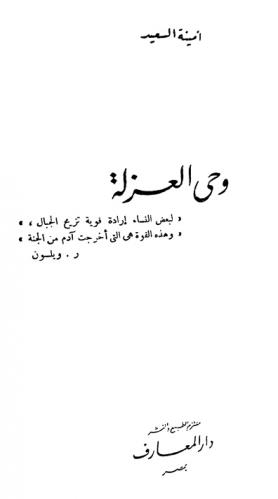
وحي العزلة
في هذا الكتاب قصة أليمة لأسرة موهوبة، عاش أفرادها منذ الطفولة في عزلة ووحشة، وحرموا نصيبهم من السعادة والرعاية والثقافة، ومع ذلك هبط الوحى واقتحم عليهم عزلتهم فاستجابوا لنداء العبقرية، وقدموا إلى الأدب الإنجليزي دررا ستظل أبد الدهر خالدة، طفولة باكية، شباب قصير حزين، أدب رفيع، مجد لم يطرب أصحابه، نهاية مفجعة محزنة، هكذا تتلخص حياة تشارلوت برونتى وإخوتها.
RAREBOOK

Victoriana
In this book Cora Kaplan looks at the politics of ‘Victoriana’ from the 1970s to the present, a politics that emerges from the alternation between nostalgia and critique in fiction, film, biography and literary studies. She asks how Jane Eyre can still evoke tears and rage, as well as inspiring imitation and high art, and why Henry James has become fiction’s favourite late Victorian character in the new millennium?
eBook

Jane, the fox & me
Hâelلene is an outcast in her grade. Her only consolation is reading Jane Eyre. Even seeing a lovely fox doesn't make her feel better, but maybe a new friendship will.
Book

A breath of fresh Eyre : intertextual and intermedial reworkings of Jane Eyre
Ever since its publication in 1847 Jane Eyre - one of the most popular English novels of all time - has fascinated scholars and a wide reading public alike and has proved a source of inspiration to successive generations of creative writers and artists. There is hardly any other hypotext that has been re-worked in so many adaptations for stage and screen, has inspired so many painters and musicians, and has been so often imitated, re-written, parodied or extended by prequels and sequels. New versions in turn refer to and revise older rewritings or take up suggestions from Brontë scholarship, creating a dense intertextual web. The essays collected in this volume do justice to the variety of media involved in the Jane Eyre reworkings, by covering narrative, visual and stage adaptations, including an adaptor's perspective. Contributions review a diverse range of works, from postcolonial revision to postmodern fantasy, from imaginary after-lives to science fiction, from plays and Hollywood movies to opera, from lithographs and illustrated editions to comics and graphic novels. The volume thus offers a comprehensive collection of reworkings that also takes into account recent novels, plays and works of art that were published after Patsy Stoneman's seminal 1996 study on Brontë Transformations.
eBook