
Catalogue Search | MBRL


Are you sure you want to remove the book from the shelf?

{{itemTitle}}
12,603
result(s) for
"1819-1892"
Sort by:


New World Poetics
A simultaneously ecocritical and comparative study, New World Poetics plumbs the earthly depth and social breadth of the poetry of Walt Whitman, Pablo Neruda, and Derek Walcott, three of the Americas' most ambitious and epic-minded poets. In Whitman's call for a poetry of New World possibility, Neruda's invocation of an \"American love,\" and Walcott's investment in the poetic ironies of an American epic, the adamic imagination of their poetry does not reinvent the mythical Garden that stands before history's beginnings but instead taps the foundational powers of language before a natural world deeply imbued with the traces of human time. Theirs is a postlapsarian Adam seeking a renewed sense of place in a biocentric and cross-cultural New World through language and nature's capacity for regeneration in the wake of human violence and suffering. The book introduces the environmental history of the Americas and its relationship to the foundation of American and Latin American studies, explores its relevance to each poet's ambition to recuperate the New World's lost histories, and provides a transnational poetics of understanding literary influence and textual simultaneity in the Americas. The study provides much needed in-depth ecocritical readings of the major poems of the three poets, insisting on the need for thoughtful regard for the challenge to human imagination and culture posed by nature's regenerative powers; nuanced appreciation for the difficulty of balancing the demands of social justice within the context of deep time; and the symptomatic dangers as well as healing potential of human self-consciousness in light of global environmental degradation.
eBook

Comrade Whitman : from Russian to internationalist icon
\"The reception of the American poet Walt Whitman has been a global phenomenon. It is central to the history of modern poetry, but it goes beyond literary stakes: Whitman's proclaimed heirs often saw him as a prophet of a new world. This book focuses on the Russian and Soviet uses of the poet, showing how they contributed to his transformation into a revolutionary and communist icon, especially in the US and in Latin America. It illuminates circuitous routes of translations and interpretations between the Soviet Union, Europe and the Americas. It covers a vast linguistic scope, including Yiddish and various languages of the Russian and Soviet empires\"-- Provided by publisher.
BOOK

Writing revolution : aesthetics and politics in Hawthorne, Whitman, and Thoreau
In recent years, formalist and deconstructive approaches to literary studies have been under attack, charged by critics with isolating texts as distinctive aesthetic or linguistic objects, separate from their social and historical contexts. Historicist and cultural approaches have often responded by simply reversing the picture, reducing texts to no more than superstructural effects of historical or ideological forces. In Writing Revolution , Peter J. Bellis explores the ways in which literature can engage with—rather than escape from or obscure—social and political issues.
Bellis argues that a number of nineteenth-century American writers, including Nathaniel Hawthorne, Henry David Thoreau, and Walt Whitman, saw their texts as spaces where alternative social and cultural possibilities could be suggested and explored. All writing in the same historical moment, Bellis's subjects were responding to the same cluster of issues: the need to redefine American identity after the Revolution, the problem of race slavery, and the growing industrialization of American society.
Hawthorne, Bellis contends, sees the romance as "neutral territory" where the Imaginary and the Actual—the aesthetic and the historical—can interpenetrate and address crucial issues of class, race, and technological modernity. Whitman conceives of Leaves of Grass as a transformative democratic space where all forms of meditation, both political and literary, are swept away. Thoreau oscillates between these two approaches. Walden , like the romance, aims to fashion a mediating space between nature and society. His abolitionist essays, however, shift sharply away from both linguistic representation and the political, toward an apocalyptic cleansing violence.
In addition to covering selected works by Hawthorne, Whitman, and Thoreau, Bellis also examines powerful works of social and political critique by Louisa May Alcott and Margaret Fuller. With its suggestions for new ways of reading antebellum American writing, Writing Revolution breaks through the thickets of contemporary literary discourse and will spark debate in the literary community.
eBook
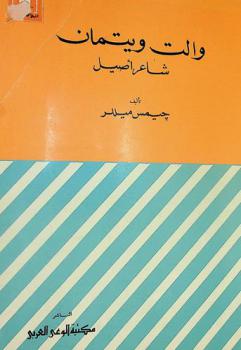
والت ويتمان : شاعر أصيل
يهدف هذا الكتاب إلى تزويد القارئ بأكبر عدد ممكن من المداخل إلى شعر \"ويتمان\" فكل صفحة تمثل طريقة للبداية.. فقد عرض المؤلف (جيمس ميللر) أولا \"ويتمان\" الإنسان في مجموعة من الرسوم تكشف عن الأدوار المتنوعة التي أداها والصور التي عكسها. وباقي الكتاب يتركز على ما كتبه \"ويتمان\". الفصل الثاني يبين كيف نمت «الأوراق» خلال تسع طبعات صدرت في حياة «ويتمان»، والفصل الثالث يظهر كيف تمت أعماله النثرية العديدة وحددت أصول شعر جديد للعالم الجديد. والفصول التالية تتناول عددا متنوعا من وجوه الأوراق : تركيبها الملحمي الأخير، قصائده الفردية العظمى، صورها المستعادة، خطئتها وحكمتها، ويلخص الفصل الأخير الصفة المتميزة لعبقرية «ويتمان» كما يمكن أن نستشفها من الصوت الغنائي للأوراق : ويحقق الكتاب المقصد منه حين يعود القارئ إلى شعر \"ويتمان\" بشهية أعظم وتأمل أعمق.
Book

Walt Whitman's Mystical Ethics of Comradeship
A giant of American letters, Walt Whitman is known both as a poet and, to a lesser extent, as a prophet of gay liberation. This revealing book recovers for today's reader a lost Whitman, delving into the original context and intentions of his poetry and prose. As Juan A. Herrero Brasas shows, Whitman saw himself as a founder of a new religion. Indeed, disciples gathered around him: the \"hot little prophets\" as they came to be called by early biographers.
Whitman's religion revolved around his concept of comradeship, an original alternative to the type of competitive masculinity emerging in the wake of industrialization and nineteenth-century capitalism. Shedding new light on the life and original message of a poet who warned future generation of treating him as a literary figure, Herrero Brasas concludes that Whitman was a moral reformer and grand theorist akin to other grand theorists of his day.
eBook


Walt Whitman in context
\"Walt Whitman is a poet of contexts. His poetic practice was one of observing, absorbing, and then reflecting the world around him. Walt Whitman in Context provides brief, provocative explorations of thirty-eight different contexts - geographic, literary, cultural, and political - through which to engage Whitman's life and work. Written by distinguished scholars of Whitman and nineteenth-century American literature and culture, this collection synthesizes scholarly and historical sources and brings together new readings and original research\"-- Provided by publisher.
Book

The List
\"I am no more lonely than the Mill Brook, or a weathercock, or the north star, or the south wind, or an April shower, or a January thaw, or the first spider in a new house,\" wrote Henry David Thoreau inWalden.In creating this list, and many others that appear in his writings, Thoreau was working within a little-recognized yet ancient literary tradition: the practice of listing or cataloguing. This beautifully written book is the first to examine literary lists and the remarkably wide range of ways writers use them.Robert Belknap first examines lists through the centuries-from Sumerian account tablets and Homer's catalogue of ships to Tom Sawyer's earnings from his fence-painting scheme-then focuses on lists in the works of four American Renaissance authors: Emerson, Whitman, Melville, and Thoreau. Lists serve a variety of functions in Emerson's essays, Whitman's poems, Melville's novels, and Thoreau's memoirs, and Belknap discusses their surprising variety of pattern, intention, scope, art, and even philosophy. In addition to guiding the reader through the list's many uses, this book explores the pleasures that lists offer.
eBook