
Catalogue Search | MBRL


Are you sure you want to remove the book from the shelf?

{{itemTitle}}
36
result(s) for
"1863-1877"
Sort by:


They Left Great Marks on Me
Well after slavery was abolished, its legacy of violence left deep wounds on African Americans' bodies, minds, and lives. For many victims and witnesses of the assaults, rapes, murders, nightrides, lynchings, and other bloody acts that followed, the suffering this violence engendered was at once too painful to put into words yet too horrible to suppress.
In this evocative and deeply moving history Kidada Williams examines African Americans' testimonies about racial violence. By using both oral and print culture to testify about violence, victims and witnesses hoped they would be able to graphically disseminate enough knowledge about its occurrence and inspire Americans to take action to end it. In the process of testifying, these people created a vernacular history of the violence they endured and witnessed, as well as the identities that grew from the experience of violence. This history fostered an oppositional consciousness to racial violence that inspired African Americans to form and support campaigns to end violence. The resulting crusades against racial violence became one of the political training grounds for the civil rights movement.
eBook


We Will Be Satisfied With Nothing Less
Historians have focused almost entirely on the attempt by southern African Americans to attain equal rights during Reconstruction. However, the northern states also witnessed a significant period of struggle during these years. Northern blacks vigorously protested laws establishing inequality in education, public accommodations, and political life and challenged the Republican Party to live up to its stated ideals.
In\"We Will Be Satisfied With Nothing Less\", Hugh Davis concentrates on the two issues that African Americans in the North considered most essential: black male suffrage rights and equal access to the public schools. Davis connects the local and the national; he joins the specifics of campaigns in places such as Cincinnati, Detroit, and San Francisco with the work of the National Equal Rights League and its successor, the National Executive Committee of Colored Persons. The narrative moves forward from their launching of the equal rights movement in 1864 to the \"end\" of Reconstruction in the North two decades later. The struggle to gain male suffrage rights was the centerpiece of the movement's agenda in the 1860s, while the school issue remained a major objective throughout the period. Following the ratification of the Fifteenth Amendment in 1870, northern blacks devoted considerable attention to assessing their place within the Republican Party and determining how they could most effectively employ the franchise to protect the rights of all citizens.
eBook

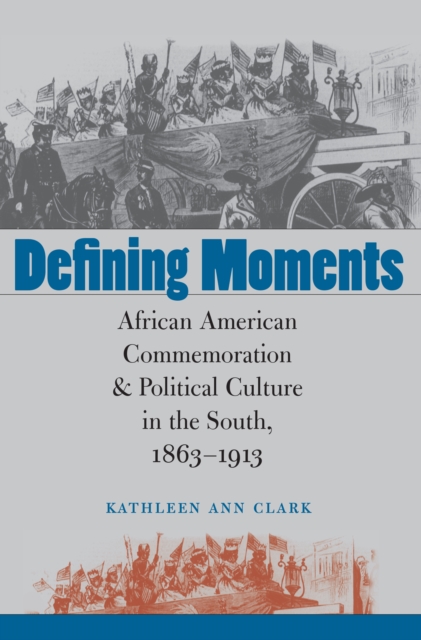
Defining moments : African American commemoration & political culture in the South, 1863-1913
The historical memory of the Civil War and Reconstruction has earned increasing attention from scholars. Only recently, however, have historians begun to explore African American efforts to interpret those events. With Defining Moments, Kathleen Clark shines new light on African American commemorative traditions in the South, where events such as Emancipation Day and Fourth of July ceremonies served as opportunities for African Americans to assert their own understandings of slavery, the Civil War, and Emancipation--efforts that were vital to the struggles to define, assert, and defend African American freedom and citizenship.Focusing on urban celebrations that drew crowds from surrounding rural areas, Clark finds that commemorations served as critical forums for African Americans to define themselves collectively. As they struggled to assert their freedom and citizenship, African Americans wrestled with issues such as the content and meaning of black history, class-inflected ideas of respectability and progress, and gendered notions of citizenship. Clark's examination of the people and events that shaped complex struggles over public self-representation in African American communities brings new understanding of southern black political culture in the decades following Emancipation and provides a more complete picture of historical memory in the South.
eBook


Dark sky rising : Reconstruction and the dawn of Jim Crow
\"This is a story about America during and after Reconstruction, one of history's most pivotal and misunderstood chapters. In a stirring account of emancipation, the struggle for citizenship and national reunion, and the advent of racial segregation, the renowned Harvard scholar delivers a book that is illuminating and timely. Real-life accounts drive the narrative, spanning the half century between the Civil War and Birth of a Nation. Here, you will come face-to-face with the people and events of Reconstruction's noble democratic experiment, its tragic undermining, and the drawing of a new \"color line\" in the long Jim Crow era that followed. In introducing young readers to them, and to the resiliency of the African American people at times of progress and betrayal, Professor Gates shares a history that remains vitally relevant today.\"--Provided by publisher.
Book

Voices of emancipation : understanding slavery, the Civil War, and Reconstruction through the U.S. Pension Bureau files
Voices of Emancipation seeks to recover the lives and words of former slaves in vivid detail, mining the case files of the U.S. Pension Bureau, which administered a huge pension system for Union veterans and their survivors in the decades following the Civil War. The files contain an invaluable, first-hand perspective of slavery, emancipation, black military service, and freedom. Moreover, as Pension Bureau examiners began interviewing black Union veterans and their families shortly after the Civil War, the files are arguably among the earliest sources of ex-slaves reflecting on their lives, occurring decades before better-known WPA Slave Narratives of the 1930s took place. Voices of Emancipation explores the words of former slaves topically, beginning with recollections of slavery, moving on to experiences of military service in the Civil War, the transition to freedom, and finally to reflections on marriage and family before and after emancipation. With an introduction that places the pension files in context and presents the themes of the book, and historical commentary interwoven throughout the excerpts of the interviews themselves, Elizabeth A. Regosin and Donald R. Shaffer effectively introduce the files and the treasures they contain to students and general readers, but also provide specialists with an indispensable research tool.
eBook