
Catalogue Search | MBRL


Are you sure you want to remove the book from the shelf?

{{itemTitle}}
124
result(s) for
"1865–1877"
Sort by:

Between freedom and progress : the lost world of Reconstruction politics
\"Between Freedom and Progress recovers and analyzes the global imaginings of Reconstruction's partisans--those who struggled over and with Reconstruction--as they vied with one another to define the nature of their country after the Civil War. The remarkable technological and commercial transformations of the mid-nineteenth century--in particular, steam engines, telegraphs, and an expanded commercial printing capacity--created a constant stream of news, description, and storytelling from across and beyond the nation. Reconstruction's partisans contended with each other to make sense of this information, motivated by intense political antagonism combined with a shared but contested set of ideas about freedom and progress. As writers, lecturers, editors, travelers, moral reformers, racists, abolitionists, politicians, suffragists, soldiers, and diplomats, Reconstruction's partisans made competing claims about their place in the world. Understanding how, why, and when they did so helps ground our understanding of Reconstruction--itself a mysterious, transatlantic term--in its own intellectual context\"-- Provided by publisher.
Book

A Shattered Nation
Historians often assert that Confederate nationalism had its origins in pre-Civil War sectional conflict with the North, reached its apex at the start of the war, and then dropped off quickly after the end of hostilities. Anne Sarah Rubin argues instead that white Southerners did not actually begin to formulate a national identity until it became evident that the Confederacy was destined to fight a lengthy war against the Union. She also demonstrates that an attachment to a symbolic or sentimental Confederacy existed independent of the political Confederacy and was therefore able to persist well after the collapse of the Confederate state. White Southerners redefined symbols and figures of the failed state as emotional touchstones and political rallying points in the struggle to retain local (and racial) control, even as former Confederates took the loyalty oath and applied for pardons in droves.Exploring the creation, maintenance, and transformation of Confederate identity during the tumultuous years of the Civil War and Reconstruction, Rubin sheds new light on the ways in which Confederates felt connected to their national creation and provides a provocative example of what happens when a nation disintegrates and leaves its people behind to forge a new identity.
eBook

Reconstruction : a concise history
\"This concise history delves into the constitutional, political, and social issues behind Reconstruction to provide [an] ... account of a historical moment that left an indelible mark on American social fabric. [The author] depicts Reconstruction as a 'bourgeois revolution'--as the attempted extension of the free-labor ideology embodied by Lincoln and the Republican Party to what was perceived as a Southern region gone awry from the Founders' intention in the pursuit of Romantic aristocracy\"-- Provided by publisher.
Book

Schooling the freed people
Conventional wisdom holds that freedmen's education was largely the work of privileged, single white northern women motivated by evangelical beliefs and abolitionism.Schooling the Freed Peopleshatters this notion entirely.For the most comprehensive quantitative study of the origins of black education in freedom ever undertaken, Ronald E. Butchart combed the archives of all of the freedmen's aid organizations as well as the archives of every southern state to compile a vast database of over 11,600 individuals who taught in southern black schools between 1861 and 1876. Based on this path-breaking research, he reaches some surprising conclusions: one-third of the teachers were African Americans; black teachers taught longer than white teachers; half of the teachers were southerners; and even the northern teachers were more diverse than previously imagined. His evidence demonstrates that evangelicalism contributed much less than previously believed to white teachers' commitment to black students, that abolitionism was a relatively small factor in motivating the teachers, and that, on the whole, the teachers' ideas and aspirations about their work often ran counter to the aspirations of the freed people for schooling.The crowning achievement of a veteran scholar, this is the definitive book on freedmen's teachers in the South as well as an outstanding contribution to social history and our understanding of African American education.
eBook

Reconstruction : life after the Civil War
Explores the reconstruction period after the Civil War, including the controversial actions in government that occurred during this time.
Book

The Journey to Separate but Equal
In The Journey to Separate but Equal: Madame Decuir's Quest for
Racial Justice in the Reconstruction Era , Jack Beermann tells
the story of how, in Hall v. Decuir , the postâ€\"Civil War
US Supreme Court took its first step toward perpetuating the
subjugation of the non-White population of the United States by
actively preventing a Southern state from prohibiting segregation
on a riverboat in the coasting trade on the Mississippi River.
The Journey to Separate but Equal offers the first
complete exploration of Hall v. Decuir , with an in-depth
look at the case's record; the lives of the parties, lawyers, and
judges; and the case's social context in 1870s Louisiana. The book
centers around the remarkable story of Madame Josephine Decuir and
the lawsuit she pursued because she had been illegally barred from
the cabin reserved for White women on the Governor Allen
riverboat. The drama of Madame Decuir's fight against segregation's
denial of her dignity as a human and particularly as a woman
enriches our understanding of the Reconstruction era, especially in
Louisiana, including political and legal changes that occurred
during that time and the plight of people of color who were freed
from slavery but denied their dignity and rights as American
citizens. Hall v. Decuir spanned the pivotal period of
1872-1878, during which White segregationist Democrats \"redeemed\"
the South from Republican control. The Supreme Court's ruling in
Hall overturned the application of an 1869 Louisiana statute
prohibiting racial segregation in Madame Decuir’s case because of
the status of the Mississippi River as a mode of interstate
commerce. The decision represents a crucial precedent that
established the legal groundwork for the entrenchment of Jim Crow
in the law of the United States, leading directly to the Court’s
adoption of “separate but equal†in Plessy v. Ferguson.
eBook


We Will Be Satisfied With Nothing Less
Historians have focused almost entirely on the attempt by southern African Americans to attain equal rights during Reconstruction. However, the northern states also witnessed a significant period of struggle during these years. Northern blacks vigorously protested laws establishing inequality in education, public accommodations, and political life and challenged the Republican Party to live up to its stated ideals.
In\"We Will Be Satisfied With Nothing Less\", Hugh Davis concentrates on the two issues that African Americans in the North considered most essential: black male suffrage rights and equal access to the public schools. Davis connects the local and the national; he joins the specifics of campaigns in places such as Cincinnati, Detroit, and San Francisco with the work of the National Equal Rights League and its successor, the National Executive Committee of Colored Persons. The narrative moves forward from their launching of the equal rights movement in 1864 to the \"end\" of Reconstruction in the North two decades later. The struggle to gain male suffrage rights was the centerpiece of the movement's agenda in the 1860s, while the school issue remained a major objective throughout the period. Following the ratification of the Fifteenth Amendment in 1870, northern blacks devoted considerable attention to assessing their place within the Republican Party and determining how they could most effectively employ the franchise to protect the rights of all citizens.
eBook

Plain Folk's Fight
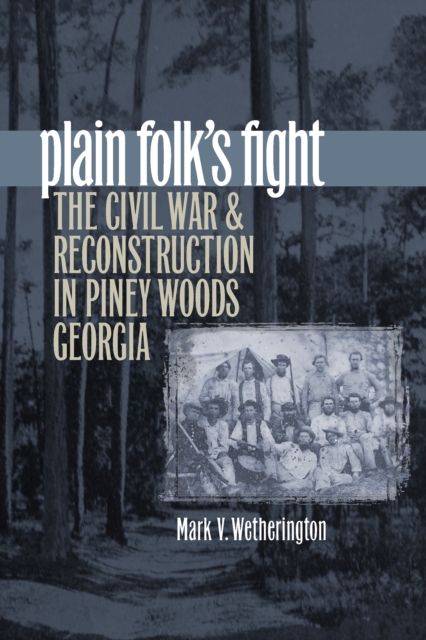
In an examination of the effects of the Civil War on the rural Southern home front, Mark V. Wetherington looks closely at the experiences of white \"plain folk\"--mostly yeoman farmers and craftspeople--in the wiregrass region of southern Georgia before, during, and after the war. Although previous scholars have argued that common people in the South fought the battles of the region's elites, Wetherington contends that the plain folk in this Georgia region fought for their own self-interest.Plain folk, whose communities were outside areas in which slaves were the majority of the population, feared black emancipation would allow former slaves to move from cotton plantations to subsistence areas like their piney woods communities. Thus, they favored secession, defended their way of life by fighting in the Confederate army, and kept the antebellum patriarchy intact in their home communities. Unable by late 1864 to sustain a two-front war in Virginia and at home, surviving veterans took their fight to the local political arena, where they used paramilitary tactics and ritual violence to defeat freedpeople and their white Republican allies, preserving a white patriarchy that relied on ex-Confederate officers for a new generation of leadership.
eBook