
Catalogue Search | MBRL


Are you sure you want to remove the book from the shelf?

{{itemTitle}}
146
result(s) for
"1865-1918"
Sort by:


American Abyss
At the beginning of the twentieth century, industrialization both dramatically altered everyday experiences and shaped debates about the effects of immigration, empire, and urbanization. InAmerican Abyss, Daniel E. Bender examines an array of sources-eugenics theories, scientific studies of climate, socialist theory, and even popular novels about cavemen-to show how intellectuals and activists came to understand industrialization in racial and gendered terms as the product of evolution and as the highest expression of civilization.
Their discussions, he notes, are echoed today by the use of such terms as the \"developed\" and \"developing\" worlds. American industry was contrasted with the supposed savagery and primitivism discovered in tropical colonies, but observers who made those claims worried that industrialization, by encouraging immigration, child and women's labor, and large families, was reversing natural selection. Factories appeared to favor the most unfit. There was a disturbing tendency for such expressions of fear to favor eugenicist \"remedies.\"
Bender delves deeply into the culture and politics of the age of industry. Linking urban slum tourism and imperial science with immigrant better-baby contests and hoboes,American Abyssuncovers the complex interactions of turn-of-the-century ideas about race, class, gender, and ethnicity. Moreover, at a time when immigration again lies at the center of American economy and society, this book offers an alarming and pointed historical perspective on contemporary fears of immigrant laborers.
eBook


In Search of Brightest Africa
In the decades between the Berlin Conference that partitioned Africa and the opening of the African Hall at the American Museum of Natural History, Americans in several fields and from many backgrounds argued that Africa had something to teach them. Jeannette Eileen Jones traces the history of the idea of Africa with an eye to recovering the emergence of a belief in \"Brightest Africa\"-a tradition that runs through American cultural and intellectual history with equal force to its \"Dark Continent\" counterpart. Jones skillfully weaves disparate strands of turn-of-the-century society and culture to expose a vivid trend of cultural engagement that involved both critique and activism. Filmmakers spoke out against the depiction of \"savage\" Africa in the mass media while also initiating a countertradition of ethnographic documentaries. Early environmentalists celebrated Africa as a pristine continent while lamenting that its unsullied landscape was \"vanishing.\" New Negro political thinkers also wanted to \"save\" Africa but saw its fragility in terms of imperiled human promise. Jones illuminates both the optimism about Africa underlying these concerns and the racist and colonial interests these agents often nevertheless served. The book contributes to a growing literature on the ongoing role of global exchange in shaping the African American experience as well as debates about the cultural place of Africa in American thought.
eBook

Daily life in the industrial United States, 1870-1900
\"Not just about the rise of the factories or the emergence of the modern city, this fascinating history conveys how it felt to work the assembly line and walk the bustling urban streets. Provides an overview of the dramatic economic changes occurring in the United States during industrialization, especially in the textile, meatpacking, steel, and railroad industries; Describes a political culture marked by high participation rates in the North, active suppression of the African American vote in the South, and a youth culture that made voting an important male rite of passage; Offers primary documents that invite readers to consider contrasting positions on a variety of issues, including how white supremacists justified violence and suppression of the black vote and how African American activists spoke out to resist this; Explores a variety of educational models, including manual education, Montessori education, and single-sex education, that resonate with contemporary debates on education.\"--Publisher's description.
Book
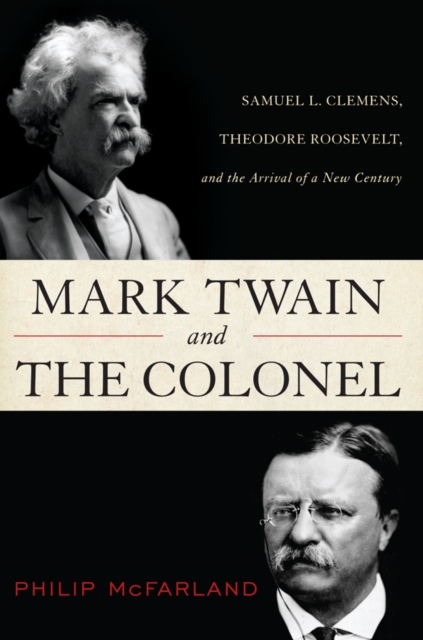
Mark Twain and the Colonel
In Mark Twain and the Colonel, Philip McFarland tells the story of the rich years of American history between 1890 and 1910 through the fully engaged involvement of two of its most vital participants. The narrative unfolds in six sections, each focusing on a different aspect of the United States of the early twentieth century that continues to matter to this day: America as an imperialist nation, America as a continental nation, America as a racial nation, America as a corporate nation, America at home, and America striving for peace. In this short span of years, the America of the late nineteenth century will move substantially closer to the America we know today, thanks in part to the influence and actions of Mark Twain and Theodore Roosevelt, two of the most influential figures of the age.
eBook

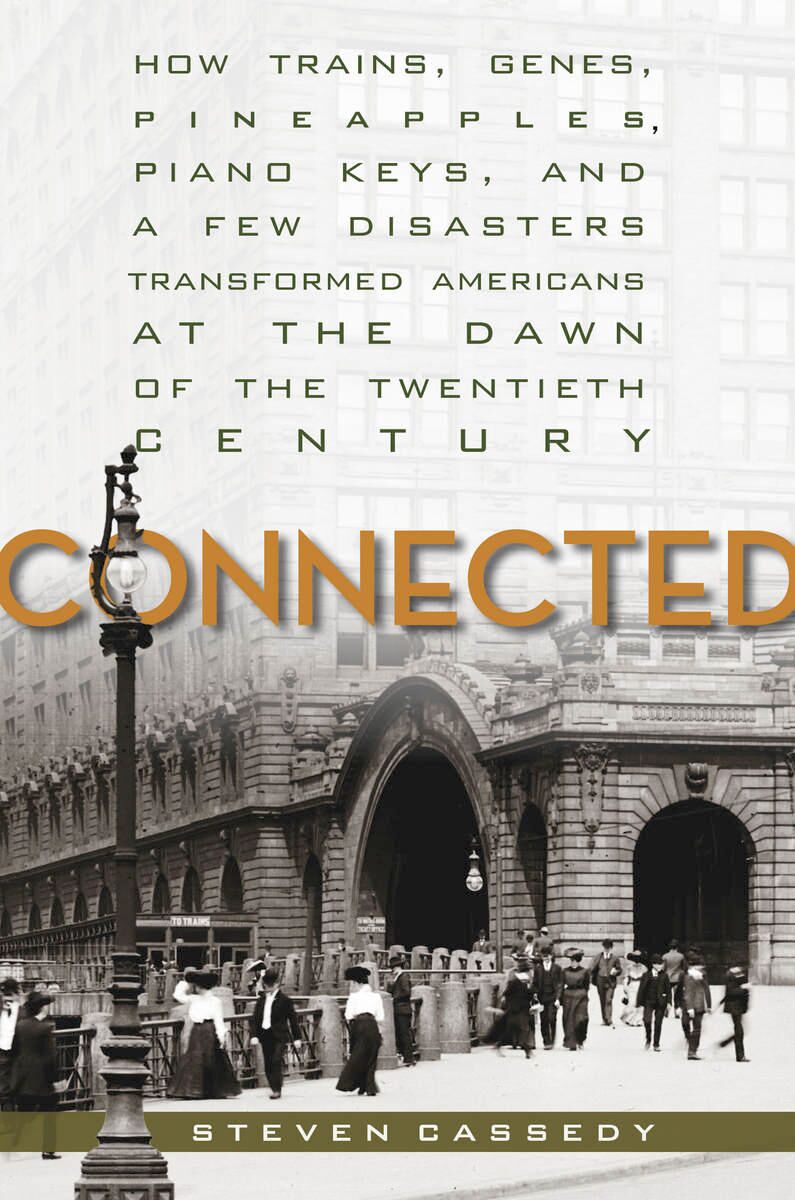
Connected : how trains, genes, pineapples, piano keys, and a few disasters transformed Americans at the dawn of the Twentieth Century
Between the end of the nineteenth century and the beginning of the twentieth, Americans underwent a dramatic transformation in self-conception: having formerly lived as individuals or members of small communities, they now found themselves living in networks, which arose out of scientific and technological innovations. There were transportation and communication networks. There was the network of the globalized marketplace, which brought into the American home exotic goods previously affordable to only a few. There was the network of standard time, which bound together all but the most rural Americans. There was the public health movement, which joined individuals to their fellow citizens by making everyone responsible for the health of everyone else. There were social networks that joined individuals to their fellows at the municipal, state, national, and global levels. Previous histories of this era focus on alienation and dislocation that new technologies caused. This book shows that American individuals in this era were more connected to their fellow citizens than ever—but by bonds that were distinctly modern.
eBook


Racism and sexual oppression in Anglo-America : a genealogy
Does the black struggle for civil rights make common cause with the movement to foster queer community, protest anti-queer violence or discrimination, and demand respect for the rights and sensibilities of queer people? Confronting this emotionally charged question, Ladelle McWhorter reveals how a carefully structured campaign against abnormality in the late 19th and early 20th centuries encouraged white Americans to purge society of so-called biological contaminants, people who were poor, disabled, black, or queer. Building on a legacy of savage hate crimes -- such as the killings of Matthew Shepard and James Byrd -- McWhorter shows that racism, sexual oppression, and discrimination against the disabled, the feeble, and the poor are all aspects of the same societal distemper, and that when the civil rights of one group are challenged, so are the rights of all.
eBook