
Catalogue Search | MBRL


Are you sure you want to remove the book from the shelf?

{{itemTitle}}
64
result(s) for
"1887-1979"
Sort by:


Jacob L. Devers
General Jacob L. \"Jake\" Devers (1897-1979) was one of only two
officers-the other was Omar C. Bradley-to command an army group
during the decisive campaigns of 1944-1945 that liberated Europe
and ended the war with Nazi Germany. After the war, Devers led the
Army Ground Forces in the United States and eventually retired in
1949 after forty years of service. Despite incredible successes on
the battlefield, General George C. Marshall's \"dependable man\"
remains one of the most underrated and overlooked figures of his
generation.
In this definitive biography, James Scott Wheeler delivers a
groundbreaking reassessment of the American commander whose
contributions to victory in Europe are topped only by General
Dwight D. Eisenhower's. Wheeler's exhaustively researched chronicle
of Devers's life and career reveals a leader who demonstrated an
extraordinary ability to cut through red tape and solve complex
problems. Nevertheless, Eisenhower disliked Devers-a fact laid bare
when he ordered Devers's Sixth Army Group to halt at the Rhine.
After the war, Eisenhower's and Bradley's accounts of the generals'
disagreements over strategy and tactics became received wisdom, to
the detriment of Devers's reputation.
An essential contribution to twentieth-century history,
Jacob L. Devers provides a fresh and nuanced
interpretation of the senior command during World War II and offers
a new perspective on a highly accomplished soldier.
eBook

Euripides, Freud, and the romance of belonging
Freud's interpretation of the ancient legend of Oedipus—as formulated in Sophocles' tragic drama—is among the most widely known concepts of psychoanalysis. Euripides' Ion, however, presents a more complex version of the development of personal identity. Here, the discovery of family origins is a process in which parent and child both take part as distinct agents driven by their own impulses of violence and desire.
Euripides, Freud, and the Romance of Belonging studies the construction of identity and the origins of the primal trauma in two texts, the Ion and Freud's case history of the Wolf Man. Victoria Pedrick challenges the conventional psychoanalytic theory of the development of the individual within the family, presenting instead a richer and more complex economy of exchange between the parent and the child. She provides a new perspective on Freud's appropriation of ancient texts and moves beyond the familiar reunion in Oedipus to the more nuanced scene of abandonment present in Ion. Her parallel investigation of these texts suggests that contemporary culture remains preoccupied by the problems of the past in the determination of identity.
Pedrick's fresh perspectives on both texts as well as on their relationship to each other shed new light on two foundational moments in the intellectual development of the West: Greek tragedy and Freudian psychoanalysis.
eBook

An Imperfect Mahlerite
As one of the chief representatives of French music in the early twentieth century, Nadia Boulanger is typically ignored in discussions of the reception of Gustav Mahler’s music, which—like most studies of reception—focus primarily on press accounts and public events. Moreover, Boulanger is usually considered in the context of a broader French aversion, in the first half of the twentieth century, to Mahler’s late-Romantic Austro-German idiom. But a range of documentary evidence concerning her attendance at the 1920 Mahler festival in Amsterdam, including previously unexamined correspondence as well as scores annotated in her hand, reveals that, motivated by a post-World War I spirit of internationalism, Boulanger contributed materially to the study and performance of Mahler. She encouraged audiences to consider his music’s emotional power and analyzed it in a way that drew attention to its orchestration and the horizontal aspects of its construction. She also introduced such figures as Aaron Copland to Mahler’s music, preparing him to approach it in a way that centered on the vocabulary of neo-classicism. Boulanger’s engagement with Mahler not only contributes to our picture of the composer’s reception, but also reveals the historiographical value of discourses that take place behind the scenes.
Journal Article
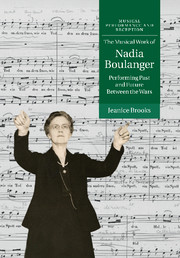
The Musical Work of Nadia Boulanger
Nadia Boulanger - composer, critic, impresario and the most famous composition teacher of the twentieth century - was also a performer of international repute. Her concerts and recordings with her vocal ensemble introduced audiences on both sides of the Atlantic to unfamiliar historical works and new compositions. This book considers how gender shaped the possibilities that marked Boulanger's performing career, tracing her meteoric rise as a conductor in the 1930s to origins in the classroom and the salon. Brooks investigates Boulanger's promotion of structurally motivated performance styles, showing how her ideas on performance of historical repertory and new music relate to her teaching of music analysis and music history. The book explores the way in which Boulanger's musical practice relied upon her understanding of the historically transcendent masterwork, in which musical form and meaning are ideally joined, and show how her ideas relate to broader currents in French aesthetics and culture.
eBook

The wolf-man and sigmund freud
It is a well known that the Wolf-Man was the subject of what James Strachey described as 'the most elaborate and no doubt the most important of all Freud's case histories'. It is less well known that he was still living in Vienna more than half a century since his analysis with Freud. In this remarkable biographical account, the Wolf-Man comes alive not only through Freud's case history, which is reprinted in full, and Ruth Mack Brunswick's account of the follow-up analysis which she conducted, but also through his own autobiographical memoirs covering his childhood in Russia, his recollections of Freud, his marriage, and the circumstances of his life in Vienna after the First World War. The story of the Wolf-Man's later years is told by the editor of this volume, the author, who kept in close touch with him following the shattering suicide of his wife in 1938.
eBook

Providing the Taste of Learning: Nadia Boulanger’s Lasting Imprint on Canadian Music
This article traces the rich Canadian legacy of the twentieth-century French musical legend Nadia Boulanger (1887–1979). Through teaching her more than seventy Canadian students, both French- and English-speaking, the renowned French pedagogue played a crucial role in the development of concert art music in this country from the 1920s, notably in Montreal and Toronto. Her numerous Canadian students went on to distinguish themselves as composers, teachers, performers, musicologists, theorists, administrators, and radio producers. Drawing on extensive archival and primary research, this study demonstrates the decisive impact Boulanger had on the development of musical styles and compositional practices in Canada in the last century.
Journal Article


Giants of tourism / edited by Richard W. Butler and Roslyn A. Russell
This book presents individuals who have made an important contribution to tourism. Most are entrepreneurs in the classic sense, but others are individuals who have had unintentional subsequent effects on tourism through their actions. The book is arranged in four parts: (i) giants of hospitality (chapters 1-5); (ii) giants of travel (chapters 6-10); (iii) giants of activities (chapters 11-14); and (iv) giants of development (chapters 15-19).
eBook

Nadia and Lili Boulanger
Pioneers in their fields and two of the best-known women in music in the twentieth century, Nadia and Lili Boulanger have previously been considered in isolation from one another. Yet, as Caroline Potter's new book demonstrates, their careers were closely linked during Lili Boulanger's short life (1893-1918) and there are several intriguing connections between their musical works. This biography also provides the first full analysis of the Boulanger sisters' musical styles, placing them within the context of French musical history. Their lives are also a case study in the issues of gender which surround music making even to the present day. Despite an unusually privileged upbringing, Nadia and Lili Boulanger exemplify the struggle women experienced when attempting to enter the professional music world. Lili became the first woman to win the Prix de Rome in 1913, and Nadia gained second place in 1908. Yet in spite of this initial success, Nadia Boulanger was to give up composing in her thirties and devoted the remainder of her long life to teaching. Her pupils included several of the great composers of the century, including Aaron Copland and Elliott Carter. This book, focusing on their musical careers, is essential reading for anyone interested in French music of the twentieth century.
eBook