
Catalogue Search | MBRL


Are you sure you want to remove the book from the shelf?

{{itemTitle}}
70
result(s) for
"1899-1992"
Sort by:


The Social Science of Hayek's ‘The Sensory Order’
\"The Social Science of Hayek's 'The Sensory Order'\" systematically examines the relevance and significance of Hayek's cognitive psychology for economics and social science, and is the only publication of its kind to do so. Sixteen original papers are divided into four parts in this volume: Hayek's Cognitive Psychology, Evolution, and Social Theory; Hayek's Cognitive Psychology and Economics; Hayek's Cognitive Psychology, Institutions, and Broader Social theory; and The Place of The Sensory Order in Hayek's Oeuvre: A Mini-Symposium. Papers examine Hayek's cognitive psychology from the perspective of evolutionary theory, economics, market and social institutions, and broader social theory. Part of \"The Advances in Austrian Economics Series\", this book will appeal to people working in a variety of traditions in economics and related disciplines. Although Austrian school economists are the primary audience, those working in public choice, new institutionalism, complexity theory, cognitive or behavior economics, entrepreneurship, and other areas will find great value in the series. This volume is edited by William Butos, Professor of Economics, Trinity College, Hartford and Visiting Research Fellow, New York University, Austrian Economics Program.
eBook


Socialism after Hayek (advances in heterodox economics)
Socialism after Hayek reinvigorates the socialist quest for class justice by rendering it compatible with the social and economic theories of F. A. Hayek. Theodore A. Burczak advances a new vision of socialism that avoids Hayek's criticisms of centrally planned socialism while adhering to a socialist conception of distributive justice and Marx's notion of freely associated labor. In contrast to the socialist models of John Roemer, Michael Albert, and Robin Hahnel, Burczak envisions a \"free market socialism\" in which privately owned firms are run democratically by workers, and governments engage in ongoing redistributions of wealth to support human development, yet markets are otherwise unregulated.
eBook


Friedrich August Von Hayek's Draft Biography of Ludwig Wittgenstein
Every student of the twentieth century has heard both of the great Viennese economist Friedrich von Hayek and of the equally great philosopher Ludwig Wittgenstein. But what isn’t well known is that the two were distant cousins and that, shortly after Wittgenstein’s death in 1951, Hayek set out to write a biography of his cousin. The project was derailed by Wittgenstein family members, who felt it was to soon to publish such a work. But Hayek’s draft acquired an underground readership, and Wittgenstein’s biographers have used it extensively.Here finally, is the text of that work itself. Hayek’s account has the great merit of being close to its subject; the draft, moreover sheds light, not only on Wittgenstein but on Hayek as well. Allan Janik’s elegant afterword makes these links clear. Anyone interested in Wittgenstein or, for that matter, in the thought and culture of the earlier twentieth century, will want to read Christian Erbacher’s excellent edition of Hayek’s draft biography. – Marjorie Perloff
eBook


Masters of the universe
How did American and British policymakers become so enamored with free markets, deregulation, and limited government? This book--the first comprehensive transatlantic history of the rise of neoliberal politics--presents a surprising answer. Based on archival research and interviews with leading participants in the movement,Masters of the Universetraces the ascendancy of neoliberalism from the academy of interwar Europe to supremacy under Reagan and Thatcher and in the decades since. Daniel Stedman Jones argues that there was nothing inevitable about the victory of free-market politics. Far from being the story of the simple triumph of right-wing ideas, the neoliberal breakthrough was contingent on the economic crises of the 1970s and the acceptance of the need for new policies by the political left.
Masters of the Universedescribes neoliberalism's road to power, beginning in interwar Europe but shifting its center of gravity after 1945 to the United States, especially to Chicago and Virginia, where it acquired a simple clarity that was developed into an uncompromising political message. Neoliberalism was communicated through a transatlantic network of think tanks, businessmen, politicians, and journalists that was held together by Friedrich Hayek and Milton Friedman. After the collapse of Bretton Woods in 1971, and the \"stagflation\" that followed, their ideas finally began to take hold as Keynesianism appeared to self-destruct. Later, after the elections of Reagan and Thatcher, a guileless faith in free markets came to dominate politics.
Fascinating, important, and timely, this is a book for anyone who wants to understand the history behind the Anglo-American love affair with the free market, as well as the origins of the current economic crisis.
eBook
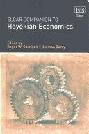
Elgar companion to Hayekian economics
The Elgar companion to Hayekian economics provides an in-depth treatment of Friedrich August von Hayek's economic through from his technical economics of the 1920s and 1930s to his broader views on the spontaneous order of a free society. Taken together, the chapters show evidence both of continuity of thought and of significant changes in focus. Providing a thorough and balanced account of Hayek's work, the authors examine his wide-ranging contribution to thought in the areas of business cycles, socialism and trade unions and the socialist calculation debate, as well as social justice, spontaneous order, globalization and free trade. The authors provide enlightening comparisons between Hayek's views and those of Ludwig von Mises, Ludwig M. Lachmann, Milton Friedman and John Maynard Keynes. Scholars working in the classical liberal tradition as well as academic economists and political scientists will find this in-depth account to be an invaluable resource.
Book
