
Catalogue Search | MBRL


Are you sure you want to remove the book from the shelf?

{{itemTitle}}
92
result(s) for
"1914-1995"
Sort by:
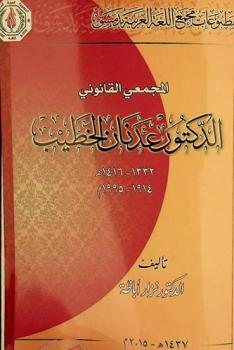
المجمعي القانوني الدكتور عدنان الخطيب 1332-1416 هـ-1914-1995 م
يتناول كتاب (المجمعي القانوني الدكتور عدنان الخطيب 1332-1416 هـ-1914-1915 م) والذي قام بتأليفه (الدكتور نزار أباظة) في حوالي (90) صفحة من القطع المتوسط موضوع (تراجم اللغويون السوريون) مستعرضا المحتويات التالية : الباب الأول : السيرة الذاتية : الفصل الأول : النشأة الأولى، الفصل الثاني : الحياة العملية، الفصل الثالث : الفكر والمواقف والصفات الشخصية ؛ الباب الثاني : الأعمال : الفصل الأول : مؤلفات الدكتور عدنان الخطيب، الفصل الثاني : نماذج من أسلوبه.
BOOK

The Many Lives of Cy Endfield
Cy Endfield (1914–1995) was a filmmaker who was also fascinated by the worlds of close-up magic, science, and invention. After directing several distinctive low-budget films in Hollywood, he was blacklisted in 1951 and fled to Britain rather than “name names” before HUAC, the U.S. House of Representatives’ Un-American Activities Committee. The Pennsylvania-born Endfield made films that exhibit an outsider’s eye for his adopted country, including the working-class “trucking” drama
Hell Drivers and the cult film
Zulu —a war epic as politically nuanced as it is spectacular. Along the way he encountered Orson Welles, collaborated with pioneering animator Ray Harryhausen, published a book of his card magic, and co-invented an early word processor that anticipated today’s technology.
The Many Lives of Cy Endfield is the first book on this fascinating figure. The fruit of years of archival research and personal interviews by Brian Neve, it documents Endfield’s many identities: among them second-generation immigrant, Jew, Communist, and exile. Neve paints detailed scenes not only of the political and personal dramas of the blacklist era, but also of the attempts by Hollywood directors in the postwar 1940s and early 1950s to address social and political controversies of the day. Out of these efforts came two crime melodramas (what would become known as film noir) on inequalities of class and race:
The Underworld Story and
The Sound of Fury (also known as
Try and Get Me! ). Neve reveals the complex production and reception histories of Endfield’s films, which the critic Jonathan Rosenbaum saw as reflective of “an uncommon intelligence so radically critical of the world we live in that it’s dangerous.”
The Many Lives of Cy Endfield is at once a revealing biography of an independent, protean figure, an insight into film industry struggles, and a sensitive and informed study of an underappreciated body of work. Best Five Books of the Year list, Iranian 24 Monthly, London UK “Make[s] a case for [Endfield’s] distinctive voice while tracing the way struggle, opposition, and thwarted ambition both defined his life and became the powerful themes of his best work.”—
Cineaste
eBook

The Walnut Mansion
This grand novel encompasses nearly all of Yugoslavia's tumultuous twentieth century, from the decline of the Austro-Hungarian and Ottoman Empires through two world wars, the rise and fall of communism, the breakup of the nation, and the terror of the shelling of Dubrovnik. Tackling universal themes on a human scale, master storyteller Miljenko Jergoviâc traces one Yugoslavian family's tale as history irresistibly casts the fates of five generations. What is it to live a life whose circumstances are driven by history? Jergoviâc investigates the experiences of a compelling heroine, Regina Delavale, and her many family members and neighbors. Telling Regina's story in reverse chronology, the author proceeds from her final days in 2002 to her birth in 1905, encountering along the way such traumas as atrocities committed by Nazi Ustashe Croats and the death of Tito. Lyrically written and unhesitatingly told, The Walnut Mansion may be read as an allegory of the tragedy of Yugoslavia's tormented twentieth century.--Provided by publisher.
BOOK

Jonas Salk
The first full biography of Jonas Salk offers a complete picture of the enigmatic figure, from his early years working on an influenza vaccine--for which he never fully got credit--to his seminal creation of the Polio vaccine, up through his later work to find a cure for AIDS.
eBook

Jonas Salk: A Life: A Life
When a waiting world learned on April 12, 1955, that Jonas Salk had created a vaccine that could prevent poliomyelitis, he became a hero overnight. Jubilation erupted worldwide, with Salk as the focus. Born in a New York tenement, humble in manner, Salk had all the makings of a twentieth-century icon-a white knight in a white coat. In the wake of his achievement, he received a staggering number of awards, a Congressional Gold Medal, a Presidential Citation; for years his name ranked with Gandhi and Churchill on lists of the most revered people. And yet the one group whose adulation he craved-the scientific community-remained ominously silent. \"The worst tragedy that could have befallen me was my success,\" Salk later said. \"I knew right away that I was through-cast out.\" In the first complete biography of Jonas Salk, Charlotte DeCroes Jacobs unravels his complexities and nuances to reveal an unconventional scientist and a misunderstood and vulnerable man. Despite his incredible success, all but eradicating a crippling disease from the world, Salk was ostracized by the scientific community. Its esteemed members accused him of two transgressions: failing to give proper credit to other researchers, and crossing the imaginary line of academic decorum by soliciting media attention. Even before his success catapulted him into the limelight, Salk was an enigmatic man disliked by many of his peers. Driven by an intense desire to aid mankind, Jacobs writes, he was initially oblivious and eventually resigned to the personal cost-as well as the costs suffered by his family and friends. And yet Salk remained, in the eyes of the public, an adored hero. Was Jonas Salk an American saint or a self-absorbed man who connived to assure himself a place in medical history? Granted unprecedented access to Salk's sealed archives and having conducted hundreds of personal interviews, Jacobs offers a more complete picture of the complicated figure than has previously existed. Salk's full story has not yet been recounted, Jacobs shows. His historical role in preventing polio has overshadowed his part in co-developing the first influenza vaccine-for which he never fully got credit; his effort to meld the sciences and humanities in the magnificent Salk Institute; and his pioneering work on AIDS, all carried out amidst scientific back-room politics with the health of the public at stake. Jacobs crafts a vivid and intimate portrait of this almost impenetrable man, showing him to be at once far more complex and layered than the public image of America's hero and far more sensitive and caring than the stubborn, standoffish, glory-seeking scoundrel suggested by some scientists.
eBook

Jonas Salk: a life
When a waiting world learned on April 12, 1955, that Jonas Salk had successfully created a vaccine to prevent poliomyelitis, he became a hero overnight. Born in a New York tenement, humble in manner, Salk had all the makings of a twentieth-century icon-a knight in a white coat. In the wake of his achievement, he received a staggering number of awards and honors; for years his name ranked with Gandhi and Churchill on lists of the most revered people. And yet the one group whose adulation he craved--the scientific community--remained ominously silent. \"The worst tragedy that could have befallen me was my success,\" Salk later said. \"I knew right away that I was through-cast out.\" In the first complete biography of Jonas Salk, Charlotte DeCroes Jacobs unravels Salk's story to reveal an unconventional scientist and a misunderstood and vulnerable man. Despite his incredible success in developing the polio vaccine, Salk was ostracized by his fellow scientists, who accused him of failing to give proper credit to other researchers and scorned his taste for media attention. Even before success catapulted him into the limelight, Salk was an inscrutable man disliked by many of his peers. Driven by an intense desire to aid mankind, he was initially oblivious and eventually resigned to the personal cost--as well as the costs suffered by his family and friends. And yet Salk remained, in the eyes of the public, an adored hero. Based on hundreds of personal interviews and unprecedented access to Salk's sealed archives, Jacobs' biography offers the most complete picture of this complicated figure. Salk's story has never been fully told; until now, his role in preventing polio has overshadowed his part in co-developing the first influenza vaccine, his effort to meld the sciences and humanities in the magnificent Salk Institute, and his pioneering work on AIDS. A vivid and intimate portrait, this will become the standard work on the remarkable life of Jonas Salk.
eBook

Balkan genocides
During the 20th century, the Balkan Peninsula was affected by three major waves of genocides and ethnic cleansings, some of which are still being denied today. In Balkan Genocides Paul Mojzes provides a balanced and detailed account of these events, placing them in their proper historical context and debunking the common misrepresentations and misunderstandings of the genocides themselves. A native of Yugoslavia, Mojzes offers new insights into the Balkan genocides, including a look at the unique role of ethnoreligiosity in these horrific events and a characterization of the first and second Balkan wars as mutual genocides. Mojzes also looks to the region's future, discussing the ongoing trials at the International Criminal Tribunal in Yugoslavia and the prospects for dealing with the lingering issues between Balkan nations and different religions. Balkan Genocides attempts to end the vicious cycle of revenge which has fueled such horrors in the past century by analyzing the terrible events and how they came to pass.
eBook
The large man at the door
Peter Townsend was a big man who lived a large life. His energies were prodigious, his interests and sympathies broad, his compassion expansive. By the time I met him, in the late 1970s or very early 1980s, the better part of his roistering days, which had been legendary, were over. Yet his huge curiosity for art (and life) still sustained his passion for publishing, and his extraordinary career as an open-minded, large-hearted art magazine editor in the United Kingdom took a new turn when he moved to this country to establish Art Monthly Australia in 1987.
Journal Article

Emigrants and Immigrants of Burkina Faso, Senegal, and France: - Ousmane Sembène's La Noire de... and S. Pierre Yameogo's Moi et mon blanc
[...]Mamadi can no longer pay his rent in time and is thrown out of the boarding house where he lives, but with the help of an older cousin, he finds himself a job at a parking garage. [...]the rules and regulations of Diouana' s employment are far more arbitrary than those under which Mamadi works. [Ah yes, I hope he's studying medicine! Because according to T V last week they're all dying of AIDS out there.] Under the trees in Ouagadougou NEIGHBOR A: In Sembène's La Noire de... the French discuss Africa after independence but without engaging in dialogue with Diouana. [...]they even talk about Diouana in her presence, as if she were not there.
Journal Article