
Catalogue Search | MBRL


Are you sure you want to remove the book from the shelf?

{{itemTitle}}
603
result(s) for
"1918-1945"
Sort by:


The lights that failed : European international history, 1919-1933
This book is first and foremost a history of ruling-class diplomacy, but other factors are not ignored: the Bolsheviks, the Turks, and the insurgencies in Europe. This book provides detailed narrative and cogent analysis of the all that happened in Paris in 1919 and all that came out of it, with the aftermath of the peace process and the difficulty of avoiding war for twenty years. This book falls into two parts. Part 1 shows how the peacemakers and their successors dealt with the problems of a shattered Europe. The war had fundamentally altered both the internal structures of many of the European states and transformed the traditional order. The book shows that the management of the European state system in the decade after 1919, while in some ways resembling that of the past, assumed a shape that distinguished it both from the pre-war decades and the post-1933 period. Part II covers the ‘hinge years’ 1929 to 1933. These were the years in which many of the experiments in internationalism came to be tested and their weakness revealed. Many of the difficulties stemmed from the enveloping economic depression. The way was open to the movements towards étatism, autarcy, virulent nationalism, and expansionism which characterized the post-1933 European scene. The events of these years were critical to both Hitler's challenge to the European status quo and the reactions of the European statesmen to his assault on what remained of an international system.
eBook


The great interwar crisis and the collapse of globalization
Challenging the standard narrative of Interwar International History, this account establishes the causal relationship between the global political and economic crises of the period, and offers a radically new look at the role of ideology, racism and the leading liberal powers in the events between the First and Second World Wars.
eBook


Hitler's cosmopolitan bastard : Count Richard Coudenhove-Kalergi and his vision of Europe
In the turbulent period following the First World War the young Count Richard Coudenhove-Kalergi founded the Pan-European Union, offering a vision of peaceful, democratic unity for Europe, with no borders, a common currency, and a single passport. Timely and captivating, Martyn Bond's biography offers an opportunity to explore a remarkable life and revisit the impetus and origins of a unified Europe.
eBook

Takeover : Hitler's final rise to power
\"In the summer of 1932, the Weimar Republic was on the verge of collapse. One in three Germans was unemployed. Violence was rampant. Hitler's National Socialists surged at the polls. Paul von Hindenburg, an aging war hero and avowed monarchist, was a reluctant president bound by oath to uphold the constitution. The November elections offered Hitler the prospect of a Reichstag majority and the path to political power. But instead, the Nazis lost two million votes. As membership hemorrhaged and financial backers withdrew, the Nazi Party threatened to fracture. Hitler talked of suicide. The New York Times declared he was finished. Yet somehow, in a few brief weeks, he was chancellor of Germany. In facinating detail and with previously un-accessed archival materials, Timothy W. Ryback tells the remarkable story of Hitler's dismantling of democracy through democratic process. He provides fresh perspective and insights into Hitler's personal and professional lives in these months, in all their complexity and uncertainty--backroom deals, unlikely alliances, stunning betrayals, an ill-timed tax audit, and a fateful weekend that changed our world forever. Above all, Ryback details why a wearied Hindenburg, who disdained the \"Bohemian corporal,\" ultimately decided to appoint Hitler chancellor in January 1933. Within weeks, Germany was no longer a democracy.\"--Amazon.com.
BOOK

Hungary in World War II
The story of Hungary's participation in World War II is part of a much larger narrative-one that has never before been fully recounted for a non-Hungarian readership. As told by Deborah Cornelius, it is a fascinating tale of rise and fall, of hopes dashed and dreams in tatters. Using previously untapped sources and interviews she conducted for this book, Cornelius provides a clear account of Hungary's attempt to regain the glory of the Hungarian Kingdom by joining forces with Nazi Germany-a decision that today seems doomed to fail from the start. For scholars and history buff s alike, Hungary in World War II is a riveting read.Cornelius begins her study with the Treaty of Trianon, which in 1920 spelled out the terms of defeat for the former kingdom. The new country of Hungary lost more than 70 percent of the kingdom's territory, saw its population reduced by nearly the same percentage, and was stripped of fi ve of its ten most populous cities. As Cornelius makes vividly clear, nearly all of the actions of Hungarian leaders during the succeedingdecades can be traced back to this incalculable defeat.In the early years of World War II, Hungary enjoyed boom times-and the dream of restoring the Hungarian Kingdom began to rise again. Caught in the middle as the war engulfed Europe, Hungary was drawn into an alliance with Nazi Germany. When the Germans appeared to give Hungary much of its pre-World War I territory, Hungarians began to delude themselves into believing they had won their long-sought objective. Instead, the final year of the world war brought widespread destruction and a genocidal war against Hungarian Jews. Caught between two warring behemoths, the country became a battleground for German and Soviet forces. In the wake of the war, Hungary suffered further devastation under Soviet occupation and forty-five years of communist rule.The author first became interested in Hungary in 1957 and has visited the country numerous times, beginning in the 1970s. Over the years she has talked with many Hungarians, both scholars and everyday people. Hungary in World War II draws skillfully on these personal tales to narrate events before, during, and after World War II. It provides a comprehensive and highly readable history of Hungarian participation in the war, along with an explanation of Hungarian motivation: the attempt of a defeated nation to relive its former triumphs.
eBook

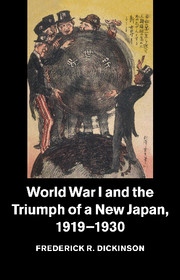
World War I and the Triumph of a New Japan, 1919–1930
Frederick R. Dickinson illuminates a new, integrative history of interwar Japan that highlights the transformative effects of the Great War far from the Western Front. World War I and the Triumph of a New Japan, 1919–1930 reveals how Japan embarked upon a decade of national reconstruction following the Paris Peace Conference, rivalling the monumental rebuilding efforts in post-Versailles Europe. Taking World War I as his anchor, Dickinson examines the structural foundations of a new Japan, discussing the country's wholehearted participation in new post-war projects of democracy, internationalism, disarmament and peace. Dickinson proposes that Japan's renewed drive for military expansion in the 1930s marked less a failure of Japan's interwar culture than the start of a tumultuous domestic debate over the most desirable shape of Japan's twentieth-century world. This stimulating study will engage students and researchers alike, offering a unique, global perspective of interwar Japan.
eBook