
Catalogue Search | MBRL


Are you sure you want to remove the book from the shelf?

{{itemTitle}}
2,157
result(s) for
"1933-1945"
Sort by:
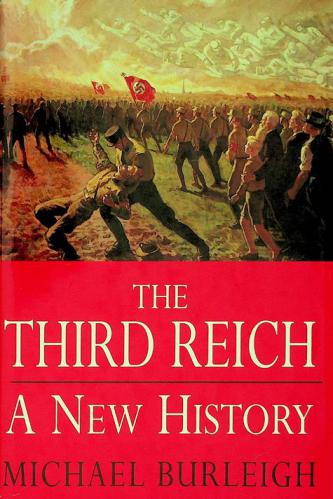
The third Reich : a new history
\"The Third Reich: A New History restores a broader perspective and intellectual unity to the many subjects that have become academic sub-specialities. It offers a radical re-examination of the Third Reich from its incubation in the hopelessness which followed the German defeat in 1918 to the Nazi regime's final destructive spiral and the aftershocks of de-Nazification.\"--Jacket.

A World Without Jews
Why exactly did the Nazis burn the Hebrew Bible everywhere in Germany on November 9, 1938? The perplexing event has not been adequately accounted for by historians in their large-scale assessments of how and why the Holocaust occurred. In this gripping new analysis, Alon Confino draws on an array of archives across three continents to propose a penetrating new assessment of one of the central moral problems of the twentieth century. To a surprising extent, Confino demonstrates, the mass murder of Jews during the war years was powerfully anticipated in the culture of the prewar years.The author shifts his focus away from the debates over what the Germans did or did not know about the Holocaust and explores instead how Germans came to conceive of the idea of a Germany without Jews. He traces the stories the Nazis told themselves-where they came from and where they were heading-and how those stories led to the conclusion that Jews must be eradicated in order for the new Nazi civilization to arise. The creation of this new empire required that Jews and Judaism be erased from Christian history, and this was the inspiration-and justification-for Kristallnacht. As Germans imagined a future world without Jews, persecution and extermination became imaginable, and even justifiable.
eBook

The Third Reich in power, 1933-1939
In The Third Reich in Power, Richard J. Evans tells the story of Germany's radical reshaping under Nazi rule. Every area of life, from literature, culture and the arts to religion, education and science, was subordinated to the relentless drive to prepare Germany for war. His book shows how the Nazis attempted to penetrate and reorder every aspect of German society, encountering many kinds and degrees of resistance along the way, but gradually winning the acceptance of the German people in the long run. Those who were seen as unworthy to be counted among the German people were dealt with in increasingly brutal terms. The Nazi regime took more and more radical measures against the racially \"unfit,\" including Germany's Jews, Gypsies, homosexuals, mentally ill, \"asocial\" and \"habitual\" criminals. After six years of foreign policy brinkmanship that took the Nazi regime from success to success, Hitler's drive to prepare Germany for the war that he saw as its destiny reached its fateful hour in September 1939. The war he unleashed was to plunge the world into a maelstrom of genocide and destruction.
The anatomy of murder
This is the first comprehensive account of \"Anatomy in National Socialism\". Traces the gradual escalation of ethical transgressions in anatomy during National Socialism from the traditional anatomical work with the dead to human experimentation, and points to the need for vigilance against similar gradual ethical compromise in contemporary medical ethics. Demonstrates the manner in which anatomists became complicit in the complete annihilation of the perceived \"enemies\" of the Nazi-government. Demands the full reconstruction of the biographies and memorialization of Nazi-victims, whose bodies were used for anatomical purposes.
eBook
ألمانيا النازية بأقلام عربية (لأعلام عاصروها)
يسلط الضوء على النازية التي شغلت وقائدها أدولف هلتر العالم في القرن العشرين، وتعد من اهم أحداث القرن إذ لم تكن الأهم، وأذهلت العالم بقيامها وطموحها، وأذهلت العالم كذلك بسقوطها المدوي، مر على سقوطها خمس وسبعون سنة ومازالت في ذاكرة الجميع، جمع الكتاب أربعا وخمسين مقالة لأهم الكتاب العرب المعاصرين للحقبة النازية، ولا شك أن استسقاء الأخبار من المعاصرين مهم جدا وأوثق، خاص إذا كان بعضهم من أشهر المؤرخين والمفكرين العرب في العصر الحديث، نعرف من مقالاتهم نظرة العرب في ذاك الزمان عن ألمانيا بوجه عام والحزب النازي بوجه خاص.
Book

Hitler’s plans for global domination
What did Hitler really want to achieve: world domination. In the early twenties, Hitler was working on this plan and from 1933 on, was working to make it a reality. During 1940 and 1941, he believed he was close to winning the war. This book not only examines Nazi imperial architecture, armament, and plans to regain colonies but also reveals what Hitler said in moments of truth. The author presents many new sources and information, including Hitler's little known intention to attack New York City with long-range bombers in the days of Pearl Harbor.
eBook

Relics of the Reich
The author of Secret Wartime Britain examines the architecture left behind after the Nazis were defeated in World War II.Hitler's Reich may have been defeated in 1945, but many buildings, military installations, and other sites remained.At the end of the war, some were obliterated by the victorious Allies, but others survived.
eBook

Takeover : Hitler's final rise to power
\"In the summer of 1932, the Weimar Republic was on the verge of collapse. One in three Germans was unemployed. Violence was rampant. Hitler's National Socialists surged at the polls. Paul von Hindenburg, an aging war hero and avowed monarchist, was a reluctant president bound by oath to uphold the constitution. The November elections offered Hitler the prospect of a Reichstag majority and the path to political power. But instead, the Nazis lost two million votes. As membership hemorrhaged and financial backers withdrew, the Nazi Party threatened to fracture. Hitler talked of suicide. The New York Times declared he was finished. Yet somehow, in a few brief weeks, he was chancellor of Germany. In facinating detail and with previously un-accessed archival materials, Timothy W. Ryback tells the remarkable story of Hitler's dismantling of democracy through democratic process. He provides fresh perspective and insights into Hitler's personal and professional lives in these months, in all their complexity and uncertainty--backroom deals, unlikely alliances, stunning betrayals, an ill-timed tax audit, and a fateful weekend that changed our world forever. Above all, Ryback details why a wearied Hindenburg, who disdained the \"Bohemian corporal,\" ultimately decided to appoint Hitler chancellor in January 1933. Within weeks, Germany was no longer a democracy.\"--Amazon.com.
BOOK

Routes into the abyss
Examining the 1930s and the different reactions to the crisis, this volume offers a global comparative perspective that includes a comparison across time to give insight into the contemporary global recession. Germany, Italy, Austria and Spain with their antidemocratic, authoritarian or fascistic answers to the economic crisis are compared not only to an opposite European perspective - the Swedish example - but also to other global perspectives and their political consequences in Japan, China, India, Turkey, Brazil and the United States. The book offers no recipe for economic, social or political action in today's recession, but it shows a wide range of reactions in the past, some of which led to catastrophe.
eBook