
Catalogue Search | MBRL


Are you sure you want to remove the book from the shelf?

{{itemTitle}}
267
result(s) for
"1940-1945"
Sort by:


France's new deal
France's New Deal is an in-depth and important look at the remaking of the French state after World War II, a time when the nation was endowed with brand-new institutions for managing its economy and culture. Yet, as Philip Nord reveals, the significant process of state rebuilding did not begin at the Liberation. Rather, it got started earlier, in the waning years of the Third Republic and under the Vichy regime. Tracking the nation's evolution from the 1930s through the postwar years, Nord describes how a variety of political actors--socialists, Christian democrats, technocrats, and Gaullists--had a hand in the construction of modern France.
eBook

News of our loved ones : a novel
Shifting back and forth through time, tells the story of the daughter of a French woman who married an American as she struggles to understand her family's experience during World War II.
Book

Propaganda and Persecution
Renée Poznanski's magisterial history of the French Resistance during World War II offers a comprehensive exploration of the most significant issue in that period's social imaginary: the \"Jewish question.\" With extraordinary nuance, she analyzes the discourse around Jews and Judaism that pervaded the Resistance's propaganda and debates, while closely examining the fate of Jews under Vichy and after.
Poznanski argues that Jews in France suffered a double persecution: one led by the Vichy government, the other imposed by the Nazis. Marginalization and exclusion soon led to internment and deportation to terrifying places. Meanwhile, a propaganda war developed between the Resistance and the official voice of Vichy. Poznanski draws on a breathtaking array of sources, especially clandestine publications and French-language BBC transmissions, to show how the Resistance both fought and accommodated the deeply entrenched antisemitism within French society. Her close readings of propaganda texts against public opinions probe ambiguities and silences in Resistance writing about the persecution of the Jews and, in parallel, the numerous and detailed denunciations that could be read in the Jewish clandestine press. This extensive synthesis extends to the post-Liberation period, during which the ongoing persecution of Jews in Europe and North Africa would be portrayed as secondary to the suffering of the nation.
The winner of the 2009 Henri Hertz Prize by the Chancellerie des Universités de Paris, Sorbonne, Propaganda and Persecution makes major contributions to the study of the Resistance and of antisemitism. Lenn J. Schramm's English translation brings Poznanski's dynamic prose to life.
eBook

The liberation of Paris : how Eisenhower, De Gaulle, and Von Choltitz saved the City of Light
\"The liberation of Paris tells the dramatic story of the Allied decision in World War II to divert from the strategic plan in order to save the City of Light from chaos and assist de Gaulle's efforts to become France's new leader even as the German general in charge of the occupation defied his orders to destroy the city as the Allies closed in\"-- Provided by publisher.
Book

National policy, global memory
The first book which studies politics of memory as a public policy. The first book which draws the history of the title of Righteous among the Nations, of which Oskar Schindler and Raoul Wallenberg are maybe the most famous examples. The book critically discusses the reality of the so-called \"global memory\" in the contemporary period.
eBook

Paris '44 : the shame and the glory
This is a heart-stopping countdown narrative recreating the liberation of Paris in 1944, one of the great and most dramatic hinge moments of WW2. When the Germans marched in and the lamps went out in the City of Light the millions who loved Paris mourned. Liberation, four years later, triggered an explosion of joy and relief. It was the party of the century and everybody who was anybody was there. General Charles de Gaulle seized the moment to create an instant legend that would take its place alongside the great moments in French history. After years of oppression and humiliation Parisians had risen to reclaim their city and drive out the forces of darkness - or so the story went. This account of the liberation, packed with revelation, tells the story of those heady days of suspense, danger, exhilaration - and vengeance - through the eyes of a range of participants.
Book
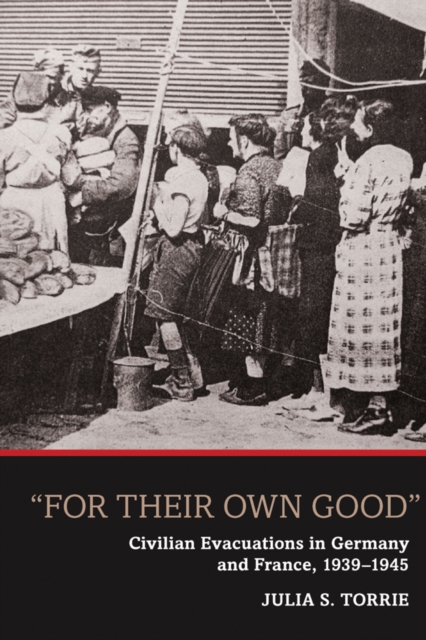
\For their own good\
The early twentieth-century advent of aerial bombing made successful evacuations essential to any war effort, but ordinary people resented them deeply. Based on extensive archival research in Germany and France, this is the first broad, comparative study of civilian evacuations in Germany and France during World War II. The evidence uncovered exposes the complexities of an assumed monolithic and all-powerful Nazi state by showing that citizens' objections to evacuations, which were rooted in family concerns, forced changes in policy. Drawing attention to the interaction between the Germans and French throughout World War II, this book shows how policies in each country were shaped by events in the other. A truly cross-national comparison in a field dominated by accounts of one country or the other, this book provides a unique historical context for addressing current concerns about the impact of air raids and military occupations on civilians.
eBook


Nationalism, Collaboration, and Resistance
Does nationalism produce resistance to foreign military occupation? The existing literature suggests that it does. Nationalism, however, also can lead to acquiescence and even to active collaboration with foreign conquerors. Nationalism can produce a variety of responses to occupation because political leaders connect nationalist motivations to other political goals. A detailed case study of the German occupation of France during World War II demonstrates these claims. In this highly nationalistic setting, Vichy France entered into collaboration with Germany despite opportunities to continue fighting in 1940 or defect from the German orbit later. Collaboration with Germany was widely supported by French elites and passively accommodated by the mass of nationalistic French citizens. Because both resisters and collaborators were French nationalists, nationalism cannot explain why collaboration was the dominant French response or why a relatively small number of French citizens resisted. Variation in who resisted and when resistance occurred can be explained by the international context and domestic political competition. Expecting a German victory in the war, French right-wing nationalists chose collaboration with the Nazis as a means to suppress and persecute their political opponents, the French Left. In doing so, they fostered resistance. This case suggests the need for a broader reexamination of the role of nationalism in explaining reactions to foreign intervention.
Journal Article