
Catalogue Search | MBRL


Are you sure you want to remove the book from the shelf?

{{itemTitle}}
462
result(s) for
"1942-1945"
Sort by:


Enemies among Us
Recent decades have drawn more attention to the United States'
treatment of Japanese Americans during World War II. Few people
realize, however, the extent of the country's relocation,
internment, and repatriation of German and Italian Americans, who
were interned in greater numbers than Japanese Americans. The
United States also assisted other countries, especially in Latin
America, in expelling \"dangerous\" aliens, primarily Germans. In
Enemies among Us John E. Schmitz examines the causes,
conditions, and consequences of America's selective relocation and
internment of its own citizens and enemy aliens, as well as the
effects of internment on those who experienced it. Looking at
German, Italian, and Japanese Americans, Schmitz analyzes the
similarities in the U.S. government's procedures for those they
perceived to be domestic and hemispheric threats, revealing the
consistencies in the government's treatment of these groups,
regardless of race. Reframing wartime relocation and internment
through a broader chronological perspective and considering
policies in the wider Western Hemisphere, Enemies among Us
provides new conclusions as to why the United States relocated,
interned, and repatriated both aliens and citizens considered
enemies.
eBook

Nora & Kettle : a paper stars novel
Set in 1953, Nora & Kettle explores the collision of two teenagers facing extraordinary adversity. Kettle, an orphaned Japanese American, is struggling to make a life in the aftermath of an event in history not often referred to--the internment of Japanese Americans during World War II and the removal of children from orphanages for having \"one drop of Japanese blood in them.\" Nora, the daughter of a civil rights lawyer who is building a compensation case for the interned Japanese Americans, is barely surviving her violent home and dreams of a life outside of the brownstone walls. Their meeting is inevitable, devastating and ultimately healing.
Book

Enduring Conviction
Fred Korematsu's decision to resist F.D.R.'s Executive Order 9066, which provided authority for the internment of Japanese Americans during World War II, was initially the case of a young man following his heart: he wanted to remain in California with his white fiancée. However, he quickly came to realize that it was more than just a personal choice; it was a matter of basic human rights.
After refusing to leave for incarceration when ordered, Korematsu was eventually arrested and convicted of a federal crime before being sent to the internment camp at Topaz, Utah.
He appealed his conviction to the Supreme Court, which, in one of the most infamous cases in American legal history, upheld the wartime orders. Forty years later, in the early 1980s, a team of young attorneys resurrected Korematsu's case. This time, Korematsu was victorious, and his conviction was overturned, helping to pave the way for Japanese American redress.
Lorraine Bannai, who was a young attorney on that legal team, combines insider knowledge of the case with extensive archival research, personal letters, and unprecedented access to Korematsu his family, and close friends. She uncovers the inspiring story of a humble, soft-spoken man who fought tirelessly against human rights abuses long after he was exonerated. In 1998, President Bill Clinton awarded Korematsu the Presidential Medal of Freedom.
eBook


Alaska Native Resilience
Alaska Native elders remember wartime invasion,
relocation, and land reclamation The US government
justified its World War II occupation of Alaska as a defense
against Japan's invasion of the Aleutian Islands, but it equally
served to advance colonial expansion in relation to the
geographically and culturally diverse Indigenous communities
affected. Offering important Alaska Native experiences of this
history, Holly Miowak Guise draws on a wealth of oral histories and
interviews with Indigenous elders to explore the multidimensional
relationship between Alaska Natives and the US military during the
Pacific War. The forced relocation and internment of Unangax̂ in
1942 proved a harbinger of Indigenous loss and suffering in World
War II Alaska. Violence against Native women, assimilation and Jim
Crow segregation, and discrimination against Native servicemen
followed the colonial blueprint. Yet Alaska Native peoples took
steps to enact their sovereignty and restore equilibrium to their
lives by resisting violence and disrupting attempts at US control.
Their subversive actions altered the colonial structures imposed
upon them by maintaining Indigenous spaces and asserting
sovereignty over their homelands. A multifaceted challenge to
conventional histories, Alaska Native Resilience shares
the experiences of Indigenous peoples from across Alaska to reveal
long-overlooked demonstrations of Native opposition to
colonialism.
eBook
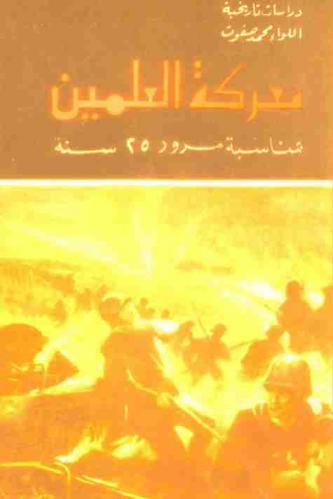
معركة العلمين بمناسبة مرور 25 سنة : دراسة تاريخية
دراسات تاريخية (معركة العلمين) للواء محمد صفوت بمناسبة مرور 25 سنة على معركة العلمين الشهيرة، \"شهدت الصحراء الغربية منذ خمسة وعشرين عاما معارك طاحنة وكانت معركة العلمين .. نقطة التحول الحاسمة فى الحرب العالمية الثانية وبدء النهاية للإنطلاقة التى مهدت الطريق لسقوط قوات المحور فى شمال إفريقيا ومطاردته عبر صقلية وإيطاليا ثم موقعة نورماندى فى فرنسا وأخيرا .. معركة ألمانيا ذاتها التى كانت المرحلة الأخيرة فى الحرب العالمية الثانية التى اكتوى العالم بنيرانها من عام 1939 حتى عام 1945.
Book

Democratizing the Enemy
During World War II some 120,000 Japanese Americans were forcibly removed from their homes and detained in concentration camps in several states. These Japanese Americans lost millions of dollars in property and were forced to live in so-called \"assembly centers\" surrounded by barbed wire fences and armed sentries.
In this insightful and groundbreaking work, Brian Hayashi reevaluates the three-year ordeal of interred Japanese Americans. Using previously undiscovered documents, he examines the forces behind the U.S. government's decision to establish internment camps. His conclusion: the motives of government officials and top military brass likely transcended the standard explanations of racism, wartime hysteria, and leadership failure. Among the other surprising factors that played into the decision, Hayashi writes, were land development in the American West and plans for the American occupation of Japan.
What was the long-term impact of America's actions? While many historians have explored that question, Hayashi takes a fresh look at how U.S. concentration camps affected not only their victims and American civil liberties, but also people living in locations as diverse as American Indian reservations and northeast Thailand.
eBook

Red berries, white clouds, blue sky
\"After Pearl Harbor is bombed by the Japanese, twelve-year-old Tomi and her Japanese-American family are split up and forced to leave their California home to live in internment camps in New Mexico and Colorado\"-- Provided by the publisher.
Book
Experiences of japanese american women during and after world war II
Experiences of Japanese American Women during and after World War II: Living in Internment Camps and Rebuilding Life Afterwards examines the experiences of Japanese American women who were in internment camps during World War II and after.
eBook