
Catalogue Search | MBRL


Are you sure you want to remove the book from the shelf?

{{itemTitle}}
144
result(s) for
"1949-1976"
Sort by:

A social history of Maoist China : conflict and change, 1949-1976
\"When the Chinese communists came into power in 1949, they promised to \"turn society upside down\". Efforts to build a communist society created hopes and dreams, coupled with fear and disillusionment. The Chinese people made great efforts towards modernization and social change in this period of transition, but they also experienced traumatic setbacks. Covering the period 1949 to 1976 and then tracing the legacy of the Mao era through the 1980s, Felix Wemheuer focuses on questions of class, gender, ethnicity and the urban-rural divide in this new social history of Maoist China. He analyzes the experiences of a range of social groups under Communist rule - workers, peasants, local cadres, intellectuals, \"ethnic minorities\", the old elites, men and women. To understand this tumultuous period, he argues, we must recognize the many complex challenges facing the People's Republic. But we must not lose sight of the human suffering and political terror that, for many now ageing quietly across China, remain the period's abiding memory.\"--Provided by publisher.
Book

Eating bitterness : new perspectives on China's Great Leap Forward and famine
When the Chinese Communist Party came to power in 1949, Mao Zedong declared that not even one person shall die of hunger. Yet some 30 million peasants died of starvation and exhaustion during the Great Leap Forward. Eating Bitterness reveals how men and women in rural and urban settings, from the provincial level to the grassroots, experienced the changes brought on by the party leaders' attempts to modernize China. This landmark volume lifts the curtain of party propaganda to expose the suffering of citizens and the deeply contested nature of state-society relations in Maoist China.
eBook

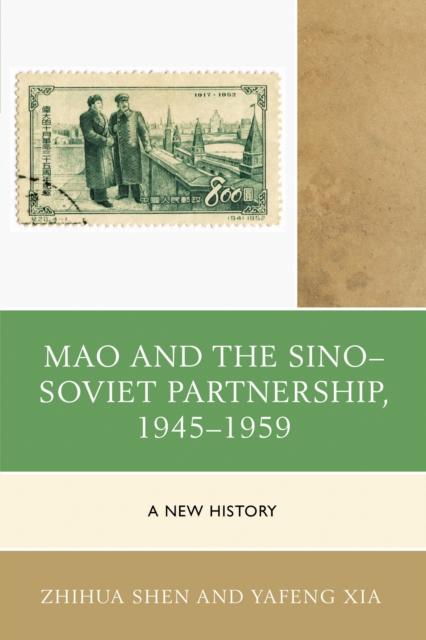
Mao and the Sino-Soviet partnership, 1945-1959
Based on Chinese archival documents, interviews, and more than twenty years of research on the subject, Zhihua Shen and Yafeng Xia offer a comprehensive look at the Sino-Soviet alliance between the end of the World War II and 1959, when the alliance was left in disarray as a result of foreign and domestic policies.
eBook

Eight outcasts : social and political marginalization in China under Mao
\"The 1949 Communist Revolution marked a period of earthshaking change in China. Political, economic, ideological, and cultural movements set into motion came to galvanize the country, culminating in dramatic social transformations at all levels but also in the persecution of hundreds of thousands of the country's citizens. Based on normally inaccessible records of confessions, interrogations, trial transcripts, and depositions, Eight Outcasts tells the stories of eight victims of the Maoist dictatorship. It introduces readers to individuals accused of infractions such as corruption, political wrong thoughts, homosexuality, illicit sexual activity, foreign ties, or \"historical problems\" (connections to the former Kuomintang regime) in the period between the revolution and Mao's death in 1976. Each chapter brings stories of China's voiceless citizens to light, broadening our knowledge of this important transitional period\"--Provided by publisher.
Book
Small Groups and Political Rituals in China
Martin King Whyte's Small Groups and Political Rituals in China examines how the Chinese Communist Party transformed Sun Yat-sen's lament about China as a \"sheet of loose sand\" into a system of remarkable social cohesion. Whyte's central argument is that political elites achieved this by embedding citizens in hsiao-tsu (small groups of 8-15 people) across nearly all institutions--factories, schools, communes, offices, labor camps, and military units--and by requiring them to participate in political rituals of study, criticism, and self-criticism. These rituals, grounded in Maoist ideology, mobilized peer pressure to reshape attitudes and behavior, creating an organizational model distinct from both Soviet and Western practices. Rather than spontaneous communities, these groups were deliberately designed and supervised by higher authorities, ensuring that even remote or socially marginal individuals were drawn into political life. Whyte contends that the combination of daily work with ritualized political activity generated a \"strict political atmosphere\" intended to secure compliance and foster ideological transformation. Because China's closed environment prevented direct fieldwork, Whyte relies on intensive interviews with 101 recent refugees in Hong Kong (1968-69), cross-checked against early 1950s Party pamphlets that prescribed how hsiao-tsu should function. Using these prescriptive texts as benchmarks, he develops case studies across five organizational settings--government offices, schools, rural communes, factories, and corrective labor camps--to analyze how closely actual practice matched the ideal. His method is inductive: instead of testing Western small-group hypotheses, he builds generalizations about when and why hsiao-tsu succeeded or faltered in reshaping members' conduct. Differences among cases reveal how organizational
structure, leadership, and external pressures shaped outcomes. Ultimately, Whyte shows that small groups and rituals were crucial in the Communist project of national integration and mobilization, but their effectiveness varied with context, and persistent obstacles limited their capacity to fully unify society. The book provides both a portrait of China's distinctive organizational strategies and a broader reflection on how states use ritual and group dynamics to transform political culture. This title is part of UC Press's Voices Revived program, which commemorates University of California Press's mission to seek out and cultivate the brightest minds and give them voice, reach, and impact. Drawing on a backlist dating to 1893, Voices Revived makes high-quality, peer-reviewed scholarship accessible once again using print-on-demand technology. This title was originally published in 1974. Many titles in the Voices Revived program are also newly available as ebooks, offered at a discounted price to support wider access to scholarly work.
eBook


Foreigners under Mao
Foreigners under Mao: Western Lives in China, 1949–1976 is a pioneering study of the Western community during the turbulent Mao era. Based largely on personal interviews, memoirs, private letters, and archives, this book ‘gives a voice’ to the Westerners who lived under Mao. It shows that China was not as closed to Western residents as has often been portrayed. The book examines the lives of six different groups of Westerners: ‘foreign comrades’ who made their home in Mao’s China, twenty-two former Korean War POWs who controversially chose China ahead of repatriation, diplomats of Western countries that recognized the People’s Republic, the few foreign correspondents permitted to work in China, ‘foreign experts’, and language students. Each of these groups led distinct lives under Mao, while sharing the experience of a highly politicized society and of official measures to isolate them from everyday China.
eBook

Bury what we cannot take : a novel
After reporting his grandmother's actions to local authorities, Ah Liam and his family attempt to flee their home on Drum Wave Islet to escape the Communist Party's investigation and punishment of their family's disloyalty.
Book

Thought reform and China's dangerous classes : reeducation, resistance, and the people
Thought reform is arguably China's most controversial social policy.If reeducation's critics and defenders agree on little else, they share the conviction that ideological remolding is inseparable from its Mao-era roots.
eBook