
Catalogue Search | MBRL


Are you sure you want to remove the book from the shelf?

{{itemTitle}}
817
result(s) for
"1969-1974"
Sort by:

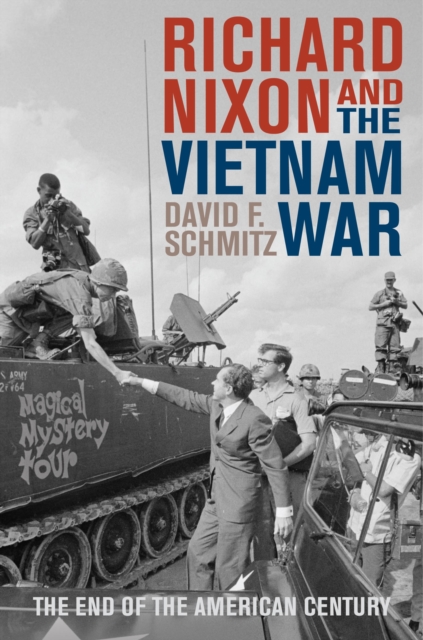
Richard Nixon and the Vietnam War
In Richard Nixon and the Vietnam War, accomplished foreign relations historian David F. Shmitz provides students of US history and the Vietnam era with an up-to-date analysis of Nixon’s Vietnam policy in a brief and accessible book that addresses the main controversies of the Nixon years. President Richard Nixon’s first presidential term oversaw the definitive crucible of the Vietnam War. Nixon came into office seeking the kind of decisive victory that had eluded President Johnson, and went about expanding the war, overtly and covertly, in order to uphold a policy of “containment,” protect America’s credibility, and defy the left’s antiwar movement at home. Tactically, politically, Nixon’s moves made sense. However, by 1971 the president was forced to significantly de-escalate the American presence and seek a negotiated end to the war, which is now accepted as an American defeat, and a resounding failure of American foreign relations. Schmitz addresses the main controversies of Nixon’s Vietnam strategy, and in so doing manages to trace back the ways in which this most calculating and perceptive politician wound up resigning from office a fraud and failure. Finally, the book seeks to place the impact of Nixon’s policies and decisions in the larger context of post-World War II American society, and analyzes the full costs of the Vietnam War that the nation feels to this day.
eBook

Constructing the U.S. Rapprochement with China, 1961–1974
With Nixon's historic reconciliation with China in 1972, Sino-American relations were restored, and China moved from being regarded as America's most implacable enemy to a friend and tacit ally. Existing accounts of the rapprochement focus on the shifting balance of power between the USA, China and the Soviet Union, but in this book Goh argues that they cannot adequately explain the timing and policy choices related to Washington's decisions for reconciliation with Beijing. Instead, she applies a more historically sensitive approach that privileges contending official American constructions of China's identity and character. This book demonstrates that ideas of reconciliation with China were already being propagated and debated within official circles in the USA during the 1960s. It traces the related policy discourse and imagery, and examines their continuities and evolution into the early 1970s that facilitated Nixon's new policy.
eBook

The fall of Richard Nixon : a reporter remembers Watergate
\"The last year of the Nixon presidency was filled with power politics, legal jiu-jitsu and high-stakes showdowns, with head-shaking surprises every day. Tom Brokaw, the NBC News White House correspondent during the final year of Watergate, gives us a close-up, personal account of the players, the strategies, and the highs and lows of the scandal that brought down a president. Brokaw writes, 'Even now, almost half a century later, I am astonished by what the country went through, and I wanted to share press stories from the inside looking out -- what it was like to be on call 24/7, the twists and turns, the laughs and tensions during this historic time.'\"-- Provided by publisher.
Book

Nixon’s Back Channel to Moscow
Most Americans consider détente-the reduction of tensions
between the United States and the Soviet Union-to be among the
Nixon administration's most significant foreign policy successes.
The diplomatic back channel that national security advisor Henry
Kissinger established with Soviet ambassador Anatoly Dobrynin
became the most important method of achieving this thaw in the Cold
War. Kissinger praised back channels for preventing leaks,
streamlining communications, and circumventing what he perceived to
be the US State Department's unresponsive and self-interested
bureaucracy. Nixon and Kissinger's methods, however, were widely
criticized by State Department officials left out of the loop and
by an American press and public weary of executive branch
prevarication and secrecy.
Richard A. Moss's penetrating study documents and analyzes
US-Soviet back channels from Nixon's inauguration through what has
widely been heralded as the apex of détente, the May 1972 Moscow
Summit. He traces the evolution of confidential-channel diplomacy
and examines major flashpoints, including the 1970 crisis over
Cienfuegos, Cuba, the Strategic Arms Limitations Talks (SALT), US
dealings with China, deescalating tensions in Berlin, and the
Vietnam War. Moss argues that while the back channels improved
US-Soviet relations in the short term, the Nixon-Kissinger methods
provided a poor foundation for lasting policy.
Employing newly declassified documents, the complete record of
the Kissinger-Dobrynin channel-jointly compiled, translated,
annotated, and published by the US State Department and the Russian
Foreign Ministry-as well as the Nixon tapes, Moss reveals the
behind-the-scenes deliberations of Nixon, his advisers, and their
Soviet counterparts. Although much has been written about détente,
this is the first scholarly study that comprehensively assesses the
central role of confidential diplomacy in shaping America's foreign
policy during this critical era.
eBook

Richard Nixon
Chronicles the life of the thirty-seventh U.S. president, covering his early life and career, entry into politics, foreign and domestic policies as commander-in-chief, and the scandal that ended his presidency.
BOOK

Posters for Peace
By the spring of 1970, Americans were frustrated by continuing war in Vietnam and turmoil in the inner cities. Students on American college campuses opposed the war in growing numbers and joined with other citizens in ever-larger public demonstrations against the war. Some politicians—including Ronald Reagan, Spiro Agnew, and Richard Nixon—exploited the situation to cultivate anger against students. At the University of California at Berkeley, student leaders devoted themselves, along with many sympathetic faculty, to studying the war and working for peace. A group of art students designed, produced, and freely distributed thousands of antiwar posters. Posters for Peace tells the story of those posters, bringing to life their rhetorical iconography and restoring them to their place in the history of poster art and political street art. The posters are vivid, simple, direct, ironic, and often graphically beautiful. Thomas Benson shows that the student posters from Berkeley appealed to core patriotic values and to the legitimacy of democratic deliberation in a democracy—even in a time of war.
eBook


A Matter of Simple Justice
In August 1972, Newsweek proclaimed that \"the person in Washington who has done the most for the women's movement may be Richard Nixon.\" Today, opinions of the Nixon administration are strongly colored by foreign policy successes and the Watergate debacle. Its accomplishments in advancing the role of women in government have been largely forgotten. Based on the \"A Few Good Women\" oral history project at the Penn State University Libraries, A Matter of Simple Justice illuminates the administration's groundbreaking efforts to expand the role of women—and the long-term consequences for women in the American workplace.
At the forefront of these efforts was Barbara Hackman Franklin, a staff assistant to the president who was hired to recruit more women into the upper levels of the federal government. Franklin, at the direction of President Nixon, White House counselor Robert Finch, and personnel director Fred Malek, became the administration's de facto spokesperson on women's issues. She helped bring more than one hundred women into executive positions in the government and created a talent bank of more than a thousand names of qualified women. The Nixon administration expanded the numbers of women on presidential commissions and boards, changed civil service rules to open thousands more federal jobs to women, and expanded enforcement of antidiscrimination laws to include gender discrimination. Also during this time, Congress approved the Equal Rights Amendment and Nixon signed Title IX of the Education Amendments into law. The story of Barbara Hackman Franklin and those \"few good women\" shows how the advances that were made in this time by a Republican presidency both reflected the national debate over the role of women in society and took major steps toward equality in the workplace for women.
eBook