
Catalogue Search | MBRL


Are you sure you want to remove the book from the shelf?

{{itemTitle}}
66
result(s) for
"1975-1979"
Sort by:

Vietnam's strategic thinking during the Third Indochina War
\"Why did Vietnam invade and occupy Cambodia in 1978? And why did it eventually change its approach, shifting from military confrontation to economic reform and reconciliation with China in the late 1980s? Drawing on rarely accessed archival documents, Kosal Path explores this major change in Vietnamese leaders' objectives and strategies. Unlike most studies, which attribute the invasion to political elites' paranoia and imperial ambition over Indochina, Path argues that Hanoi's move was rational and strategic, intended to resolve its economic crisis and counter imminent threats posed by the Sino-Cambodian alliance by cementing its own alliance with the Soviet Union. As these costly efforts failed in the 1980s, Vietnamese thinking shifted from the doctrinal Marxist-Leninist ideology that had prevailed during the last decade of the Cold War to the approach that would come to characterize the post-Cold War era. Path traces the moving target of Vietnam's changing priorities: first from military victory to Socialist economic reconstruction in 1975-76; then to military confrontation in 1978-1984; and finally, in 1985-86, to the broad reforms dubbed Doi Moi (\"renovation\"), meant to create a peaceful regional environment for Vietnam's integration into the global economy. Path's sources include internally circulated reports from provincial authorities, ministries, and ad hoc Party committees--materials that have been largely masked by the Vietnamese nationalist history of Vietnam's selfless assistance to Cambodia's revolution and glossed over by the Cambodian nationalist narrative of Vietnam's longstanding imperial ambition in Cambodia\"-- Provided by publisher.
Book

Why did they kill? : Cambodia in the shadow of genocide
Of all the horrors human beings perpetrate, genocide stands near the top of the list. Its toll is staggering: well over 100 million dead worldwide. Why Did They Kill? is one of the first anthropological attempts to analyze the origins of genocide. In it, Alexander Hinton focuses on the devastation that took place in Cambodia from April 1975 to January 1979 under the Khmer Rouge in order to explore why mass murder happens and what motivates perpetrators to kill. Basing his analysis on years of investigative work in Cambodia, Hinton finds parallels between the Khmer Rouge and the Nazi regimes. Policies in Cambodia resulted in the deaths of over 1.7 million of that country's 8 million inhabitants—almost a quarter of the population--who perished from starvation, overwork, illness, malnutrition, and execution. Hinton considers this violence in light of a number of dynamics, including the ways in which difference is manufactured, how identity and meaning are constructed, and how emotionally resonant forms of cultural knowledge are incorporated into genocidal ideologies.
eBook
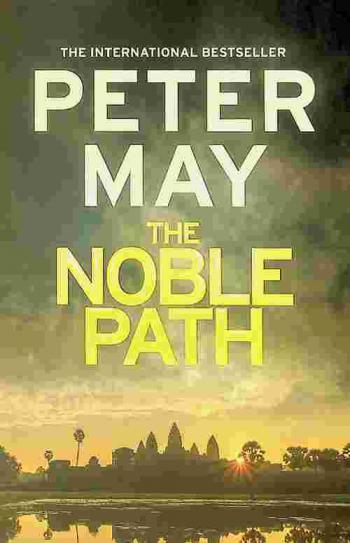
The noble path
\"THE EVIL WRATH Cambodia, 1978: Amid the Khmer Rouge's crazed genocide, soldier-of-fortune Jack Elliott is given the impossible task of rescuing a family from the regime. THE PAINFUL TRUTH Eighteen-year-old orphan and budding journalist Lisa Robinson has received the impossible news that her father is, in fact, alive. His name is Jack Elliott. THE NOBLE PATH As Jack tracks the hostages and Lisa traces her heritage, each intent on reuniting a family. Yet to succeed, they each must run a dangerous gauntlet of bullets and betrayal\"-- Provided by publisher.

Anthropological Witness
Anthropological Witness tells
the story of Alexander Laban Hinton's encounter with an accused
architect of genocide and, more broadly, Hinton's attempt to
navigate the promises and perils of expert testimony. In
March 2016, Hinton served as an expert witness at the Extraordinary
Chambers in the Courts of Cambodia, an international tribunal
established to try senior Khmer Rouge leaders for crimes committed
during the 1975-79 Cambodian genocide. His testimony culminated in
a direct exchange with Pol Pot's notorious right-hand man, Nuon
Chea, who was engaged in genocide denial.
Anthropological Witness looks at big questions about
the ethical imperatives and epistemological assumptions involved in
explanation and the role of the public scholar in addressing issues
relating to truth, justice, social repair, and genocide. Hinton
asks: Can scholars who serve as expert witnesses effectively
contribute to international atrocity crimes tribunals where the
focus is on legal guilt as opposed to academic explanation? What
does the answer to this question say more generally about academia
and the public sphere? At a time when the world faces a multitude
of challenges, the answers Hinton provides to such questions about
public scholarship are urgent.
eBook


War, Genocide, and Justice
In the three years, eight months, and twenty days of the Khmer Rouge's deadly reign over Cambodia, an estimated 1.7 million Cambodians perished as a result of forced labor, execution, starvation, and disease. Despite the passage of more than thirty years, two regime shifts, and a contested U.N. intervention, only one former Khmer Rouge official has been successfully tried and sentenced for crimes against humanity in an international court of law to date. It is against this background of war, genocide, and denied justice that Cathy J. Schlund-Vials explores the work of 1.5-generation Cambodian American artists and writers.
Drawing on what James Young labels \"memory work\"-the collected articulation of large-scale human loss-War, Genocide, and Justiceinvestigates the remembrance work of Cambodian American cultural producers through film, memoir, and music. Schlund-Vials includes interviews with artists such as Anida Yoeu Ali, praCh Ly, Sambath Hy, and Socheata Poeuv. Alongside the enduring legacy of the Killing Fields and post-9/11 deportations of Cambodian American youth, artists potently reimagine alternative sites for memorialization, reclamation, and justice. Traversing borders, these artists generate forms of genocidal remembrance that combat amnesic politics and revise citizenship practices in the United States and Cambodia.
Engaged in politicized acts of resistance, individually produced and communally consumed, Cambodian American memory work represents a significant and previously unexamined site of Asian American critique.
eBook


Archiving the Unspeakable
Roughly 1.7 million people died in Cambodia from untreated disease, starvation, and execution during the Khmer Rouge reign of less than four years in the late 1970s. The regime’s brutality has come to be symbolized by the multitude of black-and-white mug shots of prisoners taken at the notorious Tuol Sleng prison, where thousands of “enemies of the state” were tortured before being sent to the Killing Fields. In
Archiving the Unspeakable , Michelle Caswell traces the social life of these photographic records through the lens of archival studies and elucidates how, paradoxically, they have become agents of silence and witnessing, human rights and injustice as they are deployed at various moments in time and space. From their creation as Khmer Rouge administrative records to their transformation beginning in 1979 into museum displays, archival collections, and databases, the mug shots are key components in an ongoing drama of unimaginable human suffering. Winner, Waldo Gifford Leland Award, Society of American Archivists Longlist, ICAS Book Prize, International Convention of Asia Scholars
eBook


Facing the Khmer Rouge
As a child growing up in Cambodia, Ronnie Yimsut played among the ruins of the Angkor Wat temples, surrounded by a close-knit community. As the Khmer Rouge gained power and began its genocidal reign of terror, his life became a nightmare. In this stunning memoir, Yimsut describes how, in the wake of death and destruction, he decides to live.
Escaping the turmoil of Cambodia, he makes a perilous journey through the jungle into Thailand, only to be sent to a notorious Thai prison. Fortunately, he is able to reach a refugee camp and ultimately migrate to the United States, where he attended the University of Oregon and became an influential leader in the community of Cambodian immigrants.Facing the Khmer Rougeshows Ronnie Yimsut's personal quest to rehabilitate himself, make a new life in America, and then return to Cambodia to help rebuild the land of his birth.
eBook