
Catalogue Search | MBRL


Are you sure you want to remove the book from the shelf?

{{itemTitle}}
1,284
result(s) for
"1981-1989"
Sort by:


European Integration and the Atlantic Community in the 1980s
This unique collection of essays lays the groundwork for the study of the intersection of European integration and transatlantic relations in the 1980s. With archives for this period only recently being opened, scholars are beginning to analyse and understand what some have called a peak moment in the European project and others have called the Second Cold War. How do these moments intersect and relate to one another? These essays, by prominent scholars from Europe and the United States, examine these and related questions while challenging the '1980s' itself as a useful demarcation for historical analysis.
eBook


The White House Vice Presidency
\"I am nothing, but I may be everything,\" John Adams, the first vice president, wrote of his office. And for most of American history, the \"nothing\" part of Adams's formulation accurately captured the importance of the vice presidency, at least as long as the president had a heartbeat. But a job that once was \"not worth a bucket of warm spit,\" according to John Nance Garner, became, in the hands of the most recent vice presidents, critical to the governing of the country on an ongoing basis. It is this dramatic development of the nation's second office that Joel K. Goldstein traces and explains inThe White House Vice Presidency.The rise of the vice presidency took a sharp upward trajectory with the vice presidency of Walter Mondale. In Goldstein's work we see how Mondale and Jimmy Carter designed and implemented a new model of the office that allowed the vice president to become a close presidential adviser and representative on missions that mattered. Goldstein takes us through the vice presidents from Mondale to Joe Biden, presenting the arrangements each had with his respective president, showing elements of continuity but also variations in the office, and describing the challenges each faced and the work each did. The book also examines the vice-presidential selection process and campaigns since 1976, and shows how those activities affect and/or are affected by the newly developed White House vice presidency.The book presents a comprehensive account of the vice presidency as the office has developed from Mondale to Biden. ButThe White House Vice Presidencyis more than that; it also shows how a constitutional office can evolve through the repetition of accumulated precedents and demonstrates the critical role of political leadership in institutional development. In doing so, the book offers lessons that go far beyond the nation's second office, important as it now has become.
eBook


Unraveling the Gray Area Problem
In Unraveling the Gray Area
Problem , Luke Griffith examines the US role
in why the Intermediate-Range Nuclear Forces (INF) Treaty took
almost a decade to negotiate and then failed in just thirty
years. The INF Treaty enhanced Western security by
prohibiting US and Russian ground-based missiles with maximum
ranges of 500 to 5,500 kilometers. Significantly, it eliminated
hundreds of Soviet SS-20 missiles, which could annihilate targets
throughout Eurasia in minutes. Through close scrutiny of US theater
nuclear policy from 1977 to 1987, Griffith describes the Carter
administration's masterminding of the dual-track decision of
December 1979, the North Atlantic Treaty Organization (NATO)
initiative that led to the INF Treaty. The Reagan administration,
in turn, overcame bureaucratic infighting, Soviet intransigence,
and political obstacles at home and abroad to achieve a
satisfactory outcome in the INF negotiations.
Disagreements between the US and Russia undermined the INF
Treaty and led to its dissolution in 2019. Meanwhile, the US is
developing a new generation of ground-based, INF-type missiles that
will have an operational value on the battlefield. Griffith urges
policymakers to consider the utility of INF-type missiles in new
arms control negotiations. Understanding the scope and consistency
of US arms control policy across the Carter and Reagan
administrations offers important lessons for policymakers in the
twenty-first century.
eBook


1980
1980 was a turning point in American history. When the year began, it was still very much the 1970s, with Jimmy Carter in the White House, a sluggish economy marked by high inflation, and the disco still riding the airwaves. When it ended, Ronald Reagan won the presidency in a landslide, inaugurating a rightward turn in American politics and culture. We still feel the effects of this tectonic shift today, as even subsequent Democratic administrations have offered neoliberal economic and social policies that owe more to Reagan than to FDR or LBJ. To understand what the American public was thinking during this pivotal year, we need to examine what they were reading, listening to, and watching.
1980: America's Pivotal Year puts the news events of the era—everything from the Iran hostage crisis to the rise of televangelism—into conversation with the year's popular culture. Separate chapters focus on the movies, television shows, songs, and books that Americans were talking about that year, including both the biggest hits and some notable flops that failed to capture the shifting zeitgeist. As he looks at the events that had Americans glued to their screens, from the Miracle on Ice to the mystery of Who Shot J.R., cultural historian Jim Cullen garners surprising insights about how Americans' attitudes were changing as they entered the 1980s.
Praise for Jim Cullen's previous Rutgers University Press books:
\"Informed and perceptive\" —Norman Lear on Those Were the Days: Why All in the Family Still Matters
\"Jim Cullen is one of the most acute cultural historians writing today.\" —Louis P. Masur, author of The Sum of Our Dreams on Martin Scorsese and the American Dream
\"This is a terrific book, fun and learned and provocative...Cullen provides an entertaining and thoughtful account of the ways that we remember and how this is influenced and directed by what we watch.\" —Jerome de Groot, author of Consuming History on From Memory to History
eBook

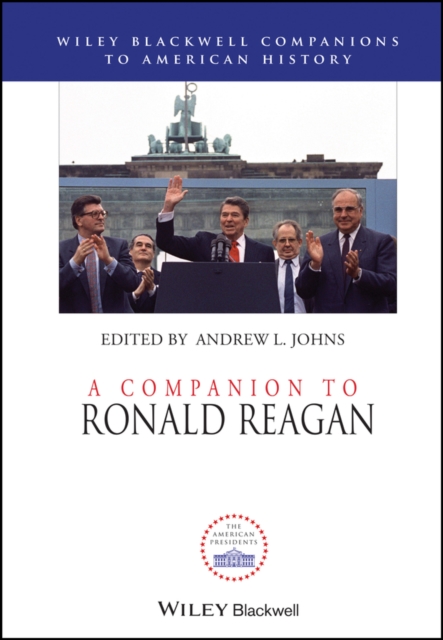
A companion to Ronald Reagan
A Companion to Ronald Reagan evaluates in unprecedented detail the events, policies, politics, and people of Reagan's administration. It assesses the scope and influence of his various careers within the context of the times, providing wide-ranging coverage of his administration, and his legacy.
eBook