
Catalogue Search | MBRL


Are you sure you want to remove the book from the shelf?

{{itemTitle}}
5,433
result(s) for
"1998"
Sort by:

Civil Islam
Civil Islamtells the story of Islam and democratization in Indonesia, the world's largest Muslim nation. Challenging stereotypes of Islam as antagonistic to democracy, this study of courage and reformation in the face of state terror suggests possibilities for democracy in the Muslim world and beyond.
Democratic in the early 1950s and with rich precedents for tolerance and civility, Indonesia succumbed to violence. In 1965, Muslim parties were drawn into the slaughter of half a million communists. In the aftermath of this bloodshed, a \"New Order\" regime came to power, suppressing democratic forces and instituting dictatorial controls that held for decades. Yet from this maelstrom of violence, repressed by the state and denounced by conservative Muslims, an Islamic democracy movement emerged, strengthened, and played a central role in the 1998 overthrow of the Soeharto regime. In 1999, Muslim leader Abdurrahman Wahid was elected President of a reformist, civilian government.
In explaining how this achievement was possible, Robert Hefner emphasizes the importance of civil institutions and public civility, but argues that neither democracy nor civil society is possible without a civilized state. Against portrayals of Islam as inherently antipluralist and undemocratic, he shows that Indonesia's Islamic reform movement repudiated the goal of an Islamic state, mobilized religiously ecumenical support, promoted women's rights, and championed democratic ideals. This broadly interdisciplinary and timely work heightens our awareness of democracy's necessary pluralism, and places Indonesia at the center of our efforts to understand what makes democracy work.
eBook

Indonesia : twenty years of democracy
This Element argues that after twenty years of democratization, Indonesia has performed admirably. This is especially so when the country's accomplishments are placed in comparative perspective. However, as we analytically focus more closely to inspect Indonesia's political regime, political economy, and how identity-based mobilizations have emerged, it is clear that Indonesia still has many challenges to overcome, some so pressing that they could potentially erode or reverse many of the democratic gains the country has achieved since its former authoritarian ruler, Soeharto, was forced to resign in 1998--Back cover.
Book

From Strangers to Neighbors
Natural disasters, the effects of climate change, and political upheavals and war have driven tens of millions of people from their homes and spurred intense debates about how governments and nongovernmental organizations (NGOs) should respond with long-term resettlement strategies. Many resettlement efforts have focused primarily on providing infrastructure and have done little to help displaced people and communities rebuild social structure, which has led to resettlement failures throughout the world. So what does it take to transform a resettlement into a successful community? This book offers the first long-term comparative study of social outcomes through a case study of two Honduran resettlements built for survivors of Hurricane Mitch (1998) by two different NGOs. Although residents of each arrived from the same affected neighborhoods and have similar demographics, twelve years later one resettlement wrestles with high crime, low participation, and low social capital, while the other maintains low crime, a high degree of social cohesion, participation, and general social health. Using a multi-method approach of household surveys, interviews, ethnography, and analysis of NGO and community documents, Ryan Alaniz demonstrates that these divergent resettlement trajectories can be traced back to the type and quality of support provided by external organizations and the creation of a healthy, cohesive community culture. His findings offer important lessons and strategies that can be utilized in other places and in future resettlement policy to achieve the most effective and positive results.
eBook

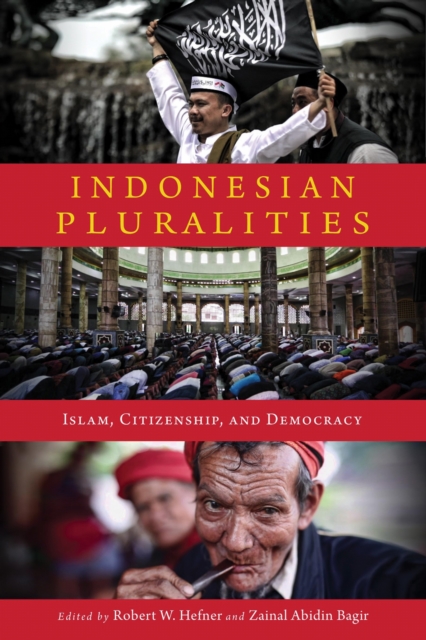
Indonesian Pluralities
The crisis of multiculturalism in the West and the failure of
the Arab uprisings in the Middle East have pushed the question of
how to live peacefully within a diverse society to the forefront of
global discussion. Against this backdrop, Indonesia has taken on a
particular importance: with a population of 265 million people
(87.7 percent of whom are Muslim), Indonesia is both the largest
Muslim-majority country in the world and the third-largest
democracy. In light of its return to electoral democracy from the
authoritarianism of the former New Order regime, some analysts have
argued that Indonesia offers clear proof of the compatibility of
Islam and democracy. Skeptics argue, however, that the growing
religious intolerance that has marred the country's political
transition discredits any claim of the country to democratic
exemplarity. Based on a twenty-month project carried out in several
regions of Indonesia, Indonesian Pluralities: Islam,
Citizenship, and Democracy shows that, in assessing the
quality and dynamics of democracy and citizenship in Indonesia
today, we must examine not only elections and official politics,
but also the less formal, yet more pervasive, processes of social
recognition at work in this deeply plural society. The contributors
demonstrate that, in fact, citizen ethics are not static discourses
but living traditions that co-evolve in relation to broader
patterns of politics, gender, religious resurgence, and ethnicity
in society.
Indonesian Pluralities offers important insights on the
state of Indonesian politics and society more than twenty years
after its return to democracy. It will appeal to political
scholars, public analysts, and those interested in Islam, Southeast
Asia, citizenship, and peace and conflict studies around the
world.
Contributors: Robert W. Hefner, Erica M. Larson, Kelli Swazey,
Mohammad Iqbal Ahnaf, Marthen Tahun, Alimatul Qibtiyah, and Zainal
Abidin Bagir
eBook

Brokering the Good Friday Agreement : the untold story
Irish civil servants and political advisers reveal their role in the Northern Ireland peace process. Their testimonies evoke a strong sense of the highly sensitive political environment in which they worked. They reflect on the impact of an ever-changing political landscape on prospects for advancing the peace process, and on the evolution of policy and thinking about Northern Ireland from the outbreak of violence in 1968 to the conclusion of the 1998 Good Friday Agreement. These personal accounts offer insight into how the Irish tried to shape the course of the negotiation of a hard-won agreement.-- Provided by publisher.
Book
Constitutional Change and Democracy in Indonesia
How did democracy became entrenched in the world's largest Muslim-majority country? After the fall of its authoritarian regime in 1998, Indonesia pursued an unusual course of democratization. It was insider-dominated and gradualist and it involved free elections before a lengthy process of constitutional reform. At the end of the process, Indonesia's amended constitution was essentially a new and thoroughly democratic document. By proceeding as they did, the Indonesians averted the conflict that would have arisen between adherents of the old constitution and proponents of radical, immediate reform. Donald L. Horowitz documents the decisions that gave rise to this distinctive constitutional process. He then traces the effects of the new institutions on Indonesian politics and discusses their shortcomings and their achievements in steering Indonesia away from the dangers of polarization and violence. He also examines the Indonesian story in the context of comparative experience with constitutional design and intergroup conflict.
eBook

My father's daughter : a memoir
A portrait of Frank Sinatra by daughter Tina focuses on his marriage to Barbara Marx Sinatra and his later years.
Book
Elements of War Crimes under the Rome Statute of the International Criminal Court
The Elements of War Crimes will assist the International Criminal Court (ICC) in the interpretation and application of the articles of the ICC Statute defining the crimes under its jurisdiction. These will not only be necessary for the future work of the ICC in interpreting the crimes provisions, but also for national courts, which have primary responsibility in the prosecution of international crimes under the Rome Statute. This commentary provides a critical insight into the travaux préparatoires of the Preparatory Commission leading to the adoption of the elements of war crimes. It contains an analysis of existing case law related to each war crime in the Statute. It will provide States, judges, prosecutors and international and national lawyers with key background information to implement international humanitarian law in future cases dealing with war crimes under the ICC. A unique, indispensable tool for prosecuting and defense lawyers working in international criminal law.
eBook