
Catalogue Search | MBRL


Are you sure you want to remove the book from the shelf?

{{itemTitle}}
1,994
result(s) for
"20. Jahrhundert"
Sort by:

Von Weinnestern und goldenen Söhnen
Nach dem Zweiten Weltkrieg waren die Bemühungen um den Auf- und Ausbau des deutschen Bibliothekswesens vornehmlich auf die Universitätsbibliotheken gerichtet, während die Landesbibliotheken als Stätten des historischen Erbes ihrer jeweiligen Regionen an den Rand gedrängt zu werden drohten. Ihr maßgeblich von Dr. Hermann Sauter (Landesbibliothek Speyer) initiierter Zusammenschluss zur Arbeitsgemeinschaft der Landesbibliotheken im Jahre 1958 verschaffte ihnen bibliothekspolitisches Gewicht: 1964 fanden sie Einlass in die „Empfehlungen des Wissenschaftsrates zum Ausbau der wissenschaftlichen Einrichtungen“. Durch die Vereinigung mit der Arbeitsgemeinschaft der kommunalen wissenschaftlichen Bibliotheken im Jahre 1971 entstand die Arbeitsgemeinschaft der Regionalbibliotheken. Der vorliegende Beitrag blickt zurück insbesondere auf die Anfänge dieser sechzigjährigen Geschichte, skizziert aber auch in groben Zügen deren weiteren Verlauf. Er wurde in verkürzter Form auf der Herbsttagung der Arbeitsgemeinschaft der Regionalbibliotheken als Festvortrag präsentiert.
Journal Article

Immigration in American economic history
The United States has long been perceived as a land of opportunity for immigrants. Yet, both in the past and today, US natives have expressed concern that immigrants fail to integrate into US society and lower wages for existing workers. This paper reviews the literatures on historical and contemporary migrant flows, yielding new insights on migrant selection, assimilation of immigrants into US economy and society, and the effect of immigration on the labor market.
Journal Article

Genes, gender inequality, and educational attainment
Women’s opportunities have been profoundly altered over the past century by reductions in the social and structural constraints that limit women’s educational attainment. Do social constraints manifest as a suppressing influence on genetic indicators of potential, and if so, did equalizing opportunity mean equalizing the role of genetics? We address this with three cohort studies: the Wisconsin Longitudinal Study (WLS; birth years 1939 to 1940), the Health and Retirement Study, and the National Longitudinal Study of Adolescent Health (Add Health; birth years 1975 to 1982). These studies include a “polygenic score” for educational attainment, providing a novel opportunity to explore this question. We find that within the WLS cohort, the relationship between genetics and educational outcomes is weaker for women than for men. However, as opportunities changed in the 1970s and 1980s, and many middle-aged women went back to school, the relationship between genetic factors and education strengthened for women as they aged. Furthermore, utilizing the HRS and Add Health, we find that as constraints limiting women’s educational attainment declined, gender differences in the relationship between genetics and educational outcomes weakened. We demonstrate that genetic influence must be understood through the lens of historical change, the life course, and social structures like gender.
Journal Article

Cultural change as learning
This paper develops a learning model of cultural change to investigate why women's labor force participation (LFP) and attitudes toward women's work both changed dramatically. In the model, women's beliefs about the long-run payoff from working evolve endogenously via an intergenerational learning process. This process generically generates the data's S-shaped LFP curve and introduces a novel role for wage changes via their effect on the speed of intergenerational learning. The calibrated model does a good job of replicating the evolution of female LFP in the United States over the last 120 years and finds that the new role for wages was quantitatively significant.
Journal Article

The Bloomsbury handbook of Montessori education
\"Maria Montessori (1870-1952) was an Italian physician, anthropologist, and educator known around the world for her educational philosophy and pedagogy. Her work established educational environments tailored to the child where autonomy and independence are encouraged within thriving and respectful communities. The Bloomsbury Handbook of Montessori Education is an accessible resource tracing Montessori education from its historical roots to current scholarship and contemporary issues of culture, social justice, and environmentalism. Divided into six sections the handbook encompasses a range of topics related to Maria Montessori and Montessori education including foundations and evolution of the field; key writings; pedagogy across the lifespan; scholarly research; global reach; and contemporary considerations such as gender, inclusive education, race and multilingualism. Written by scholars and practitioners based in over 20 countries, this is the go-to reference work for anyone interested in Montessori education.\" -- Publisher. Contents: Part 1. Foundations and evolution of Montessori education -- Part 2. Key writings of Maria Montessori -- Part 3. Montessori pedagogy across the lifespan -- Part 4. The science of Montessori education -- Part 5. Global Montessori education -- Part 6. Contemporary considerations regarding Montessori education.
Book

Exploring the associations of daily movement behaviours and mid-life cognition: a compositional analysis of the 1970 British Cohort Study
BackgroundMovement behaviours (eg, sedentary behaviour (SB), moderate and vigorous physical activity (MVPA), light intensity physical activity (LIPA) and sleep) are linked to cognition, yet the relative importance of each component is unclear, and not yet explored with compositional methodologies.ObjectiveTo (i) assess the associations of different components of daily movement and participant’s overall cognition, memory and executive function, and (ii) understand the relative importance of each individual component for cognition.MethodsThe 1970 British Cohort Study (BCS70) is a prospective birth cohort study of UK-born adults. At age 46, participants consented to wear an accelerometer device and complete tests of verbal memory and executive function. Compositional linear regression was used to examine cross-sectional associations between 24-hour movement behaviours and standardised cognition scores. Isotemporal substitution was performed to model the effect of reallocating time between components of daily movement on cognition.ResultsThe sample comprised 4481 participants (52% female). Time in MVPA relative to SB, LIPA and sleep was positively associated with cognition after adjustments for education and occupational physical activity, but additional adjustment for health status attenuated associations. SB relative to all other movements was robustly positively associated with cognition. Modelling time reallocation between components revealed an increase in cognition centile after MVPA theoretically replaced 9 min of SB (OR=1.31; 95% CI 0.09 to 2.50), 7 min of LIPA (1.27; 0.07 to 2.46) or 7 min of sleep (1.20; 0.01 to 2.39).ConclusionsRelative to time spent in other behaviours, greater MVPA and SB was associated with higher cognitive scores. Loss of MVPA time, given its smaller relative amount, appears most deleterious. Efforts should be made to preserve MVPA time, or reinforce it in place of other behaviours.
Journal Article

The Eurocentric Conception of World Politics
John Hobson claims that throughout its history most international theory has been embedded within various forms of Eurocentrism. Rather than producing value-free and universalist theories of inter-state relations, international theory instead provides provincial analyses that celebrate and defend Western civilization as the subject of, and ideal normative referent in, world politics. Hobson also provides a sympathetic critique of Edward Said's conceptions of Eurocentrism and Orientalism, revealing how Eurocentrism takes different forms, which can be imperialist or anti-imperialist, and showing how these have played out in international theory since 1760. The book thus speaks to scholars of international relations and also to all those interested in understanding Eurocentrism in the disciplines of political science/political theory, political economy/international political economy, geography, cultural and literary studies, sociology and, not least, anthropology.
eBook

Wages and human capital in the U.S. finance industry
We study the allocation and compensation of human capital in the U.S. finance industry over the past century. Across time, space, and subsectors, we find that financial deregulation is associated with skill intensity, job complexity, and high wages for finance employees. All three measures are high before 1940 and after 1985, but not in the interim period. Workers in finance earn the same education-adjusted wages as other workers until 1990, but by 2006 the premium is 50% on average. Top executive compensation in finance follows the same pattern and timing, where the premium reaches 250%. Similar results hold for other top earners in finance. Changes in earnings risk can explain about one half of the increase in the average premium; changes in the size distribution of firms can explain about one fifth of the premium for executives.
Journal Article
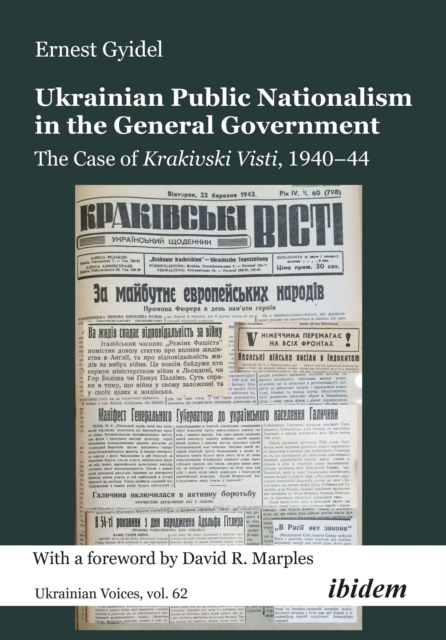
Ukrainian Public Nationalism in the General Government
Most research on Ukrainian nationalism in the 20th century focuses on the OUN and UPA and their armed struggle for Ukraine’s independence. Ernest Gyidel’s book stands apart. It deals with a little-studied page in the history of nationalism, namely its public expression in the legal press under German occupation in World War II. He uses Krakivski Visti (Cracow News)—the leading Ukrainian newspaper of the General Government—as a case study due to its unique status of being less constrained by German censorship. Gyidel walks us through a variety of nationalistic expressions, from articles attacking Poles, Jews, and Russians to texts celebrating great Ukrainian writers, commemorating the national sacrifice, and discussing the threats of mixed marriages. He reminds us that the history of Ukrainian nationalism was written not only by people with guns and bullets but also with typewriters and printed words.
eBook
The Scattered Library
The National Socialists’ May 1933 Berlin book burning and, to a growing extent, their looting of Magnus Hirschfeld’s Institute of Sexual Science (Institut für Sexualwissenschaft) are part and parcel of memorial culture in Germany and around the world. Thanks to the ongoing rehabilitation of Magnus Hirschfeld (1868–1935), and the revival of interest in his work, more people are now aware that this pioneering Jewish sexologist and LGBT-rights activist died in exile in Nice, France, profoundly traumatized by the destruction of his life’s work. This is the very first book to offer a meticulously detailed report of the three years leading up to Hirschfeld’s death in 1935 and, especially, the seven years following. This book is also the first biography of Karl Giese (1898–1938) and Karl Fein (1894–1942), the main players in the afterlife of Magnus Hirschfeld in France and Czechoslovakia, focusing on their dealings with the surviving materials of Hirschfeld’s Institute, and the consequences of the decisions they made – or may have made – as Nazi terror deepened. Numerous, hitherto untapped archival sources are used to reveal vital new facts. On their basis, this book puts forward original explanations touching on the various fates of the remnants of Hirschfeld’s Institute. It also offers the first account of the “miraculous rescue” of Hirschfeld’s guestbook (Magnus Hirschfelds Exil-Gästebuch 1933–1935) from an old paper container in Brno, Czechoslovakia, in 1942. This seminal, generously illustrated book picks up the thread where Rainer Herrn’s Der Liebe und dem Leid: Das Institut für Sexualwissenschaft (2022), a history of Hirschfeld and his Institute from 1919 to 1933, left off. Its thorough documentation provides essential context for the facsimile edition of Hirschfeld’s guestbook, published in 2019 by Hans Bergemann, Ralf Dose, Marita Keilson-Lauritz and Kevin Dubout.
eBook