
Catalogue Search | MBRL


Are you sure you want to remove the book from the shelf?

{{itemTitle}}
7,728
result(s) for
"2005"
Sort by:


Beyond Katrina
Beyond Katrina is poet Natasha Trethewey's very personal profile of the Mississippi Gulf Coast and of the people there whose lives were forever changed by hurricane Katrina. Trethewey spent her childhood in Gulfport, where much of her mother's extended family, including her younger brother, still lives. As she worked to understand the devastation that followed the hurricane, Trethewey found inspiration in Robert Penn Warren's book Segregation: The Inner Conflict in the South, in which he spoke with southerners about race in the wake of the Brown decision, capturing an event of wide impact from multiple points of view. Weaving her own memories with the experiences of family, friends, and neighbors, Trethewey traces the erosion of local culture and the rising economic dependence on tourism and casinos. She chronicles decades of wetland development that exacerbated the destruction and portrays a Gulf Coast whose citizens-particularly African Americans-were on the margins of American life well before the storm hit. Most poignantly, Trethewey illustrates the destruction of the hurricane through the story of her brother's efforts to recover what he lost and his subsequent incarceration. Renowned for writing about the idea of home, Trethewey's attempt to understand and document the damage to Gulfport started as a series of lectures at the University of Virginia that were subsequently published as essays in the Virginia Quarterly Review. For Beyond Katrina, Trethewey has expanded this work into a narrative that incorporates personal letters, poems, and photographs, offering a moving meditation on the love she holds for her childhood home. A Sarah Mills Hodge Fund Publication.
eBook

إيران الحائرة بين الشمولية والديمقراطية : نظرة من الداخل على التطورات السياسية والثقافية في عهد خاتمي
هذا الكتاب يحتوي على مجموعة من المقالات التي كتبها عزيزي ونشرها في صحف عربية ترصد الحدث الإيراني وتربطه بشقيقه العربي، تأكيدا على ترابط المسارات في المنطقة، فمصير هذه الشعوب واحد، لمواجهة الخطر المشترك وإيران والعالم العربي يشكلان وحدة حضارية مترابطة منذ ظهور الإسلام في شبه الجزيرة العربية وهذا لا يعني أن قبل ذلك لم تكن عرى ثقافية وسياسية تربط العرب بالفرس، بل إن الإسلام أرسى حضارة عظيمة، نواتها العرب وكان للفرس أيضا دورا لا يستهان به وقد فصلت الأسوار في القرن المنصرم وبفعل المؤثرات المختلفة، الشعوب الإيرانية عن الأمة العربية، غير أن قيام الثورة في فبراير 1979 والتطورات الأخيرة بعد رئاسة خاتمي، تنبئ بأن الأسوار يمكن أن تزول يوما بعد أن اهتزت واخترقت.
Book

Reforming New Orleans
Hurricane Katrina devastated New Orleans in 2005, but in the subsequent ten years, the city has demonstrated both remarkable resilience and frustrating stagnation. InReforming New Orleans, Peter F. Burns and Matthew O. Thomas chart the city's recovery and assess how successfully officials at the local, state, and federal levels transformed the Big Easy in the wake of disaster. Focusing on reforms in four key sectors of urban governance-economic development, education, housing, and law enforcement-both before and after Katrina, they find lessons for cities hit by sudden shocks, such as natural disasters or large-scale financial crises.
One of their key insights is that post-disaster recovery tends to limit local control. State and federal officials, national foundations, and local actors excluded by pre-Katrina politics used their resources and authority to displace entrenched local interests and implement a public agenda focused on institutional and governmental change. Burns and Thomas also make clear reform in New Orleans was already underway before Katrina hit, but that it had focused largely on upper- and middle-class residents, a trend that accelerated after the storm. The market-centered nature of the reforms have ensured that they largely benefited city and regional elites while not significantly aiding the city's working-class and impoverished populations. Thus reform has come at a cost and that cost, in the long term, could undermine the political gains of the post-Katrina era.
eBook

Hurricanes
Using Hurricane Katrina as an example, describes the formation, course, and effects of these violent storms and explains how scientists predict and track them.
Book

Flood of Images
Anyone who was not in New Orleans during Hurricane Katrina and the subsequent flooding of the city experienced the disaster as a media event, a flood of images pouring across television and computer screens. The twenty-four-hour news cycle created a surplus of representation that overwhelmed viewers and complicated understandings of the storm, the flood, and the aftermath. As time passed, documentary and fictional filmmakers took up the challenge of explaining what had happened in New Orleans, reaching beyond news reports to portray the lived experiences of survivors of Katrina. But while these narratives presented alternative understandings and more opportunities for empathy than TV news, Katrina remained a mediated experience. In Flood of Images, Bernie Cook offers the most in-depth, wide-ranging, and carefully argued analysis of the mediation and meanings of Katrina. He engages in innovative, close, and comparative visual readings of news coverage on CNN, Fox News, and NBC; documentaries including Spike Lee’s When the Levees Broke and If God Is Willing and Da Creek Don’t Rise, Tia Lessin and Carl Deal’s Trouble the Water, and Dawn Logsdon and Lolis Elie’s Faubourg Treme; and the HBO drama Treme. Cook examines the production practices that shaped Katrina-as-media-event, exploring how those choices structured the possible memories and meanings of Katrina and how the media’s memory-making has been contested. In Flood of Images, Cook intervenes in the ongoing process of remembering and understanding Katrina.
eBook

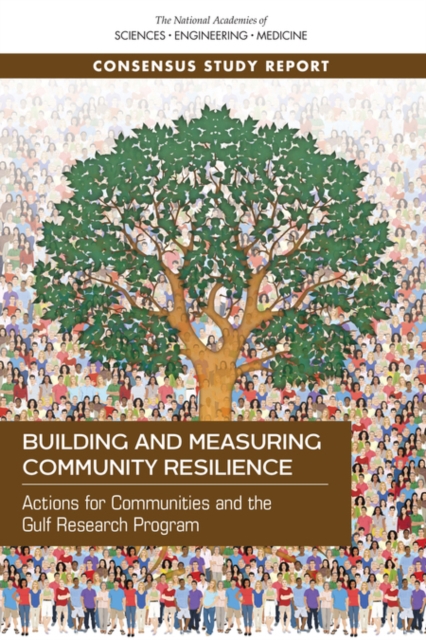
Building and Measuring Community Resilience
The frequency and severity of disasters over the last few decades have presented unprecedented challenges for communities across the United States. In 2005, Hurricane Katrina exposed the complexity and breadth of a deadly combination of existing community stressors, aging infrastructure, and a powerful natural hazard. In many ways, the devastation of Hurricane Katrina was a turning point for understanding and managing disasters, as well as related plan making and policy formulation. It brought the phrase \"community resilience\" into the lexicon of disaster management.
Building and Measuring Community Resilience: Actions for Communities and the Gulf Research Program summarizes the existing portfolio of relevant or related resilience measurement efforts and notes gaps and challenges associated with them. It describes how some communities build and measure resilience and offers four key actions that communities could take to build and measure their resilience in order to address gaps identified in current community resilience measurement efforts. This report also provides recommendations to the Gulf Research Program to build and measure resilience in the Gulf of Mexico region.
eBook

The Cultural and Political Economy of Recovery
In August 2005 the nation watched as Hurricane Katrina pummelled the Gulf Coast. Residents did not just suffer the personal costs of a home that had been severely damaged or destroyed; frequently they also lost their entire neighbourhood and the social systems that under normal circumstances made their lives \"work\". Katrina raised the questions of whether and how communities could solve the complex social coordination problems catastrophic disaster poses, and what inhibits them from doing so?
Professor Chamlee-Wright investigates not only the nature of post-disaster recovery, but the nature of the social order itself – how societies are able to achieve a level of complex social coordination that far exceeds our ability to design. By deploying the tools of both political economy and cultural economy, the book contributes to the bourgeoning literature on the social, political and economic impact of Hurricane Katrina.
Through a selection of case studies, the author argues that post-disaster resilience depends crucially upon the discovery that unfolds within commercial and civil society. The book will be of particular interest to postgraduate students and researchers in economics, sociology and anthropology as well as disaster specialists.
Introduction: Understanding the Sources of Resilience Part I: Theoretical Frame and Methodology 1. The Nature and Causes of Social Order as Seen Through Post-Disaster Recovery 2. Qualitative Methods and the Pursuit of Economic Understanding Part II: Deploying Socially Embedded Resources in a Post-Disaster Context 3. Collective Action in the Wake of Disaster: Social Capital Rebuilding Strategies of Early Returnees 4. Social Capital, Community Narratives, and Recovery Within a Vietnamese-American Neighborhood 5. Collective Narratives and Entrepreneurial Discovery in St. Bernard Parish 6. Negotiating Structure and Agency in the Ninth Ward: Sense of Place and Divine Purpose in Post Disaster Recovery Part III: Political -Economy and Social Learning in Non-Priced Environments 7. The Deleterious Effects of Signal Noise in Post-Disaster Recovery 8. Expectations Anchoring and the Civil Society Vacuum: Lessons for Public Policy 9. Concluding Remarks Part IV: Appendices Appendix A: Demographic Summaries of Research Subjects in Neighborhoods of Interest Appendix B: Sample Interview Guide Appendix C: Primary and Secondary Theme Codes
eBook