
Catalogue Search | MBRL


Are you sure you want to remove the book from the shelf?

{{itemTitle}}
1,443
result(s) for
"2008-2009"
Sort by:

False dawn : the delusions of global capitalism
In the midst of the current financial crisis, John Gray revisits his polemic against the forces of global capitalism and deregulation. In a substantial new chapter he considers how the economic landscape has shifted in the last decade and asks the question: where do we go from here?
Book

The Leaderless Economy
The Leaderless Economyreveals why international financial cooperation is the only solution to today's global economic crisis. In this timely and important book, Peter Temin and David Vines argue that our current predicament is a catastrophe rivaled only by the Great Depression. Taking an in-depth look at the history of both, they explain what went wrong and why, and demonstrate why international leadership is needed to restore prosperity and prevent future crises.
Temin and Vines argue that the financial collapse of the 1930s was an \"end-of-regime crisis\" in which the economic leader of the nineteenth century, Great Britain, found itself unable to stem international panic as countries abandoned the gold standard. They trace how John Maynard Keynes struggled for years to identify the causes of the Great Depression, and draw valuable lessons from his intellectual journey. Today we are in the midst of a similar crisis, one in which the regime that led the world economy in the twentieth century--that of the United States--is ending. Temin and Vines show how America emerged from World War II as an economic and military powerhouse, but how deregulation and a lax attitude toward international monetary flows left the nation incapable of reining in an overleveraged financial sector and powerless to contain the 2008 financial panic. Fixed exchange rates in Europe and Asia have exacerbated the problem.
The Leaderless Economyprovides a blueprint for how renewed international leadership can bring today's industrial nations back into financial balance--domestically and between each other.
eBook
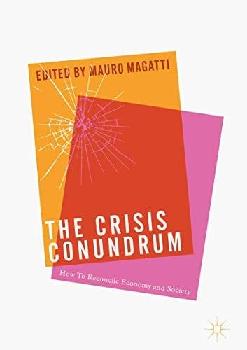
The crisis conundrum : how to reconcile economy and society
This collection addresses the path to a new prosperity after the Great Recession. The contributors ask that if the 2008 crisis proved the unsustainability of the neoliberal development model, what does well-being mean today in advanced western democracies? What kind of production and consumption will be a feature of the coming decades? What are the financial, economic, institutional and social innovations needed to reconcile economy and society after decades of disembedding? The Crisis Conundrum offers an interdisciplinary interpretation of the crisis as an opportunity to reform capitalism and consumption societies, structurally as well as culturally. Students and scholars across a range of disciplines, including sociology, economics, development studies and European studies, with find this book of interest.
Book

Subprime cities
\"Subprime Cities: The Political Economy of Mortgage Markets presents a collection of works from social scientists that offer important insights into what is happening in today's mortgage market including the causes, effects, and aftermath of the 'subprime' mortgage crisis\"--
eBook


No Freedom without Regulation
Almost everyone who follows politics or economics agrees on one thing: more regulation means less freedom. Joseph William Singer, one of the world's most respected experts on property law, explains why this understanding of regulation is simply wrong. While analysts as ideologically divided as Alan Greenspan and Joseph Stiglitz have framed regulatory questions as a matter of governments versus markets, Singer reminds us of what we've willfully forgotten: government is not inherently opposed to free markets or private property, but is, in fact, necessary to their very existence. Singer uses the recent subprime crisis to demonstrate:Regulation's essential importance for freedom and democracyWhy consumer protection laws are a basic pillar of economic freedomHow private property rests on a regulatory infrastructureWhy liberals and conservatives actually agree on these relationships far more than they disagreeThis concise volume is essential reading for policy makers, philosophers, political theorists, economists, and financial professionals on both sides of the aisle.
eBook

ما بعد الحرب على غزة : قراءة في التصورات الإسرائيلية
يقرأ الكتاب آثار العدوان الأخير على غزة على العلاقات الفلسطينية الإسرائيلية، وموقف إسرائيل من حركة حماس، والموقف من الرئيس محمود عباس كممثل لمنظمة التحرير الفلسطينية، ومن السلطة الفلسطينية، إضافة إلى القراءات الإسرائيلية لتبعات الحرب على العملية السياسية ويتتبع الكتاب تداعيات العدوان من خلال تفكيك العلاقات المركبة التي ظهرت خلال العدوان والمواقف الرسمية والعامة والفكرية التي وقفت وراء أو سعت إلى تفسير ما جرى ويخلص الكتاب إلى أن غالبية التصورات الموجودة حاليا في المشهد السياسي الإسرائيلي هي تصورات أحادية، ويبقي نتنياهو الوحيد في السلطة الذي يريد إدارة الصراع مرة أخرى مع السلطة الفلسطينية وبين الكتاب أن رؤية نتنياهو اتضحت أكثر فأكثر خلال السنوات الماضية، فهو يريد إبقاء الانقسام والتعامل مع غزة تحت حكم حماس ضعيفة أو صراع فلسطيني على السيطرة على غزة بين حماس والسلطة الفلسطينية.
Book

Political Bubbles
Behind every financial crisis lurks a \"political bubble\"--policy biases that foster market behaviors leading to financial instability. Rather than tilting against risky behavior, political bubbles--arising from a potent combination of beliefs, institutions, and interests--aid, abet, and amplify risk. Demonstrating how political bubbles helped create the real estate-generated financial bubble and the 2008 financial crisis, this book argues that similar government oversights in the aftermath of the crisis undermined Washington's response to the \"popped\" financial bubble, and shows how such patterns have occurred repeatedly throughout US history.
The authors show that just as financial bubbles are an unfortunate mix of mistaken beliefs, market imperfections, and greed, political bubbles are the product of rigid ideologies, unresponsive and ineffective government institutions, and special interests. Financial market innovations--including adjustable-rate mortgages, mortgage-backed securities, and credit default swaps--become subject to legislated leniency and regulatory failure, increasing hazardous practices. The authors shed important light on the politics that blinds regulators to the economic weaknesses that create the conditions for economic bubbles and recommend simple, focused rules that should help avoid such crises in the future.
The first full accounting of how politics produces financial ruptures,Political Bubblesoffers timely lessons that all sectors would do well to heed.
eBook

Stolen : how to save the world from financialisation
A must-read polemic about why the 'recovery' from the 2007-08 crash mostly benefited the 1%, and how democratic socialism can save us from a new crash and climate catastrophe. For decades, it has been easier to imagine the end of the world than the end of capitalism. In the decade leading up to the 2008 financial crisis, booming banks, rising house prices and cheap consumer goods propped up living standards in the rich world. Thirty years of rocketing debt and financial wizardry had masked the deep underlying fragility of finance-led growth, and in 2008 we were forced to pay up. The decade since has witnessed all kinds of morbid symptoms, as all around the rich world, wages and productivity are stagnant, inequality is rising, and ecological systems are collapsing. Stolen is a history of finance-led growth and a guide as to how we might escape it. We've sat back as financial capitalism has stolen our economies, our environment and even the future itself. Now, we have an opportunity to change course. What happens next is up to us.
Book

Digital Depression
For decades society venerated advanced information and communications technologies (ICTs) as a source of economic rejuvenation and uplift. The financial crisis of 2007-08 shook such ideas. Originating in the United States, the driver of digital systems and services, the prolonged economic slump precipitated a perplexing historical outcome: a technological revolution wrapped inside an economic collapse. Dan Schiller analyzes the crisis tendencies of capitalism to root out the sources of this digital depression. From there he traces the economic re-composition wrought by ICTs, seeing them as a leading economic growth pole akin to the 1930s consumer industries that came out of the Great Depression. Finally, he lays out the present-day battles to capture and control digital technology and its growth. Demonstrating digital technology's central role in the global political economy and connecting it to the rise of worldwide financial, production and military networks, Schiller sets the digital communication industry in the context of intensifying geopolitical conflicts over the Internet. As he shows, the forces at the core of capitalism--exploitation, commodification, and inequality--are ongoing and accelerating within the networked political economy. Timely and wide ranging, Digital Depression blazes new ground in illuminating the role of information and communications within the political economy's developmental processes.
eBook