
Catalogue Search | MBRL


Are you sure you want to remove the book from the shelf?

{{itemTitle}}
34
result(s) for
"218-201 B.C."
Sort by:


Crisis Management during the Roman Republic
'Crisis' is the defining word for our times and it likewise played a key role in defining the scope of government during the Roman Republic. This book is a comprehensive analysis of key incidents in the history of the Republic that can be characterized as crises, and the institutional response mechanisms that were employed by the governing apparatus to resolve them. Concentrating on military and other violent threats to the stability of the governing system, this book highlights both the strengths and weaknesses of the institutional framework that the Romans created. Looking at key historical moments, Gregory K. Golden considers how the Romans defined a crisis and what measures were taken to combat them, including declaring a state of emergency, suspending all non-war-related business, and instituting an emergency military draft, as well as resorting to rule by dictator in the early Republic.
eBook


Hannibal's Odyssey
Hannibal's invasion of Italia in 218 BC is depicted from the standpoint of environmental evidence elicited from ancient texts, and analyzed against present-day Earth Science databases. The conclusion is that the Punic Army followed the southern route over the Alps; a proposal first made by Sir Gavin de Beer in the 1960's.
eBook


War with Hannibal
This edition of Book III of Eutropiuss Breviarium ab urbe condita is designed to be a students first encounter with authentic, unabridged Latin prose. Written in a simple and direct style, the Breviarium covers the period of Roman history that students find the most interestingthe Second Punic War fought against Carthageand the original Latin text is supplemented with considerable learning support. Full annotations on every page, detailed commentary on grammar and syntax, and a glossary designed specifically for the text allow students to build both their confidence and their reading skills.The commentary in the back of the book is cross-referenced to the following commonly used textbooks:Wheelocks Latin, 6th EditionLatin: An Intensive Course by Moreland and FleischerEcce Romani II, 3rd EditionLatin for Americans, Level 2Jenneys Second Year LatinAllen and Greenoughs New Latin GrammarMacrons have been added to the entire text in accordance with the vowel quantities used in the Oxford Latin Dictionary. Additional resources include an unannotated version of the text for classroom use, supplementary passages in English from other ancient authors, and appendixes with a timeline of events and maps and battle plans.The text may be used in secondary schools and colleges as early as the first year of study. The copious translation help, notes, and cross-references also make it ideal for independent learners.
eBook


Brill’s Companion to Lucan
The present collection samples the most current approaches to Lucan's poem, its themes, its dialogue with other texts, its reception in medieval and early modern literature, and its relevance to audiences of all times.
eBook
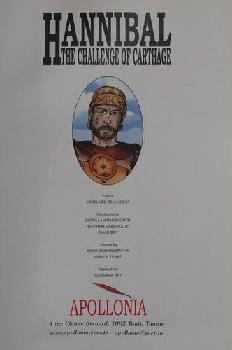
Hannibal : the challenge of Carthage
A history of the campaigns of the military genius who vowed to conquer the Romans and who entered Italy by crossing the Alps on elephants.
