
Catalogue Search | MBRL


Are you sure you want to remove the book from the shelf?

{{itemTitle}}
9
result(s) for
"843-1273"
Sort by:


Princely Brothers and Sisters
InPrincely Brothers and Sisters, Jonathan R. Lyon takes a fresh look at sibling networks and the role they played in shaping the practice of politics in the Middle Ages. Focusing on nine of the most prominent aristocratic families in the German kingdom during the Staufen period (1138-1250), Lyon finds that noblemen-and to a lesser extent, noblewomen-relied on the cooperation and support of their siblings as they sought to maintain or expand their power and influence within a competitive political environment. Consequently, sibling relationships proved crucial at key moments in shaping the political and territorial interests of many lords of the kingdom.
Family historians have largely overlooked brothers and sisters in the political life of medieval societies. As Lyon points out, however, siblings are the contemporaries whose lives normally overlap the longest. More so than parents and children, husbands and wives, or lords and vassals, brothers and sisters have the potential to develop relationships that span entire lifetimes. The longevity of some sibling bonds therefore created opportunities for noble brothers and sisters to collaborate in especially potent ways. As Lyon shows, cohesive networks of brothers and sisters proved remarkably effective at counterbalancing the authority of the Staufen kings and emperors. Well written and impeccably researched,Princely Brothers and Sistersis an important book not only for medieval German historians but also for the field of family history.
eBook

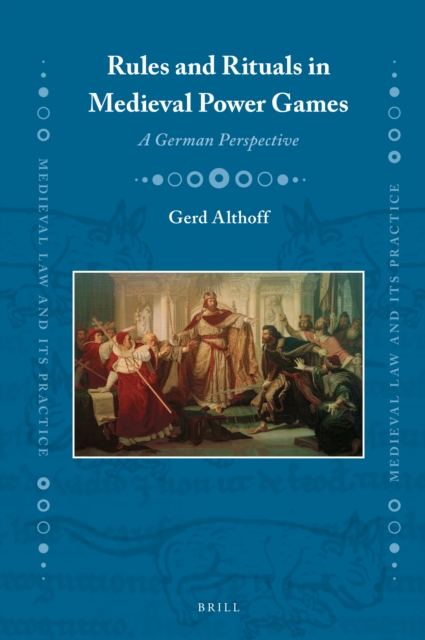
Rules and Rituals in Medieval Power Games
In Rules and Rituals in Medieval Power Games Gerd Althoff highlights the great impact of unwritten rules (Spielregeln) and rituals in establishing order in prestate societies. He underpins this view with new examples and insights taken from the German perspective and thus offers a model suitable for comparison with other societies.
eBook

Kingship and justice in the Ottonian Empire
\"Laura E. Wangerin challenges traditional views of the Ottonian Empire's rulership. Drawing from a broad array of sources including royal and imperial diplomas, manuscript illuminations, and histories, Ottonian kingship and the administration of justice are investigated using traditional historical and comparative methodologies as well as through the application of innovative approaches such as modern systems theories. This study suggests that distinctive elements of the Ottonians' governing apparatus, such as its decentralized structure, emphasis on the royal iter, and delegation of authority, were essential features of a highly developed political system. Kingship and Justice in the Ottonian Empire provides a welcome addition to English-language scholarship on the Ottonians, as well as to scholarship dealing with rulership and medieval legal studies. Scholars have recognized the importance of ritual and symbolic behaviors in the Ottonian political sphere, while puzzling over the apparent lack of administrative organization, a contradiction between what we know about the Ottonians as successful rulers and their traditional characterization as rulers of a disorganized polity. Trying to account for the apparent disparity between their political and military achievements, cultural and artistic efflorescence, and relative dynastic stability, which seemingly accompanied a disinterest in writing law or creating a centralized hierarchical administration, is a tension that persists in the scholarship\"-- Provided by publisher.
Book
Kings, politics, and the right order of the world in German historiography c. 950-1150
The volume presents a new understanding of medieval historiography by examining the representation of society, politics and human behaviour in six historical writings from imperial Germany, one of the leading political and intellectual centres during the period c. 950-1150.
eBook

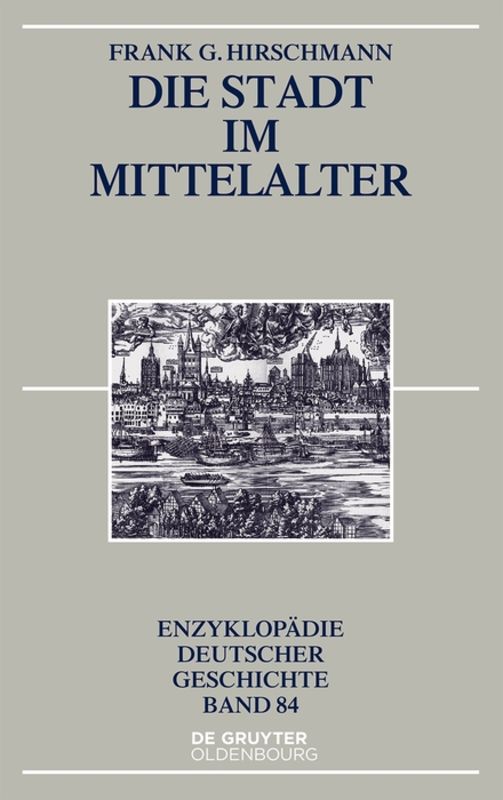
Die Stadt im Mittelalter
Frank G. Hirschmann legt sein hochgelobtes Lehrbuch zur mittelalterlichen Stadt überarbeitet vor. Die Städte werden in ihrer ganzen Vielfalt sowie unter wirtschafts-, sozial-, kirchen- und baugeschichtlicher Sicht betrachtet. Ein Nachtrag stellt die Tendenzen und Entwicklungen der Stadtgeschichtsforschung seit der ersten Auflage dar; die aktualisierte Bibliographie rundet den Band ab.
eBook
State and Society in the Early Middle Ages
This book, first published in 2000, is a pioneering study of politics and society in the early Middle Ages. Whereas it is widely believed that the source materials for early medieval Europe are too sparse to allow sustained study of the workings of social and political relationships on the ground, this book focuses on a uniquely well-documented area to investigate the basis of power. Topics covered include the foundation of monasteries, their relationship with the laity, and their role as social centres; the significance of urbanism; the control of land, the development of property rights and the organization of states; community, kinship and lordship; justice and dispute settlement; the uses of the written word; violence and the feud; and the development of political structures from the Roman empire to the high Middle Ages.
eBook