
Catalogue Search | MBRL


Are you sure you want to remove the book from the shelf?

{{itemTitle}}
3,059
result(s) for
"ACCESS TO WATER SUPPLY"
Sort by:
Africa's water and sanitation infrastructure : access, affordability, and alternatives
The Africa Infrastructure Country Diagnostic (AICD) has produced continent-wide analysis of many aspects of Africa's infrastructure challenge. The main findings were synthesized in a flagship report titled Africa's Infrastructure: a time for transformation, published in November 2009. Meant for policy makers, that report necessarily focused on the high-level conclusions. It attracted widespread media coverage feeding directly into discussions at the 2009 African Union Commission Heads of State Summit on Infrastructure. Although the flagship report served a valuable role in highlighting the main findings of the project, it could not do full justice to the richness of the data collected and technical analysis undertaken. There was clearly a need to make this more detailed material available to a wider audience of infrastructure practitioners. Hence the idea of producing four technical monographs, such as this one, to provide detailed results on each of the major infrastructure sectors, information and communication technologies (ICT), power, transport, and water, as companions to the flagship report. These technical volumes are intended as reference books on each of the infrastructure sectors. They cover all aspects of the AICD project relevant to each sector, including sector performance, gaps in financing and efficiency, and estimates of the need for additional spending on investment, operations, and maintenance. Each volume also comes with a detailed data appendix, providing easy access to all the relevant infrastructure indicators at the country level, which is a resource in and of itself.
eBook

Investigating Alternative Water Supply in Settlements: Cases from Turkana County in Kenya and Orangi in Karachi, Pakistan
In urban areas, water is usually provided through piped systems from specific sources to consumers. Cities, towns, and peri-urban settlements typically benefit from piped systems, while rural areas rely on water supplies from surface sources like rivers and canals, as well as ground sources such as wells and tube wells. When traditional methods fail, alternative water supply systems emerge in both urban and rural areas. This paper addresses the question of whether alternative water supply arrangements are sustainable in terms of system reliability, consumer acceptance, cost-effectiveness, convenience, perceptions of service levels, and ease of access to service providers. This paper examines the status of alternative water supply arrangements in Turkana County, Kenya, and Orangi in Karachi, Pakistan, using qualitative methods. It highlights that underprivileged communities commonly turn to alternative water supply arrangements when conventional methods are unavailable or underperforming.
Journal Article

Water, electricity, and the poor : who benefits from utility subsidies?
This book is an extremely thorough and readable review of how effective utility subsidies are in reaching the poor. It makes sobering reading for policy makers who have implemented such subsidy programmes, who are looking for ways to ameliorate heavy price increases, or who believed that these subsidies were useful instruments for alleviating poverty. - Catherine Waddams, Director, Center for Competition PolicySchool of Management, University of East Anglia, United Kingdom This study makes a fine contribution, theoretical and empirical, in an area where much nonsense has been preached, and many misconceptions have long been accepted as gospel. Analyzing a mass of material, the authors quantify the extent to which the most commonly applied forms of utility subsidies are regressive. And they then offer a range of practical measures that can be taken to correct the problem.- John Nellis, Senior Fellow Center for Global Development, Washington, DC While consumer utility subsidies are widespread in both the water and electricity sectors, their effectiveness in reaching and distributing resources to the poor is the subject of much debate. Water, Electricity, and the Poor brings together empirical evidence on subsidy performance across a wide range of countries. It documents the prevalence of consumer subsidies, provides a typology of the many variants found in the developing world, and presents a number of indicators useful in assessing the degree to which such subsidies benefit the poor, focusing on three key concepts: beneficiary incidence, benefit incidence, and materiality. The findings on subsidy performance will be useful to policy makers, utility regulators, and sector practitioners who are contemplating introducing, eliminating, or modifying utility subsidies, and to those who view consumer utility subsidies as a social protection
instrument.
eBook

Contrasting Two Dimensions of Disaster-Induced Water-Shortage Experiences: Water Availability and Access
The value of a good is contingent on an individual’s experience that reveals the nature of the good. This study investigates the effects of a water shortage due to the Great East Japan Earthquake and Tsunami Disaster in 2011 on the voluntary management of community wells in the water-rich town of Otsuchi, Japan. A questionnaire survey based on a choice experiment (CE) framework was conducted in 2015 in which a total of 127 residents participated. The responses were then analyzed using two types of logit models that consider preference heterogeneity across survey participants. The results revealed that the severity and duration of the water shortage had opposing effects on people’s attitudes toward the wells. More specifically, increasingly severe water shortages due to the unavailability of water rendered people less supportive of the wells, whereas water shortages of a longer duration caused by limited access to water resources made people more supportive.
Journal Article
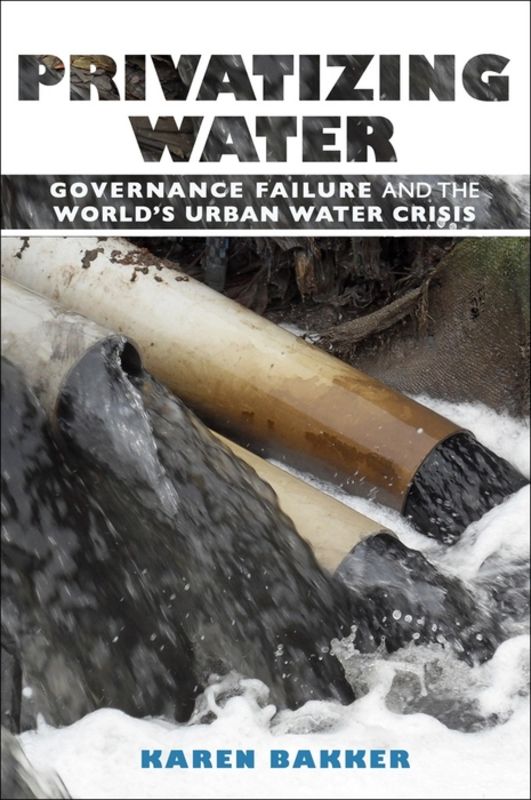
Privatizing water
Water supply privatization was emblematic of the neoliberal turn
in development policy in the 1990s. Proponents argued that the
private sector could provide better services at lower costs than
governments; opponents questioned the risks involved in delegating
control over a life-sustaining resource to for-profit companies.
Private-sector activity was most concentrated-and contested-in
large cities in developing countries, where the widespread lack of
access to networked water supplies was characterized as a global
crisis.
In Privatizing Water, Karen Bakker focuses on three questions:
Why did privatization emerge as a preferred alternative for
managing urban water supply? Can privatization fulfill its
proponents' expectations, particularly with respect to water supply
to the urban poor? And, given the apparent shortcomings of both
privatization and conventional approaches to government provision,
what are the alternatives?
In answering these questions, Bakker engages with broader
debates over the role of the private sector in development, the
role of urban communities in the provision of \"public\" services,
and the governance of public goods. She introduces the concept of
\"governance failure\" as a means of exploring the limitations facing
both private companies and governments. Critically examining a
range of issues-including the transnational struggle over the human
right to water, the \"commons\" as a water-supply-management
strategy, and the environmental dimensions of water
privatization-Privatizing Water is a balanced exploration of a
critical issue that affects billions of people around the
world.
Water supply privatization was emblematic of the neoliberal turn
in development policy in the 1990s. Proponents argued that the
private sector could provide better services at lower costs than
governments; opponents questioned the risks involved in delegating
control over a life-sustaining resource to for-profit companies.
Private-sector activity was most concentrated-and contested-in
large cities in developing countries, where the widespread lack of
access to networked water supplies was characterized as a global
crisis.
In Privatizing Water , Karen Bakker focuses on three
questions: Why did privatization emerge as a preferred alternative
for managing urban water supply? Can privatization fulfill its
proponents' expectations, particularly with respect to water supply
to the urban poor? And, given the apparent shortcomings of both
privatization and conventional approaches to government provision,
what are the alternatives? In answering these questions, Bakker
engages with broader debates over the role of the private sector in
development, the role of urban communities in the provision of
\"public\" services, and the governance of public goods. She
introduces the concept of \"governance failure\" as a means of
exploring the limitations facing both private companies and
governments.
Critically examining a range of issues-including the
transnational struggle over the human right to water, the \"commons\"
as a water-supply-management strategy, and the environmental
dimensions of water privatization- Privatizing Water is a
balanced exploration of a critical issue that affects billions of
people around the world.
eBook

Addressing china's water scarcity : recommendations for selected water resource management issues
This report reviews China's water scarcity situation, assesses the policy and institutional requirements for addressing it, and recommends key areas for strengthening and reform. It is a synthesis of the main findings and recommendations from analytical work and case studies prepared under the World Bank Analytical and Advisory Assistance (AAA) program entitled 'Addressing China's Water Scarcity: from Analysis to Action.' These studies focus on several strategically important thematic areas for China where additional research was needed, as identified by the research team and advisory group based on a review of pressing issues. These areas are governance, water rights, pricing, ecological compensation, pollution control, and emergency response. The approach has been to evaluate Chinese and international experience to identify policy and institutional factors that have proven effective in promoting the adoption of water conservation and pollution reduction technologies. The research was based on literature reviews, qualitative and quantitative policy analyses, household surveys, field trips, and case studies to develop feasible recommendations for a plan of action based on realities on the ground.
eBook

Water Supply Challenges in Rural Areas: A Case Study from Central Kazakhstan
Rural water supplies have traditionally been overshadowed by urban ones. That must now change, as the Sustainable Development Goals calls for water for all. The objective of the paper is to assess the current access to and the perceived water quality in villages with various types of water supply. The survey was carried out during July–December 2017 in four villages in central Kazakhstan. Overall, 1369 randomly selected households were interviewed. The results revealed that even though villagers were provided with tap water, significant numbers used alternative sources. There were three reasons for this situation: residents’ doubts regarding the tap water quality; use of other sources out of habit; and availability of cheaper or free sources. Another problem concerned the volume of water consumption, which dropped sharply with decreased quality or inconvenience of sources used by households. Moreover, people gave a poor estimate to the quality and reliability of water from wells, open sources and tankered water. The paper suggests that as well decentralization of water management as monitoring of both water supply and water use are essential measures. There must be a tailor-made approach to each village for achieving the Sustainable Development Goal of providing rural Kazakhstan with safe water.
Journal Article
Berg Water Project
The past decade has witnessed a major global shift in thinking about water, including the role that water infrastructure plays in sustainable development. This rethinking aims to better balance the social, economic, and environmental performance aspects in the development and management of large dams. Additionally, it reinforces efforts to combat poverty by ensuring more equitable access to water and energy services. There is also growing appreciation of how broad-based policy reforms come into play and influence decisions around issues related to dams. Apart from democratization of the development process itself, it is increasingly recognized that infrastructure strategies must complement strategies for water, environment, and energy security; they must also address emerging concerns to reduce vulnerability in water resource systems due to the probability of climate change. Communication comes to the forefront in modern approaches to dam planning and management in several respects. Communication is central to multi-stakeholder dialogue and partnerships at all levels needed to achieve sustainability and governance reform in water resource management and infrastructure provision. At the same time, communication drives the advocacy to mobilize political will and public support for beneficial change and continuous improvement in practices. This case study emphasizes that it is important not only to mobilize all opportunities to reconcile water demand and supply in river basins facing increasing levels of water stress, but also to effectively integrate governance and anticorruption reforms and sustainability improvements into all stages of the planning and project cycle-adding value for all stakeholders, not just for some of them.
eBook

Improving transparency, integrity, and accountability in water supply and sanitation
More than 1 billion people around the world live without access to safe, potable water, in part because of poor governance and corruption. Illegal connections and substantial losses caused by deferred maintenance have eroded the revenues of water utilities, leading to a downward spiral in performance. Embezzlement of funds, bribes for access to illegal water connections, manipulation of meter counters, and collusion in public contracts add to the litany of corrupt practices. 'Improving Transparency, Integrity, and Accountability in Water Supply and Sanitation' is a useful tool for diagnosing, analyzing, and remedying systemic corruption in the water supply and sanitation sectors. It will serve as a practical guide for governments; utility regulators, managers, and staff; civil society organizations; contractors; and citizens in their quest for a model of service provision that responds to the pressing needs of people in the developing world. The book aims to increase the involvement of civil society by engaging all stakeholders in setting priorities and monitoring performance; help water and sanitation delivery contribute to poverty reduction by increasing the service quality and coverage provided by service delivery organizations to poorer communities on an equitable basis; provide a tool that promotes the financial sustainability of service delivery organizations, thus building stakeholders' confidence in those institutions' ability to expand and improve service; and raise ethical standards among all stakeholders, especially service delivery organizations, thereby instilling a sense of public service in these organizations.
eBook

Environmental flows in water resources policies, plans, and projects
This book advances the understanding and integration in operational terms of environmental flows (water allocation) into integrated water resources management (IWRM). Based on an in-depth analysis of 17 global water policy, plan, and project case studies, it addresses the highly contested complexities of environmentally responsible water resources development, broadens the global perspectives on \"equitable sharing\" and \"sustainable use\" of water resources, and expands the definitions of \"benefits sharing\" in high-risk water resources development. The book fills a major gap in knowledge on IWRM and forms an important contribution to the ongoing discourse on climate change adaptation in the water sector.
eBook