
Catalogue Search | MBRL


Are you sure you want to remove the book from the shelf?

{{itemTitle}}
88
result(s) for
"ALAS, LEOPOLDO ("
Sort by:


La pasión esclava
La pasión esclava aborda la discursividad masoquista en La Regenta (1884-1885) de Leopoldo Alas, Clarín, como una estrategia subversiva de dominio y sumisión mediante la cual se rebaten los fundamentos del pensamiento liberal sobre la educación, la agencia y la libertad del sujeto moderno. Frente a las investigaciones que priman el enfoque psicoanalítico de tradición freudiana y vinculan el masoquismo a conductas perversas y pasivas, este estudio brinda una aproximación pluralista -donde destaca la perspectiva cultural, histórica-clínica y literaria- gracias a la cual es posible reubicar el masoquismo en el amplio terreno de las pasiones y subrayar la agencia y creatividad sobre las que se conforma el sentido discursivo del masoquismo transgresor en la narrativa finisecular. Nuria Godón muestra cómo la novela cumbre de Alas problematiza las propuestas de compañerismo en la sociedad moderna presentando una reformulación del contrato masoquista que parodia el contrato matrimonial, satiriza el contrato social rousseriano y cuestiona el engranaje del sistema educativo krausista. Asimismo, explora el impacto del catolicismo en la dinámica masoquista en otros textos de autores contemporáneos entre los cuales figuran Emilia Pardo Bazán y Armando Palacio Valdés, sin olvidar a Leopold von Sacher-Masoch-autor sobre el que se acuña el término de masoquismo-para explicar posteriormente cómo la influencia religiosa da forma al despliegue de la dialéctica del masoquismo femenino y filial en el contexto español trazado en La Regenta. En este sentido, La pasión esclava invita a una reconsideración del masoquismo como herramienta que hace saltar los mecanismos de sujeción genérica, susceptibles de ser observados no solo en el ámbito literario español que el libro presenta sino también dentro de otras producciones culturales. La pasión esclava addresses the masochist discursivity of La Regenta (1884-1885) by Leopoldo Alas, Clarín, as a subversive strategy of dominance and submission through which the foundations of liberal thinking on education, agency, and freedom of the modern subject are refuted. Differing from studies that prioritize the Freudian psychoanalytic focus and link masochism with perverse and passive behaviors, this book offers a pluralist approach, where cultural, clinical-historical, and literary perspectives are essential to relocate masochism to the area of passions, while emphasizing the agency and creativity upon which the discursive meaning of transgressive masochism in fin-de-siècle narrative is articulated. Nuria Godón shows how La Regenta challenges the models of partnership in modern society by displaying a reformulation of the masochist contract that parodies the marital contract, satirizes Rousseau's social contract, and places the wheels of Krause's educational machine under scrutiny. Likewise, she explores Catholicism's impact on the masochist dynamic in other contemporary texts by authors such as Emilia Pardo Bazán and Armando Palacio Valdés, without excluding Leopold von Sacher-Masoch-the Austrian writer from whom the term masochism was coined-to further disclose how religion's influence shapes the dialectic of female and filial masochism in the Spanish context represented in Alas's masterpiece. In this sense, La pasión esclava invites one to reconsider masochism as a tool that tears apart the mechanisms of gender subjection, which are observable not only in the Spanish literary texts analyzed in this book, but also in other cultural productions.
eBook

A New Iberian Social Critique
Guilherme de Azevedo traded his promising poetic career for journalism at a young age. Following the polemical 1871 Casino Conferences in Lisbon, he founded the revolutionary periodical O alfageme, which was discontinued under government pressure. Azevedo’s early poetry was also censored. A alma nova (1874), initially titled Poesia da revolução, was slated for publication in 1871 but delayed three years, with its original title subverted. Later in his career, Azevedo moved to Paris and wrote biting crónicas about Paris and Lisbon for Portuguese newspapers until his death in 1882. Upon Azevedo’s death, Spanish novelist and literary critic Leopoldo Alas (known as Clarín) published an extensive tribute to Azevedo’s crónicas in the newspaper La Diana, arguing that the humorous approach of Azevedo’s hastío (weariness/boredom) differentiated his works from famous Spanish writers. This article analyzes Clarín’s reception of Azevedo’s social poetry and crónicas by exploring Clarín’s 1882 homage. In his review, Clarín argued that Azevedo’s poetic and journalistic works were innovative in both literary style and sharp editorial content (i.e., op-ed). Through Clarín’s reception, this article demonstrates how Azevedo’s revolutionary crónicas provided a potential model of social critique for Iberian, and particularly Spanish fin de siglo writers, to emulate.
Journal Article
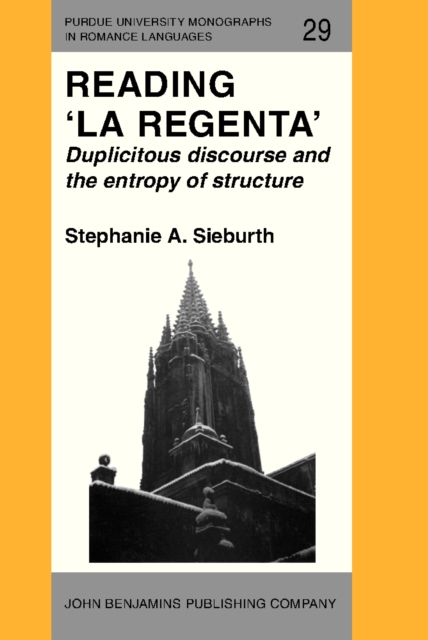
Reading La regenta : duplicitous discourse and the entropy of structure
Criticism of La Regenta has until recently focused on the text's plot as an extraordinarily coherent and convincing fictional world. Stephanie A. Sieburth demonstrates that the devices which produce order in the text are counterbalanced by an equally strong tendency toward entropy of meaning. The narrator is shown to be duplicitous and unreliable in his judgments on characters and events. Without an omniscient narrator, readers must interpret for themselves the complex intertextual structure of the novel. Saints' lives, honor plays, and serial novels each provide partial reflections of Ana Ozores' story. The text becomes a collage of mutually reflecting segments which, like Ana in her moments of self-doubt and madness, ultimately question the function of language and of any overriding interpretation or meaning.
eBook

Leopoldo Alas (Clarín)
Novelist-critic Leopoldo Alas's reputation suffered neglect and silent reproval during much of the twentieth century, especially under the Franco regime, but his reputation has now achieved classic status in Spain. Clearly related to this is the great increase in the number of translations - Julian Barnes called La Regenta 'the foreign classic tardily discovered'. This bibliography picks up where the first one left off in 1984. It is divided into primary material and secondary material. Primary material includes: Anthologies and Selections; Criticism; Novels; Short Story Collections; Plays; Correspondence; Prologues; Reprints; Translations; and Miscellaneous, with two new categories: autograph manuscripts and iconography.
eBook

Hispanidad y modernismo(s)
Dentro del ensayismo crítico de Leopoldo Alas resulta necesario analizar el contraste entre su elogio del influjo francés en el adelantado modernismo catalán, y la denostación del modernismo americano por un esnobismo que adjudica – de forma repetida y paradójica – a ese mismo influjo francés que suele calificar de deseable para Barcelona. En el contraste mismo de sus opuestas apreciaciones sobre ambas grupalidades, pueden rastrearse tal vez los mecanismos más evidentes del nacionalismo de “Clarín”, en su contradicción suspensa entre el impulso de conservación de la tradición hispana y la pugna por reconocer el carácter emancipador de lo nuevo foráneo.
Within the critical essays of Leopoldo Alas, it is necessary to analyze the contrast between his praise of the French influence in Catalan modernism, and his dismissal of American modernism with a snobbishness that corresponds – in a repeated and paradoxical way – to that same French influence that he usually qualifies as desirable for Barcelona. In the contrast to his opposing views on both groups, perhaps the most obvious mechanisms of “Clarín”’s nationalism can be traced in their contradiction between the impulse to preserve the Hispanic tradition and the struggle to recognize the emancipating character of new foreign thought.
Journal Article

El monstruo en el espejo
El cuento “Avecilla”, publicado por Leopoldo Alas “Clarín” en 1882, se centra en el encuentro entre un humilde oficinista y una mujer monstruosa en una feria popular. Clarín utiliza este episodio para explorar la manera en que las formas de diversión pública reflejan la relación entre el individuo y las estructuras sociales, culturales y políticas que dan sentido a su experiencia. En particular, el autor sugiere que la distinción entre lo “normal” y lo “anormal” constituye la base de una gran variedad de discursos de la época mientras satiriza la inseguridad de clase social y género del protagonista, cuyo concepto de sí mismo depende del establecimiento de jerarquías sociales y culturales.
Journal Article
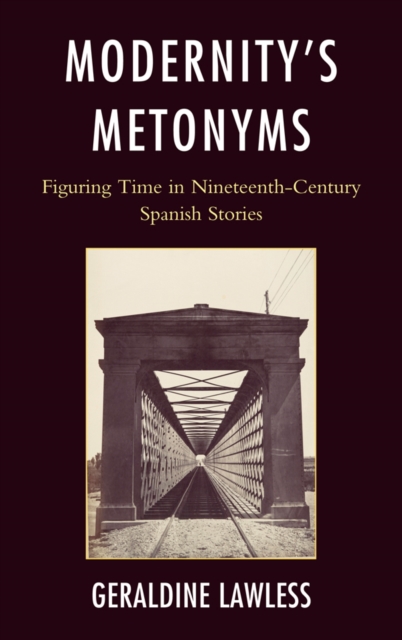
Modernity's metonyms
Modernity's Metonyms considers the representation of temporal frameworks in stories by the nineteenth-century Spanish authors, Leopoldo Alas and Antonio Ros de Olano. Adopting a metonymic approach—exploring the reiteration of specific associations across a range of disciplines, from literature, philosophy, historiography, to natural history—Modernity's Metonyms moves beyond the consideration of nineteenth-century Spanish literary modernity in terms of the problem of representation. Through an exploration of the associations prompted by three themes, the railway, food, and suicide, it argues that literary modernity can be considered as the expression of the perception that a linear model of time bringing together the past, the present and the future, was fragmenting into a proliferation of simultaneous moments. It draws French, German, American and British writers into discussion of stories by the canonical author Alas, and Ros de Olano, an author who is receiving increasing attention from scholars of nineteenth-century Spanish literature. Recent scholarship in the field of nineteenth-century Spanish literature and culture has challenged the thesis of \"retraso,\" the thesis that Spain lagged far behind its European neighbors. Building on this scholarship, this monograph incorporates shorter works of experimental prose fiction into discussions of nineteenth-century literary modernity in Spain. It further expands the field by combining analysis of the writing of the canonical author, Leopoldo Alas with stories by Antonio Ros de Olano, whose work has been receiving increasing attention from scholars in the field. Rather than thinking of these works in terms of the ways they conform to established models provided by either contemporaneous French and British works, or by fin de siglo and early twentieth-century Spanish literature, Modernity's Metonyms works inductively.
eBook

\Las dos cajas\ de Clarín en la Biblioteca Mignon
El trabajo tiene como objetivo el análisis de la versión icónica de la novela corta de Leopoldo Alas Las dos cajas, en su edición para la Biblioteca Mignon. La metodología consiste en la contextualización de la edición estudiada, tras la cual se pasa a señalar aquellos elementos temáticos y técnicos que singularizan el relato, y sobre los que no se ha hecho hincapié en trabajos previos. A continuación se procede al análisis de los iconos, desde la perspectiva de una supuesta interpretación por parte del dibujante. Todo ello lleva a la conclusión de que la versión icónica de la historia queda reducida a los aspectos más externos de la misma, omitiéndose así la posibilidad de una interpretación amplificadora del texto.
Journal Article
El soldado en los cuentos de Clarín
Este artículo atiende a la representación del soldado en siete cuentos de Clarín publicados entre 1892 y 1896 como estrategia discursiva para tratar los diferentes usos de la palabra patria en el contexto de luchas coloniales y pérdida territorial. Estos cuentos rompen con la imagen recurrente del soldado idealizado para revelar el sentido demagógico-doctrinario de la patriotería y contraponerlo al sentido emotivo y espiritual del término patria. Sostengo que, en su representación del soldado, Clarín se sirve del factor de clase social para forjar un sentido de solidaridad fraternal entre oprimidos y lograr así una mayor identificación con el Otro. Aunando la pérdida de las colonias a la sombra del desahucio que amenaza a las familias de los soldados en la metrópolis, muestro cómo el autor problematiza la alegoría nacional.
Journal Article