
Catalogue Search | MBRL


Are you sure you want to remove the book from the shelf?

{{itemTitle}}
15,568
result(s) for
"ALGERIA"
Sort by:

Chaos of the senses
In the midst of the Algerian civil war, Hayat is a young novelist trapped in a loveless marriage. While her husband, a high-ranking officer, preoccupies himself with politics, Hayat finds freedom from her highly regimented life in the world of her writing. There she weaves a passionate story for her characters. But the line between fiction and reality blurs when she falls for a man who seems to have walked straight out of the pages of her notebook, a man who seduces her, instead of her heroine, with his silence. As love on paper becomes a forbidden love lived out in the dark corners of a broken city, Hayat's country convulses with political upheaval. In a place where those who dare to write the truth are made to pay a heavy price, she and her characters will discover that no one can truly be the author of their own destiny. The second novel in the international bestselling trilogy from 'the literary phenomenon' (Elle), Ahlem Mosteghanemi, Chaos of the Senses is a powerful story of love, identity and liberation.
Book

Language Conflict in Algeria
This is a book about the use of languages as a proxy for conflict. It traces the history of Algeria from colonization by the French in 1830 to the celebration of 50 years of independence in 2012, and examines the linguistic issues that have accompanied this turbulent period. The book begins with an examination of 'language conflict' and related concepts, and then applies them to both the French colonists' language policies and the Arabization campaigns which followed independence. This is followed by an analysis of the rivalry between the English and French languages in independent Algeria. The book concludes with a study of the language choices made by Algerian writers and the complex tensions which arose from these choices among intellectuals in the colonial and post-colonial periods.
eBook


Arabs of the Jewish Faith
Exploring how Algerian Jews responded to and appropriated France's newly conceived \"civilizing mission\" in the mid-nineteenth century, Arabs of the Jewish Faith shows that the ideology, while rooted in French Revolutionary ideals of regeneration, enlightenment, and emancipation, actually developed as a strategic response to the challenges of controlling the unruly and highly diverse populations of Algeria's coastal cities.
eBook

The Battle for Algeria
InThe Battle for AlgeriaJennifer Johnson reinterprets one of the most violent wars of decolonization: the Algerian War (1954-1962). Johnson argues that the conflict was about who-France or the National Liberation Front (FLN)-would exercise sovereignty of Algeria. The fight between the two sides was not simply a military affair; it also involved diverse and competing claims about who was positioned to better care for the Algerian people's health and welfare. Johnson focuses on French and Algerian efforts to engage one another off the physical battlefield and highlights the social dimensions of the FLN's winning strategy, which targeted the local and international arenas. Relying on Algerian sources, which make clear the centrality of health and humanitarianism to the nationalists' war effort, Johnson shows how the FLN leadership constructed national health care institutions that provided critical care for the population and functioned as a protostate. Moreover, Johnson demonstrates how the FLN's representatives used postwar rhetoric about rights and national self-determination to legitimize their claims, which led to international recognition of Algerian sovereignty.
By examining the local context of the war as well as its international dimensions, Johnson deprovincializes North Africa and proposes a new way to analyze how newly independent countries and nationalist movements engage with the international order. The Algerian case exposed the hypocrisy of selectively applying universal discourse and provided a blueprint for claim-making that nonstate actors and anticolonial leaders throughout the Third World emulated. Consequently,The Battle for Algeriaexplains the FLN's broad appeal and offers new directions for studying nationalism, decolonization, human rights, public health movements, and concepts of sovereignty.
eBook

A history of Algeria
The EU and China are often characterised as parties whose bilateral political differences remain too large to bridge, so that they have failed to convert rhetorical promises into tangible results of cooperation, particularly with regards to the international security. Yet in terms of their bilateral interaction on security risk management in Africa; EU and Chinese naval officers jointly brought down the number of Somali pirate attacks in the Gulf of Aden and to a lesser extent were involved in seeking a resolution to the lingering conflict in Darfur. This book asks how we can make sense as a whole of this relatively sudden shift in regards to the dealings between their respective officials on the topic of security risk management. It argues that the outcomes of Sino-European bilateral dealings on are above all determined by the ability/inability of these officials to build political trust as a complex and cognitive social phenomenon. Consequently, the book applies an innovative conceptual framework on political trust to explain why EU and Chinese officials bridged their 'endemic' political differences to cooperate on Somali piracy but were unable to do so when it came to their interaction on Darfur. To conclude, it examines the longer term impact of this bilateral trust-building process by covering more recent examples of engagement in Libya and Mali and aims to show that although this trust-building process may be case specific, ramifications may go beyond the realm of their dealings on security matters in Africa, to impact wider issues of international security. This text will be of key interest to scholars and students of African and Chinese politics, EU politics, security and maritime studies, and more broadly of international relations and to governmental actors.--Publisher's summary.
Book

What Fanon Said: A Philosophical Introduction to His Life and Thought
Antiblack racism avows reason is white while emotion, and thus supposedly unreason, is black. Challenging academic adherence to this notion, Lewis R. Gordon offers a portrait of Martinican-turned-Algerian revolutionary psychiatrist and philosopher Frantz Fanon as an exemplar of \"living thought\" against forms of reason marked by colonialism and racism. Working from his own translations of the original French texts, Gordon critically engages everything in Fanon from dialectics, ethics, existentialism, and humanism to philosophical anthropology, phenomenology, and political theory as well as psychiatry and psychoanalysis. Gordon takes into account scholars from across the Global South to address controversies around Fanon's writings on gender and sexuality as well as political violence and the social underclass. In doing so, he confronts the replication of a colonial and racist geography of reason, allowing theorists from the Global South to emerge as interlocutors alongside northern ones in a move that exemplifies what, Gordon argues, Fanon represented in his plea to establish newer and healthier human relationships beyond colonial paradigms.
eBook
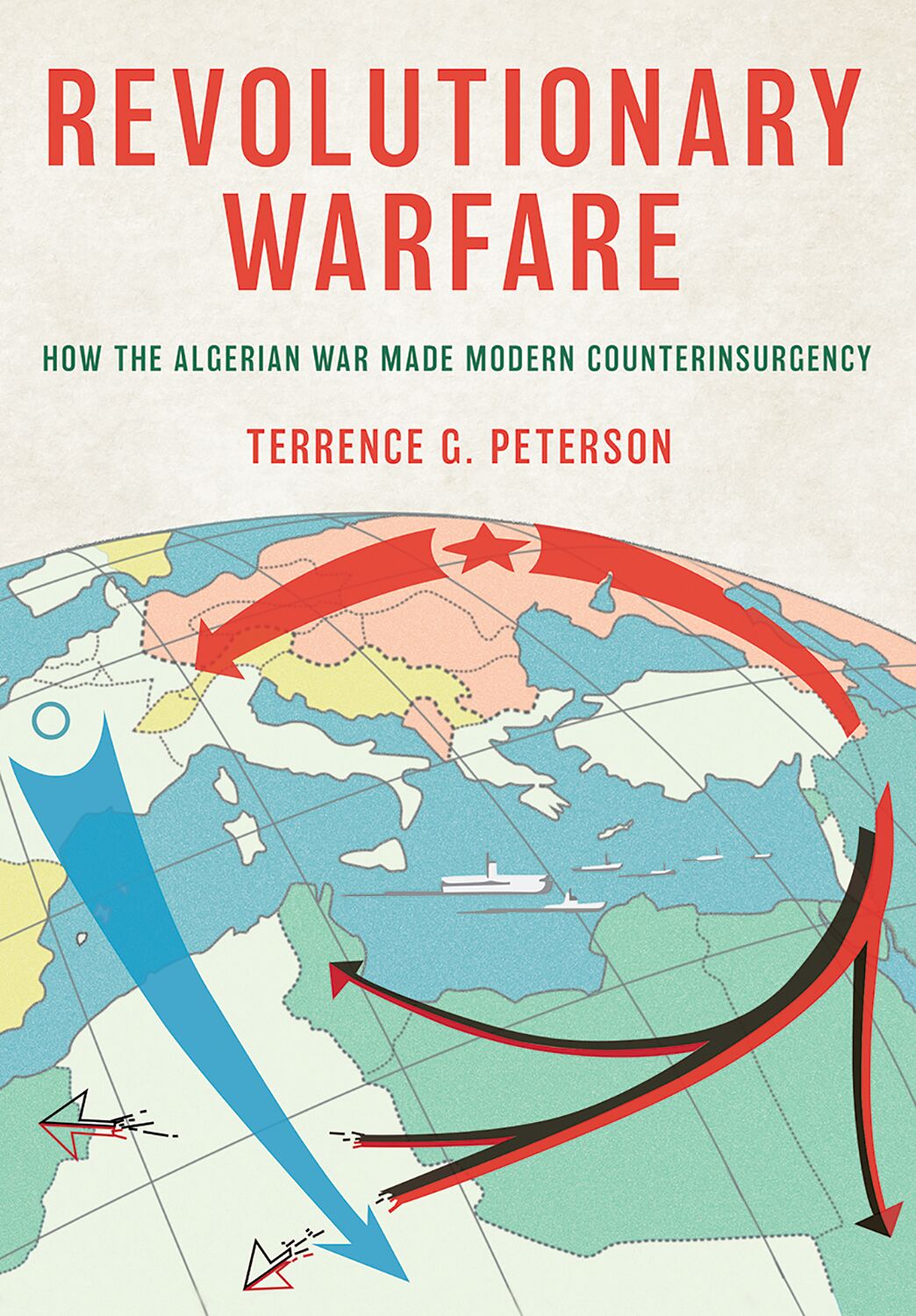
Revolutionary Warfare
Revolutionary Warfare
investigates how efforts to counter a revolution could also
be revolutionary. The Algerian War fractured the French
Empire, destroyed the legitimacy of colonial rule, and helped
launch the Third Worldist movement for the liberation of the Global
South. By tracing how French generals, officers, and civil
officials sought to counter Algerian independence with their own
project of radical social transformation, Terrence G. Peterson
reveals that the conflict also helped to transform the nature of
modern warfare.
The French war effort was never defined solely by repression. As
Peterson details, it also sought to fashion new forms of
surveillance and social control that could capture the loyalty of
Algerians and transform Algerian society. Hygiene and medical aid
efforts, youth sports and education programs, and psychological
warfare campaigns all attempted to remake Algerian social
structures and bind them more closely to the French state. In
tracing the emergence of such programs, Peterson reframes the
French war effort as a project of armed social reform that sought
not to preserve colonial rule unchanged, but to revolutionize it in
order to preserve it against the global challenges of
decolonization.
Revolutionary Warfare demonstrates how French officers'
efforts to transform warfare into an exercise in social engineering
not only shaped how the Algerian War unfolded from its earliest
months, but also helped to forge a paradigm of warfare that
dominated strategic thinking during the Cold War and after:
counterinsurgency.
eBook