
Catalogue Search | MBRL


Are you sure you want to remove the book from the shelf?

{{itemTitle}}
449
result(s) for
"ALGERIAN HISTORY"
Sort by:


Algeria in France : transpolitics, race, and nation
Algerian migration to France began at the end of the 19th century, but in
recent years France's Algerian community has been the focus of a shifting public
debate encompassing issues of unemployment, multiculturalism, Islam, and terrorism.
In this finely crafted historical and anthropological study, Paul A. Silverstein
examines a wide range of social and cultural forms -- from immigration policy,
colonial governance, and urban planning to corporate advertising, sports, literary
narratives, and songs -- for what they reveal about postcolonial Algerian
subjectivities. Investigating the connection between anti-immigrant racism and the
rise of Islamist and Berberist ideologies among the second generation
(Beurs), he argues that the appropriation of these cultural-political
projects by Algerians in France represents a critique of notions of European or
Mediterranean unity and elucidates the mechanisms by which the Algerian civil war
has been transferred onto French soil.
eBook

Women fight, women write : texts on the Algerian war
\"This book examines Algerian women's narratives of the Algerian War of Independence, drawing on political and historical analyses, interviews, memoirs, fiction, poetry, essays, and films\"-- Provided by publisher.
Book

From empire to exile
This book explores the memory of the war of independence in France as viewed by the former European settlers (pieds-noirs) and the harkis, those Algerians who worked for the French security forces. It examines how the memorial dynamics of the two groups are related both to each other and to other memories of the war.
eBook

History's place
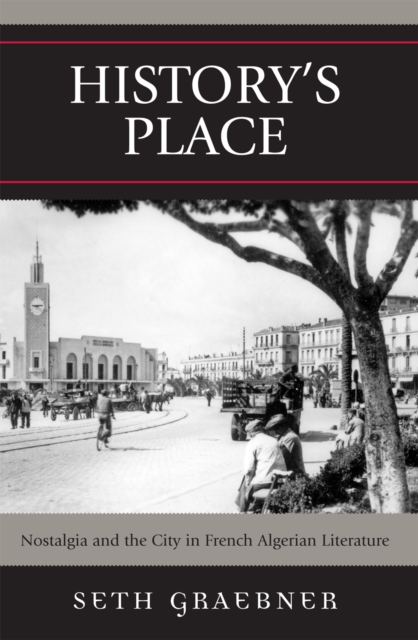
History's Place explores nostalgia as one of the defining aspects of the relationship between France and North Africa. Dr. Seth Graebner argues that France's most important colony developed a historical consciousness through literature, and that post-colonial writers revised it while retaining its dominant effect. The North African city became a privileged place in the relationship between literacy and historical discourses in the colony. Graebner analyzes the importance of architecture and urbanism as markers of historical development, as the urban fabric and descriptions of it became signs of difference between metropole and colony. Discussing writers as diverse as Bertrand, Randau, and Kateb, this book examines how the changing Algerian city has remained the locus of a debate colored by various sorts of nostalgia. Graebner demonstrates that nostalgia was symptomatic of historical anxiety generated by colonial conditions, but with literary consequences for mainland France as well. History's Place is a comprehensive and valuable addition to the study of French literature and cultural studies.
eBook


Berber culture on the world stage : from village to video
[S]ure to interest a number of different audiences, from language
and music scholars to specialists on North Africa... a superb book, clearly
written, analytically incisive, about very important issues that have not been
described elsewhere. -- John Bowen, Washington University In
this nuanced study of the performance of cultural identity, Jane E. Goodman travels
from contemporary Kabyle Berber communities in Algeria and France to the colonial
archives, identifying the products, performances, and media through which Berber
identity has developed. In the 1990s, with a major Islamist insurgency underway in
Algeria, Berber cultural associations created performance forms that challenged
Islamist premises while critiquing their own village practices. Goodman describes
the phenomenon of new Kabyle song, a form of world music that transformed village
songs for global audiences. She follows new songs as they move from their producers
to the copyright agency to the Parisian stage, highlighting the networks of
circulation and exchange through which Berbers have achieved global
visibility.
eBook

Arab Women in Algeria
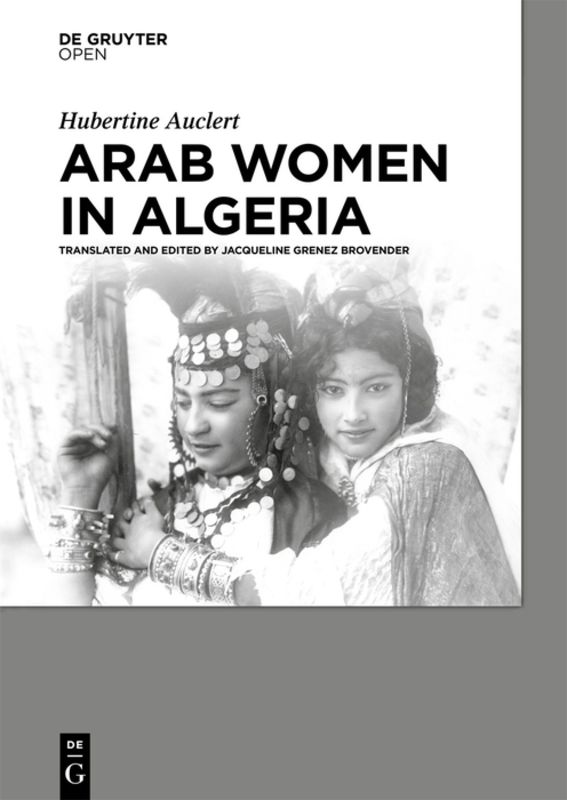
The book presents the first English edition of Hubertine Auclert's Arab Women in Algeria which offers a unique picture of Algerian society in late 19th century. Hubertine Auclert (1848-1914) was one of the foremost militants for women's political rights in France from the mid-1870s. She lived in Algeria from 1888 to 1892, where she investigated the customs and traditions that defined the condition of women. She witnessed both the exploitation of women and that of the colonized people; in doing so, she drew a picture of colonial Algerian society. While women were mistreated by men (sale of prepubescent girls into marriage, forced marriage, repudiation permitted only to men, polygamy), Arab men were mistreated by the colonial administration and excluded from the government of Algeria. She denounced the contradictions and hypocrisy of French justice, which often enforced, for their own interest, the \"anomalies\" of Muslim law in contradiction with French law. The last chapter of the book comprises of several striking anecdotes that illustrate the author's theoretical views.
eBook