
Catalogue Search | MBRL


Are you sure you want to remove the book from the shelf?

{{itemTitle}}
285,539
result(s) for
"ANNUAL INCOME"
Sort by:

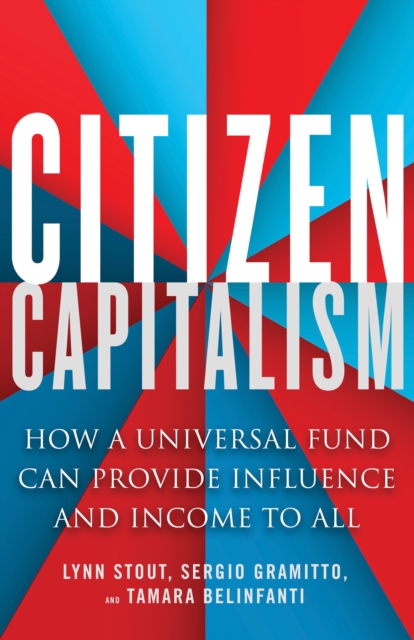
Citizen capitalism : how a universal fund can provide influence and income to all
Corporations have a huge influence on the life of every citizen--this book offers a visionary but practical plan to give every citizen a say in how corporations are run while also gaining some supplemental income.It lays out a clear approach that uses the mechanisms of the private market to hold corporations accountable to the public.
eBook

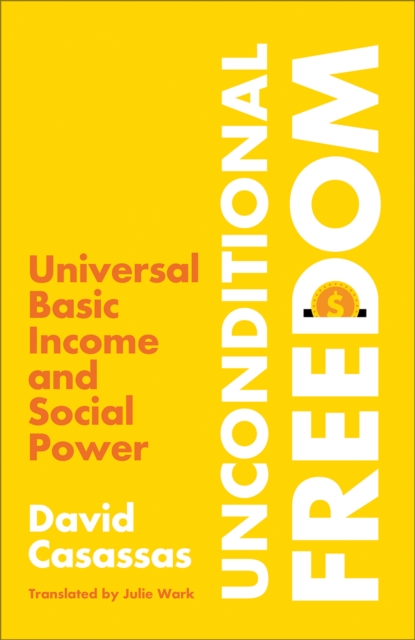
Unconditional Freedom
'A carefully argued case for basic income as central to a democratic transformation of society' Carole Pateman, Distinguished Professor Emeritus, UCLA
'This path-breaking work throws new light on how we understand work, freedom, and emancipation in today's highly precariatised and insecure world... A must-read' Sarath Davala, Chair, Basic Income Earth Network
As the rich get richer and take more of our wealth, our democratic freedoms are also in danger. The elite are gaining large profits without contributing back to society, hollowing out our public services and institutions and preventing the vast majority of us from living our lives to the fullest.
In Unconditional Freedom, David Casassas argues that for us to live freely, we need unconditional resources such as Universal Basic Income. In a sharp and lucid analysis, he shows that UBI would not only liberate us from the nightmare of social exclusion and precarious employment, it would also increase our bargaining power as individuals and collectives, opening doors to democratise our lives.
eBook

Right-to-work?
In 2006, India embarked on an ambitious attempt to fight poverty by attempting to introduce a wage floor in a setting in which many unskilled workers earn less than the minimum wage. The 2005 national rural employment guarantee act (NREGA) creates a justiciable \"right to work\" by promising 100 days of wage employment in every financial year to all rural households whose adult members volunteer to do unskilled manual work. In attempting to fight poverty in poor places with weak administrative capabilities, the idea of \"rights\" has often been invoked. This book aims to contribute to the understanding of the efficacy of poor states in fighting poverty using an ambitious rights-based program - the largest antipoverty public employment program in India, and possibly anywhere in the world. The program authors study is India's Mahatma Gandhi National Rural Employment Guarantee Scheme (MGNREGS), which was launched to implement the NREGA. This book presents survey-based estimates for India as a whole as well as results for Bihar. Results for India are based on the 2009-10 national sample survey. Two surveys were carried out in 2009 and 2010 and spanned 150 villages spread across all 38 districts in Bihar. These data are supplemented by qualitative research in six districts to better understand supply-side challenges. A distinctive feature of the methodology is that the authors identify the key counterfactual outcomes of interest - that is, what Bihar Rural Employment Guarantee Scheme (BREGS) participants will have done in the absence of the program - by directly asking individual BREGS participants. The advantage of this approach is that it produces an individual-specific estimate of impact - exploiting the information available for each participant - rather than delivering only a mean impact. The authors find compelling evidence that the scheme is reaching relatively poor families. It is important that reform efforts for MGNREGS work on both of these aspects - a stronger, more capable, local administration, plus more effective participation by civil society.
eBook
PBS news weekend. As communities test basic income programs, here’s how one California city fared
Guaranteed basic income, the concept of no-strings-attached payments to provide people with a financial floor, is being tested in dozens of pilot programs across the country. Stockton, California was one of the first cities to launch a pilot program in 2019. John Yang speaks with Michael Tubbs, Stockton’s mayor at the time and the founder of Mayors for a Guaranteed Income, to learn more.
Streaming Video

The failed welfare revolution
Today the United States has one of the highest poverty rates among the world's rich industrial democracies.The Failed Welfare Revolutionshows us that things might have turned out differently. During the 1960s and 1970s, policymakers in three presidential administrations tried to replace the nation's existing welfare system with a revolutionary program to guarantee Americans basic economic security. Surprisingly from today's vantage point, guaranteed income plans received broad bipartisan support in the 1960s. One proposal, President Nixon's Family Assistance Plan, nearly passed into law in the 1970s, and President Carter advanced a similar bill a few years later. The failure of these proposals marked the federal government's last direct effort to alleviate poverty among the least advantaged and, ironically, sowed the seeds of conservative welfare reform strategies under President Reagan and beyond.
This episode has largely vanished from America's collective memory. Here, Brian Steensland tells the whole story for the first time--from why such an unlikely policy idea first developed to the factors that sealed its fate. His account, based on extensive original research in presidential archives, draws on mainstream social science perspectives that emphasize the influence of powerful stakeholder groups and policymaking institutions. But Steensland also shows that some of the most potent obstacles to guaranteed income plans were cultural. Most centrally, by challenging Americans' longstanding distinction between the \"deserving\" and \"undeserving\" poor, the plans threatened the nation's cultural, political, and economic status quo.
eBook
Universal Basic Income and the Threat to Democracy as We Know It
Some of the greatest minds of the century have predicted that computers or artificial intelligence will replace 80 percent, if not more, of the world's workforce. The only uncertainty is the time frame, with the average prediction at about 30 years, although many believe it will be sooner. No matter the exact period, the impact on our planet will eventually be enormous because governments will still need to find a way to provide the unemployed with money on which to live and a Universal Basic Income (UBI), or something similar, is proposed to be paid to everyone without means test. That solution might appear well in theory, but the large numbers of unemployed will not want to be marginalized and will demand over time that the UBI be increased. Following human nature, under a democratic system as we know it, supposedly based on one person one vote, people will vote for whoever gives them more, and more, until the economic system breaks down, unable to afford the payments. The question is whether democracy will survive the challenge or whether we finish with a benign group of bureaucrats at the top who decide what is in the best interests of the majority and the rest of the global population simply accepts it.
eBook
Basic income : Could cash handouts revitalize the economy?
Americans just want to pay their bills. Is universal basic income the path to financial stability and economic opportunity?
Streaming Video
Universal basic income is a brilliant idea : here's why
The welfare state is an ineffective and expensive system that hurts and targets the poor more than it helps. Universal basic income is a better alternative that could work.The question becomes, then, where would the money for UBI come from? There are a myriad of reasons why UBI via taxes would be a bad idea. Instead, we should look to socially produced capital. Companies rely on people to be successful, so a percentage of all shares of all companies should go into a public equity trust and the dividends should be distributed to every member of society equally.
Streaming Video