
Catalogue Search | MBRL


Are you sure you want to remove the book from the shelf?

{{itemTitle}}
2,497
result(s) for
"ARABIC MUSIC"
Sort by:

Lives in Musicology: My Life in Arabic Music—Scholarship, Translation, Teaching, Performance
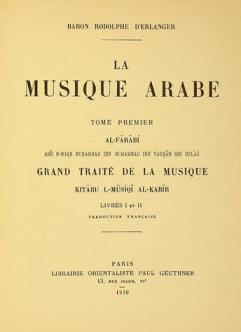
This overview of my five decades researching Arabic music, studying and translating treatises on Arabic music dating back to the ninth century CE, and teaching and performing this tradition is the latest installment of the \"Lives in Musicology\" series of Acta Musicologica. I cover my early training in Western music, seen at the time in my native country of Egypt as advanced compared to \"backward\" Arabic music, followed by my turn to a deep, lifelong involvement with the latter, which began with my reading of \"Kitāb al-Mūsīqī l-Kab¯r\" (Grand book of music) by al-Fārābī (d. 950), the beauty of whose scholarship and language stunned me. So instead of trying to bring Arabic music into the twentieth century, Arabic music brought me back to the medieval era! My overview of my many writings tries to offer a sense of the richness, humanity, and humor of the music to which I have devoted my career.
Journal Article

Arab music : a survey of its history and its modern practice
Arab Music: A survey of its history and modern practice' is primarily meant for the general Western reader with some basic knowledge of music and music notation. It aims at correcting the still prevalent romantic image of Arab music, spread in the 19th century, as exotic and typified by long, plaintive and erotic sounding melodic lines and inciting rhythms. It offers the reader a comprehensive survey of the history and the development of Arab music and musical theory from its pre-Islamic roots until 1970, as well as a discussion of the major genres and forms practiced today, such as the Egyptian gil, the Algerian rai and Palestinian hip hop. Other topics touched upon are musical instruments and folk music. The analysis of each genre is accompanied by a complete musical notation of an exemplary composition or improvisation, including lyrics and translation.
Book

Statistical characteristics of tonal harmony: A corpus study of Beethoven’s string quartets
Tonal harmony is one of the central organization systems of Western music. This article characterizes the statistical foundations of tonal harmony based on the computational analysis of expert annotations in a large corpus. Using resampling methods, this study shows that 1) the rank-frequency distribution of chords resembles a power law, i.e. few chords govern a large proportion of the data; 2) chord transitions are referential and chord predictability is significantly affected by distinguished chord features; 3) tonal harmony conveys directedness in time; and 4) tonal harmony operates differently at the hierarchical levels of chords and keys. These results serve to characterize tonal harmony on empirical grounds and advance the methodological state-of-the-art in digital musicology.
Journal Article
Commentary
[1.3] Music Theory has yet to catch up with field of Linguistics in being fully comparative, and is at least 108 years behind that field in my estimation: dating to the 1916 publication of Saussure’s Le Cours de linguistique générale, which established a theoretical framework rooted in the comparison of different languages, the arbitrariness of the sign, and the description of language as a communication system. [1.4] Hence the current MTO special volume by the editors of Music Theory in the Plural is tremendously important in beginning to rectify these gaps in knowledge—at minimum it will allow English-language readers to begin to contemplate what they didn’t know that they don’t know. ~ [2.1] On the second level of my commentary I’ll say that the basic premise of Liam Hynes-Tawa’s translation of Fumio Koizumi’s text is convincing to me on the basis of the evidence presented: that there exist nuclear tones in Japanese melodies, and that many melodies exhibit two such tones, often a fourth apart. A deeper comparison between these traditions might yield interesting insights. ~ [3.1] The third level of my commentary will be on the weaknesses of the analysis in my view. For those without such experience, the experiential proof I assert here is rooted in a more concrete fact: that notating music strips the overwhelming majority of information content from the sound in order to reduce it to notation.
Journal Article

Zakariyya Ahmad: Authenticity in a Modernizing Period
Zakariyya Ahmad (1896–1961) is one of the most prominent composers of modern Egypt. He is remembered today for having composed numerous songs for Um Kulthum (1904–75) and other lead Egyptian singers, and for his long collaboration with the colloquial poet and political satirist Bayram al-Tunsi (1893–1961). He also had a lasting impact on Egyptian vocal music in the early 20th century, a period defined by technological innovation and changing popular tastes. Although contemporary composers such as Muhammad ʿAbd al-Wahhab (1902–91) were considered “innovative” for blending traditional Arabic music with Western musical elements, Zakariyya Ahmad was counted as traditional: he remained loyal to the maqām (a system of melodic scales) while striving to preserve and develop traditional musical forms with Arabic and Egyptian aṣāla (authenticity). In addition to his musical contributions, Zakariyya Ahmad also played an important role in the Egyptian cinema, both as composer and actor. He was also a political activist, composing songs around national concerns. 1
Journal Article

Colours of Islam
Collects nine illustrated children's poems that explore Islam and the diversity of its followers.
Book

Firas Zreik: The Paco de Lucia of the Qanun
In March, 27-year-old Firas Zreik released his first full-length album, \"Salute,\" which is also the name of the album's first song, described by Zreik as the most \"bombastic,\" with a \"very intense solo.\" The album combines classical Arabic music with jazz. Its musical ideas, its energy and its clarity are reminiscent of saxophonist Kenny Garrett. The record features eight original compositions written before and during COVID-19, in the United States and in Palestine. Producing an album during COVID-19 was challenging, but Zreik is thrilled with the journey. He finished the album during what he describes as \"one of the most horrible times for both humanity and live music.\" Zreik's creative process involves synesthesia.
Journal Article