
Catalogue Search | MBRL


Are you sure you want to remove the book from the shelf?

{{itemTitle}}
29,346
result(s) for
"ARCHITECTURE - General."
Sort by:

Understanding architecture : its elements, history, and meaning
\"This bestselling, illustrated survey of Western architecture is now fully revised throughout, explaining the structure, function, history, and meaning of architecture in a way that is both accessible and engaging. The long-awaited third edition includes increased global coverage with new mini chapters on Africa, Japan, China, India, and Islamic Architecture; a new chapter covering the future of architecture in the twenty-first century; updated coverage of sustainability and green architecture and its impact on design; an update to the historical survey; and over fifty images in full color. Understanding Architecture continues to be the only text in the field to examine architecture as a cultural phenomenon as well as an artistic and technological achievement with its straightforward, two-part structure: (1) The Elements of Architecture and (2) The History and Meaning of Architecture. Comprehensive and clearly written, Understanding Architecture is a classic survey of Western architecture. \"-- Provided by publisher.
Book

Building Modern Turkey
Building Modern Turkeyoffers a critical account of how the built environment mediated Turkey's transition from a pluralistic (multiethnic and multireligious) empire into a modern, homogenized nation-state following the collapse of the Ottoman Empire at the end of World War I. Zeynep Kezer argues that the deliberate dismantling of ethnic and religious enclaves and the spatial practices that ensued were as integral to conjuring up a sense of national unity and facilitating the operations of a modern nation-state as were the creation of a new capital, Ankara, and other sites and services that embodied a new modern way of life. The book breaks new ground by examining both the creative and destructive forces at play in the making of modern Turkey and by addressing the overwhelming frictions during this profound transformation and their long-term consequences. By considering spatial transformations at different scales-from the experience of the individual self in space to that of international geopolitical disputes-Kezer also illuminates the concrete and performative dimensions of fortifying a political ideology, one that instills in the population a sense of membership in and allegiance to the nation above all competing loyalties and ensures its longevity.
eBook

Peripheries : edge conditions in architecture
\"Architects are now more than ever part of an interdisciplinary context. The emergence of creative art-based practices, film making, post-disaster designs and slum management, as part of the architecture discourse and curriculum, is an indication of how broad architecture has become, and the extent to which it has already merged peripheral practices into its core. This new volume in the AHRA Critiques Series is a statement about how broad, complex, influential, and, ironically central, architecture has become in the contemporary culture, economy and society, despite the marginal position the profession currently occupies. Peripheries questions and challenges the boundaries of architectural research by bringing together subjects and relevant streams of investigation, some of which rarely feature in architectural research and practice titles. Divided into four themes, Places of Formation and Insight, Practices at the Edge, People on the Margins and Edge Readings, each section presents a selection of high calibre interdisciplinary research papers, from a range of renowned contributors including Stephen Walker, Gerry Adler, Dana Vais and author Glen Patterson. The volume also includes a Dialogue between Murray Fraser, Christine Boyer and Kim Dovey. Each section interrogates a peripheral aspect of the built environment, and brings to the fore peripheral case studies. Chapters discuss architecture in United States, Lebanon, Egypt, Japan, Romania, and Europe. Hence, the book takes Architectural humanities discussions to new cultures, societies and practices and towards a global level of influence and impact.\"-- Provided by publisher.
Book

Architecture, Politics, and Identity in Divided Berlin
On August 13, 1961, under the cover of darkness, East German authorities sealed the border between East and West Berlin using a hastily constructed barbed wire fence. Over the next twenty-eight years of the Cold War, the Berlin Wall grew to become an ever-present physical and psychological divider in this capital city and a powerful symbol of Cold War tensions. Similarly, stark polarities arose in nearly every aspect of public and private life, including the built environment.InArchitecture, Politics, and Identity in Divided BerlinEmily Pugh provides an original comparative analysis of selected works of architecture and urban planning in both halves of Berlin during the Wall era, revealing the importance of these structures to the formation of political, cultural, and social identities. Pugh uncovers the roles played by organizations such as the Foundation for Prussian Cultural Heritage and the Building Academy in conveying the political narrative of their respective states through constructed spaces. She also provides an overview of earlier notable architectural works, to show the precursors for design aesthetics in Berlin at large, and considers projects in the post-Wall period, to demonstrate the ongoing effects of the Cold War.Overall, Pugh offers a compelling case study of a divided city poised between powerful contending political and ideological forces, and she highlights the effort expended by each side to influence public opinion in Europe and around the World through the manipulation of the built environment.
eBook

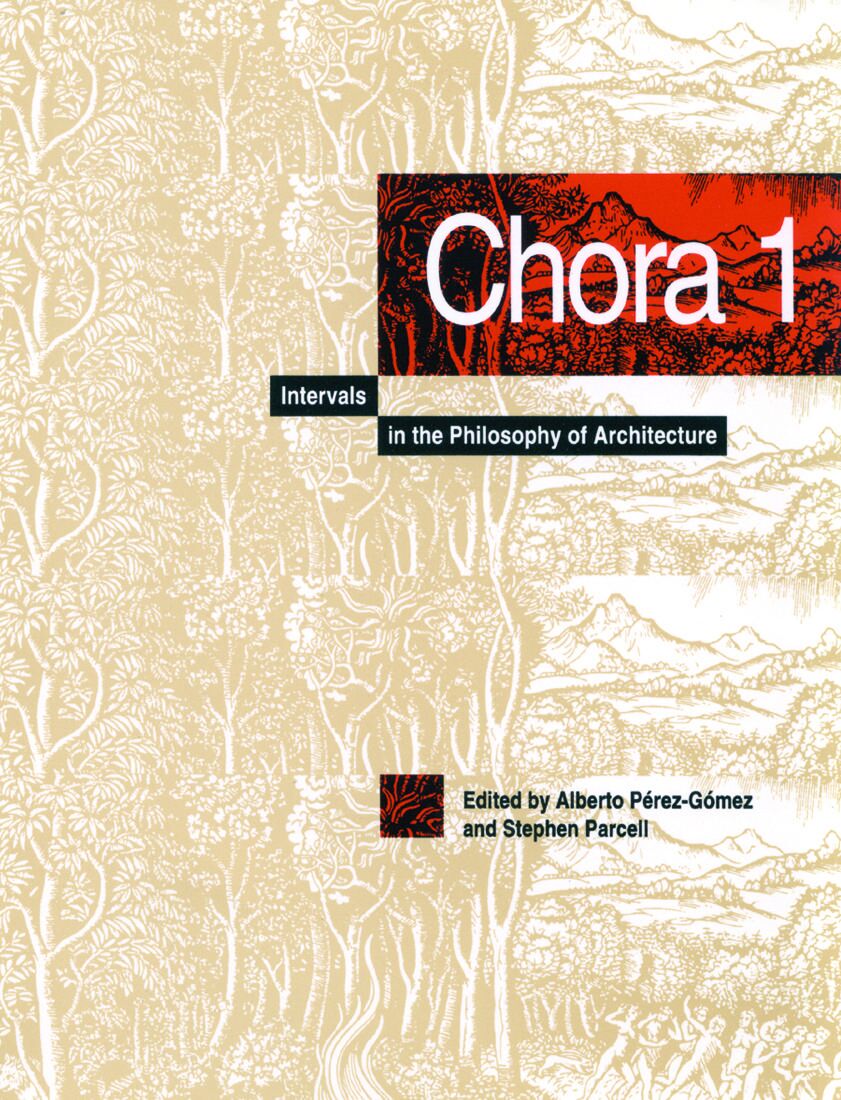
Chora 1
Contents Chora: The Space of Architectural Representation - Alberto Pérez-Gómez - The Measure of Expression: Physiognomy and Character in the Nouvelle Méthode of Jean-Jacques Lequeu - Jean-François Bédard - Michelangelo: The Image of the Human Body, Artifice, and Architecture - Helmut Klassen - Architecture as Site of Reception - Part I: Cuisine, Frontality, and the Infra-thin - Donald Kunze - Fictional Cities - Graham Livesey - Instrumentality and the Organic Assistance of Looms - Indra Kagis McEwen - Space and Image in Andrey Tarkovsky's \"Nostalgia\": Notes on a Phenomenology of Architecture in Cinema - Juhani Pallasmaa - The Momentary Modern Magic of the Panorama - Stephen Parcell - The Building of a Horizon - Louise Pelletier - Anaesthetic Induction: An Excursion into the World of Visual Indifference - Natalija Subotincic. The essays in this collection explore architectural form and content in the hope of finding new and better alternatives to traditionally accepted practices.
eBook

Virilio for architects
\"Paul Virilio is an innovative figure in the study of architecture, space, and the city. Virilio for Architects primes readers for their first encounter with his crucial texts on some of the vital theoretical debates of the twenty-first century, including: - Oblique Architecture and Bunker Archeology - Critical Space and the Overexposed City - The Ultracity and Very High Buildings - Grey Ecology and Global Hypermovement In exploring Virilio's most important architectural ideas and their impact, John Armitage traces his engagement with other key architectural and scientific thinkers such as Claude Parent, Benoit B. Mandelbrot, and Bernard Tschumi. Virilio for Architects allows students, researchers, and non-academic readers to connect with Virilio's distinctive architectural theories, critical studies, and fresh ideas\"-- Provided by publisher.
Book

Modelscapes of Nationalism
Modelscapes are clusters of miniature architectural models that represent entire environments. They're frequently found in museums as representations of heritage, architecture, and collective identity. This book offers a critical analysis of modelscapes, using case studies from Israel, to show how miniature representations of contested physical space participate in the construction of a sense of national identity and appropriation of the land and its history. What, Yael Padan asks, is the meaning of such models, and what role do they play within the context of an ongoing violent conflict over territory and history?
eBook

Traditions : the \real\, the hyper, and the virtual in the built environment
\"Traditions: the 'Real', the Hyper, and the Virtual in the Built Environment is a continuation of Nezar AlSayyad's engagement with the subject of tradition in the built environment. In it he attempts to unsettle the belief that tradition is simply a product of history and transmission. Without dismissing the parallels between history and tradition, he argues that normative discourses that conceive of tradition as a place-based, temporally situated concept, as a static authoritative legacy of a past, and as a heritage owned by certain groups of people can no longer be sustained in the present moment of globalization. Instead he calls for an approach that recognizes how the main qualities of tradition are transient, fleeting, and contingent. While using the built environment as the primary lens of investigation, other approaches for the study of tradition, with origins in geography, history, sociology, or anthropology, are more actively deployed in this book. AlSayyad offers a recasting of the epistemology of tradition as fundamentally spatial, thus providing a much-needed theoretical rudder for the emerging debates. Rather than analyzing tradition as a reaction to modernity or as its antithetical other, he examines those discursive and spatial terrains where tradition collides and colludes with modernity. AlSayyad argues that built traditional environments have been studied until recently as 'authentic' environments that represent 'real' everyday practices. But, as his research illustrates, their consumption at a mass scale, especially in the arena of tourism and mass media, has often elevated them to hyper-environments whose connection to 'real' places results in fundamentally 'dis-placed' and disembodied experience. More recently, the portrayal of traditional environments in both the virtual realm and heritage discourses has resulted in new articulations of tradition that could not be imagined just a few decades ago. AlSayyad interrogates the meanings and practices of tradition in the twenty-first century by looking at these three distinct categories of the built environment: the 'real', the hyper, and the virtual\"-- Provided by publisher.
Book

Cities in Time
From street-markets and pop-up shops to art installations and Olympic parks, the temporary use of urban space is a growing international trend in architecture and urban design. Partly a response to economic and ecological crisis, it also claims to offer a critique of the status quo and an innovative way forward for the urban future. Cities in Time aims to explore and understand the phenomenon, offering a first critical and theoretical evaluation of temporary urbanism and its implications for the present and future of our cities. The book argues that temporary urbanism needs to be understood within the broader context of how different concepts of time are embedded in the city. In any urban place, multiple, discordant and diverse timeframes are at play – and the chapters here explore these different conceptions of temporality, their causes and their effects. Themes explored include how institutionalised time regulates everyday urban life, how technological and economic changes have accelerated the city’s rhythms, our existential and personal senses of time, concepts of memory and identity, virtual spaces, ephemerality and permanence.
eBook