
Catalogue Search | MBRL


Are you sure you want to remove the book from the shelf?

{{itemTitle}}
7,273
result(s) for
"ARMENIANS"
Sort by:

The Young Turks' crime against humanity : the Armenian genocide and ethnic cleansing in the Ottoman Empire
Introducing evidence from more than 600 secret Ottoman documents, this book demonstrates in unprecedented detail that the Armenian Genocide and the expulsion of Greeks from the late Ottoman Empire resulted from an official effort to rid the empire of its Christian subjects.
eBook

Reimagining a lost Armenian home : the Dildilian photography collection
For nearly a century members of the Dildilian family practiced the art of photography in Ottoman Turkey, Greece and the United States. This book contains over 200 photographs, primarily from the Ottoman era, beginning with the creation of the family business by Tsolag Dildilian in Sivas in central Turkey in 1882 and concluding in 1922 in Samsun, when the family was forced into exile in Greece. The photographs and the stories that unfold around them capture a defining period in the nearly three thousand year history of the Armenians in Anatolia and the Armenian Highlands. The early-twentieth century witnessed the violent erasure of the Armenians from their historic homeland, with catastrophic effects for the Dildilian family and their community. Yet this was also a period of unprecedented educational, cultural and commercial development for the Armenians. The Dildilian family was intimately involved in the triumphs and tragedies of these years and this book, through its rich pictorial history, sheds unprecedented light on the real-life experiences of Armenians in the devastating years of the Armenian Genocide and beyond. It is an unusual and original contribution to the social history of the Near East.
Book
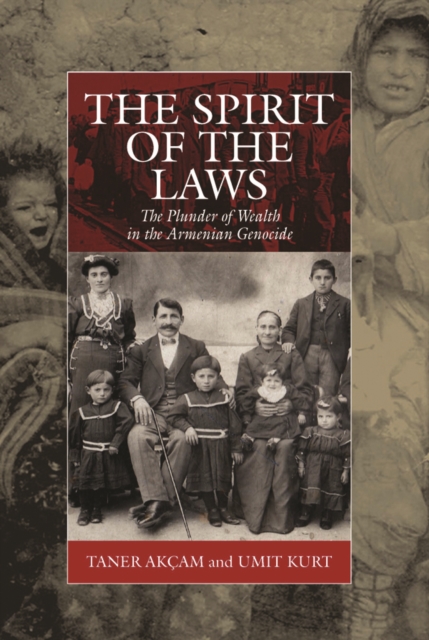
The spirit of the laws
Pertinent to contemporary demands for reparations from Turkey is the relationship between law and property in connection with the Armenian Genocide. This book examines the confiscation of Armenian properties during the genocide and subsequent attempts to retain seized Armenian wealth. Through the close analysis of laws and treaties, it reveals that decrees issued during the genocide constitute central pillars of the Turkish system of property rights, retaining their legal validity, and although Turkey has acceded through international agreements to return Armenian properties, it continues to refuse to do so. The book demonstrates that genocides do not depend on the abolition of the legal system and elimination of rights, but that, on the contrary, the perpetrators of genocide manipulate the legal system to facilitate their plans.
eBook

The transgenerational consequences of the Armenian genocide : near the foot of Mount Ararat
This book brings together the Armenian Genocide process and its transgenerational outcome, which are often juxtaposed in existing scholarship, to ask how the Armenian Genocide is conceptualized and placed within diasporic communities. Taking a dual approach to answer this question, Anthonie Holslag studies the cultural expression of violence during the genocidal process itself, and in the aftermath for the victims. By using this approach, this book allows us to see comparatively how genocide in diasporic communities in the Netherlands, London and the US is encapsulated in an historic narrative. It paints a picture of the complexity of genocidal violence itself, but also in its transgenerational and non-spatial consequences, raising new questions of how violence can be perpetuated or interlocked with the discourse and narratives of the victims, and how the violence can be relived.-- Provided by publisher.
Book

We Are All Armenian
In the century since the Armenian Genocide, Armenian survivors and their descendants have written of a vast range of experiences using storytelling and activism, two important aspects of Armenian culture. Wrestling with questions of home and self, diasporan Armenian writers bear the burden of repeatedly telling their history, as it remains widely erased and obfuscated. Telling this history requires a tangled balance of contextualizing the past and reporting on the present, of respecting a culture even while feeling lost within it.We Are All Armenian brings together established and emerging Armenian authors to reflect on the complications of Armenian ethnic identity today. These personal essays elevate diasporic voices that have been historically silenced inside and outside of their communities, including queer, multiracial, and multiethnic writers. The eighteen contributors to this contemporary anthology explore issues of displacement, assimilation, inheritance, and broader definitions of home. Through engaging creative nonfiction, many of them question what it is to be Armenian enough inside an often unacknowledged community.
eBook


The Armenian Genocide
In 1915, the Armenians were exiled from their land, and in the process of deportation 1.5 million of them were killed. The 1915-1916 annihilation of the Armenians was the archetype of modern genocide, in which a state adopts a specific scheme geared to the destruction of an identifiable group of its own citizens. Official German diplomatic documents are of great importance in understanding the genocide, as only Germany had the right to report day-by-day in secret code about the ongoing genocide. The motives, methods, and after-effects of the Armenian Genocide echoed strongly in subsequent cases of state-sponsored genocide. Studying the factors that went into the Armenian Genocide not only gives us an understanding of historical genocide, but also provides us with crucial information for the anticipation and possible prevention of future genocides.
eBook


Daily Life in the Abyss
Historical research into the Armenian Genocide has grown tremendously in recent years, but much of it has focused on large-scale questions related to Ottoman policy or the scope of the killing. Consequently, surprisingly little is known about the actual experiences of the genocide's victims. Daily Life in the Abyss illuminates this aspect through the intertwined stories of two Armenian families who endured forced relocation and deprivation in and around modern-day Syria. Through analysis of diaries and other source material, it reconstructs the rhythms of daily life within an often bleak and hostile environment, in the face of a gradually disintegrating social fabric.
eBook