
Catalogue Search | MBRL


Are you sure you want to remove the book from the shelf?

{{itemTitle}}
72,704
result(s) for
"ART / Asian."
Sort by:

Chinese Toggles
A new perspective for understanding the technology behind goods \"made in China\" The exquisite ceramic ware produced at the Imperial Porcelain Manufactory at Jingdezhen in southern China functioned as a kind of visual propaganda for the Qing dynasty (1644–1911) court. Porcelain for the Emperor charts the career of bannerman Tang Ying, a technocrat in the porcelain industry, through the first half of the eighteenth century to uncover the wider role of specialist officials in producing the technological knowledge and distinctive artistic forms that were essential to cultural policies of the Chinese state. Through fiscal management, technical experimentation, and design, these imperial technocrats facilitated rationalized manufacturing in precapitalist and preindustrial society. Drawing on museum collections and firsthand archaeological evidence, as well as the voluminous Archive of the Imperial Workshops, this book contributes new insights to scholarship on global empires and the history of science and technology in China. Readers will learn how the imperial state's intervention in industry left a lingering imprint on modern China through its modes of labor-intensive production, the division of domestic and foreign markets, and, above all, a technocratic culture of centralization.
eBook

Islamic Aesthetics
It is often argued that a very special sort of consciousness
went into creating Islamic art, that Islamic art is very different
from other forms of art, that Muslims are not allowed to portray
human beings in their art, and that calligraphy is the supreme
Islamic art form. Oliver Leaman challenges all of these ideas, and
argues that they are misguided. Instead, he suggests that the
criteria we should apply to Islamic art are identical to the
criteria applicable to art in general, and that the attempt to put
Islamic art into a special category is a result of orientalism.
Leaman criticizes the influence of Sufism on Islamic aesthetics
and contends that it is generally misleading regarding both the
nature of Islam and artistic expression. He discusses issues
arising in painting, calligraphy, architecture, gardens,
literature, films, and music and pays close attention to the
teachings of the Qur'an. In particular he asks what it would mean
for the Qur'an to be a miraculous literary creation, and he
analyzes two passages in the Qur'an-those of Yusuf and Zulaykha
(Joseph and Zuleika) and King Sullayman (Solomon) and the Queen of
Sheba. His arguments draw on examples from history, art,
philosophy, theology, and the artefacts of the Islamic world, and
raise a large number of difficulties in the accepted paradigms for
analyzing Islamic art.
eBook

Photo-Attractions
In Spring 1938, an Indian dancer named Ram Gopal and an American writer-photographer named Carl Van Vechten came together for a photoshoot in New York City. Ram Gopal was a pioneer of classical Indian dance and Van Vechten was reputed as a prominent white patron of the African-American movement called the Harlem Renaissance. Photo-Attractions describes the interpersonal desires and expectations of the two men that took shape when the dancer took pose in exotic costumes in front of Van Vechten's Leica camera. The spectacular images provide a rare and compelling record of an underrepresented history of transcultural exchanges during the interwar years of early-20th century, made briefly visible through photography.
Art historian Ajay Sinha uses these hitherto unpublished photographs and archival research to raise provocative and important questions about photographic technology, colonial histories, race, sexuality and transcultural desires. Challenging the assumption that Gopal was merely objectified by Van Vechten's Orientalist gaze, he explores the ways in which the Indian dancer co-authored the photos. In Sinha's reading, Van Vechten's New York studio becomes a promiscuous contact zone between world cultures, where a \"photo-erotic\" triangle is formed between the American photographer, Indian dancer, and German camera.
A groundbreaking study of global modernity, Photo-Attractions brings scholarship on American photography, literature, race and sexual economies into conversation with work on South Asian visual culture, dance, and gender. In these remarkable historical documents, it locates the pleasure taken in cultural difference that still resonates today.
eBook

The international spread of Asian and Islamic art histories: an intersectional approach to trajectories of the Vienna School (c. 1920 – 1970)
In early 20th century, the art historical institute in Vienna led by Josef Strzygowski (1862-1941) offered the unique opportunity to study the arts of Asia and the Middle East at university level (fig. I).· 1 The rich material repository for the study of 'Oriental' art - consisting of ca. 4000 books, 52.000 photographs and images, and 20.000 lantern slides - was unparalleled in Europe.2 It attracked a large number of students and turned the institute into a hub for Asian and Islamic art. Numerous guest auditors from all over Europe and abroad further enriched the lively community.3 Between 1910 and 1933, more than one hundred students supervised by Strzygowski completed their dissertations on Northern European, Austrian, Persian, Islamic, Chinese, Japanese and Indian art.4 Suzanne Marchand has directed attention to the strikingly Targe number of female students' at Strzygowski's institute, 'who would make careers outside Central Europe and remain relatively free from racist ideologies' The article pursues the twofold aim of combining a historical intersectional study of the Vienna school with a critique of patriarchal patterns of historiography. This study aims to contribute to research of the co-constitutive relation of art and identity markers such as gender and race.The article consists of three parts: two historical studies (part I and III) embrace a theoretical section on patriarchal patterns in historiography (part II). In the first part, Melanie Stiassny's presidency of the Society of Friends of Asian Art and Culture is the centerpiece of the historical investigation. The society was one of the liveliest in inter war Vienna, and Stiassny, as its managing vice-president, organized exhibitions, broadcasts and adult education, edited the journal of the society, and published articles on Chinese art. Knowledge about Stiassny and the infrastructure of the society sheds light on the processes of valorizing Asian art. It furthermore gives insights into how Strzygowskian graduates built networks and professionalized.23 The second part, the theoretical section, draws on feminist, gender and intersectional studies to analyse patterns and conventions of historiography. A close reading of several articles on Viennese art history reveals how androcentric criteria shape historiography to date. The third part adopts some of the androcentric historiographical criteria such as 'success' to comparatively trace careers of 'successful' women and men art historians.24 Interestingly, their migratory trajectories reveal a gendered and raced pattern of migration: Women and non-European men art historians often found their first academic positions at universities in the Middle East or Asia, whereas European men began their careers at museums in Vienna and Berlin. Eventually, most worked in area studies departments at US-American universities.
Journal Article
Climate Change and the Art of Devotion
In the enchanted world of Braj, the primary pilgrimage center in north India for worshippers of Krishna, each stone, river, and tree is considered sacred. In Climate Change and the Art of Devotion, Sugata Ray shows how this place-centered theology emerged in the wake of the Little Ice Age (ca. 1550-1850), an epoch marked by climatic catastrophes across the globe. Using the frame of geoaesthetics, he compares early modern conceptions of the environment and current assumptions about nature and culture.A groundbreaking contribution to the emerging field of eco-art history, the book examines architecture, paintings, photography, and prints created in Braj alongside theological treatises and devotional poetry to foreground seepages between the natural ecosystem and cultural production. The paintings of deified rivers, temples that emulate fragrant groves, and talismanic bleeding rocks that Ray discusses will captivate readers interested in environmental humanities and South Asian art history.Art History Publication Initiative. For more information, visit http://arthistorypi.org/books/climate-change-and-the-art-of-devotion
eBook
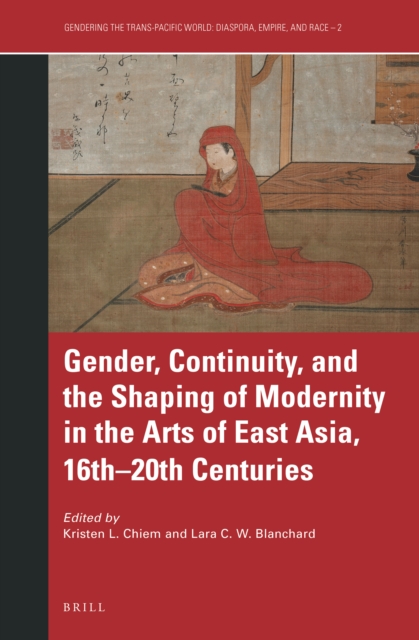
Gender, Continuity, and the Shaping of Modernity in the Arts of East Asia, 16th-20th Centuries
Gender, Continuity, and the Shaping of Modernity in the Arts of East Asia, 16th-20th Centuries presents a critical introduction and nine essays that examine women's and men's participation in the art world and gendered visual representations from the premodern through modern eras.
eBook

Collecting Objects / Excluding People
In Collecting Objects / Excluding People, Lenore Metrick-Chen demonstrates an unknown impact of Chinese immigration upon nineteenth-century American art and visual culture. The American ideas of \"Chineseness\" ranged from a negative portrayal to an admiring one and these varied images had an effect on museum art collections and advertising images. They brought new ideas into American art theory, anticipating twentieth-century Modernism. Metrick-Chen shows that efforts to construct a cultural democracy led to the creation of unforeseen new categories for visual objects and unanticipated social changes. Collecting Objects / Excluding People reveals the power of images upon culture, the influence of media representation upon the lives of Chinese immigrants, and the impact of political ideology upon the definition of art itself.
eBook

Independent Filmmaking across Borders in Contemporary Asia
This book examines an array of auteur-driven fiction and documentary independent film projects that have emerged since the turn of the millennium from East and Southeast Asia, a strand of transnational filmmaking that converges with Asia's vibrant yet unevenly developed independent film movements amidst global neoliberalism.
eBook